- Статьи
- Army
- Cancelled commitments: does the "death" of the START Treaty lead to a new nuclear arms race

Cancelled commitments: does the "death" of the START Treaty lead to a new nuclear arms race

On February 5, the Strategic Offensive Arms Reduction Treaty officially ends. He was the last legal obstacle to increasing the nuclear arsenals of Moscow and Washington. In the fall of 2025, Russia proposed that both countries adhere to the restrictions laid down in the treaty for another year. The United States ignored the initiative. On February 4, the Russian Foreign Ministry announced that, as a result, the parties to the START Treaty were no longer bound by any obligations. But at the same time, he assured that the Russian Federation would act "responsibly and carefully," and take any steps "based on a thorough analysis of US military policy." Izvestia looked into the consequences of the termination of the treaty, what novelties superpowers could use to build up their nuclear arsenals, and whether the notification mechanism for missile launches, which insured against the risks of accidental escalation, would continue to operate.
The contract is no longer valid
The Strategic Offensive Arms Reduction Treaty (START, also known as START-3), signed in Prague in 2010 by Dmitry Medvedev and Barack Obama, has been the foundation of global nuclear deterrence for 15 years. Firstly, he limited the number of nuclear weapons carriers and nuclear warheads, and secondly, he created a transparent control system.

Over the years of the document's validity, the parties have exchanged more than 25,000 notifications on activities related to these weapons (their movement, production and disposal, training launches, etc.) and conducted 328 on-site inspections. The inspectors monitored both deployed systems and the number of warheads on them, as well as non-deployed systems in storage locations.
— What were the inspections for? Firstly, it is a measure that increases the degree of trust in the context of a geopolitical confrontation," military expert Dmitry Boltenkov told Izvestia. — Secondly, even with a powerful satellite constellation and conducting detailed reconnaissance, the parties may face measures to counteract this method of data collection. The treaty forbade such opposition, but technically not everything is visible from space and not always — there remains a field for maneuver, what to show and what to hide.
The crisis in the implementation of the START Treaty did not begin today. At first, the 2020 pandemic "froze" the visits of inspectors, and in February 2023, Russia officially suspended participation in the treaty. She took this step in response to Western military support for Ukraine.

At the same time, Vladimir Putin called NATO's demands to return to conducting inspections provided for by the START Treaty a "theater of the absurd," given that Western countries are involved in attempts to strike at Russian territory. The exchange of telemetric information has stopped, and the direct communication telephones between the departments controlling strategic offensive weapons have been silenced.

Nevertheless, until today, the parties have declared compliance with the "ceilings" on the number of weapons provided for in the treaty. In September 2025, Vladimir Putin proposed that both sides commit themselves to adhere to the limits set by the treaty for a year even after February 5, 2026. It was assumed that during this time, the diplomats would try to reach an agreement on a new agreement.
However, Washington has not reacted to the Russian initiative for a long time. And in January 2026, Donald Trump drew a line in an interview with The New York Times, saying about the agreement: "If the deadline expires, it will expire. We'll just make a better agreement."

"In fact, we are talking about the fact that our ideas were deliberately left unanswered. Such an approach seems to be erroneous and causes regret," the Russian Foreign Ministry said in its official statement on February 4. "From a practical point of view, our country considers such a development of events as a given that needs to be taken into account when determining further Russian policy in this direction."
Will a nuclear arms race begin
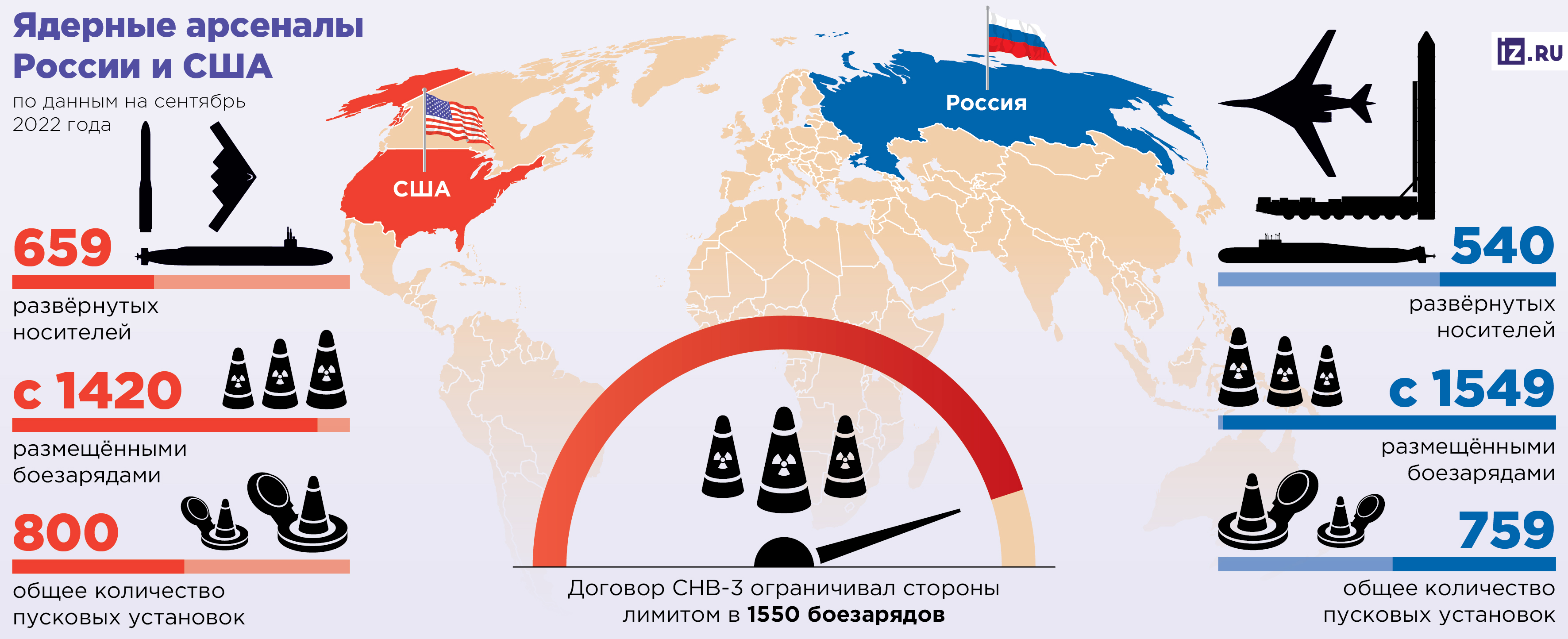
The START Treaty limited the number of strategic offensive weapons of Russia and the United States in three parameters:
— 700 nuclear weapons carriers (deployed intercontinental ballistic missiles, submarine-launched ballistic missiles and heavy bombers);
— 1,550 warheads on these deployed carriers;
— 800 deployed and non-deployed nuclear weapons launchers.
At the time of the last official data exchange, in September 2022, a certain parity in these indicators remained between Russia and the United States.
Our country possessed 540 deployed carriers, which housed 1,549 warheads. There were 759 launchers (both deployed and in storage).

The United States had slightly more carriers in service — 659, but fewer warheads stationed on them — 1420. The number of launchers reached a maximum of 800 units.
In a statement on February 4, the Russian Foreign Ministry stressed that under the circumstances, "the parties to the START Treaty are no longer bound by any obligations" and "are free to choose their next steps." At the same time, the Russian Federation "intends to act responsibly and carefully, building its line in the field of strategic offensive arms based on a thorough analysis of US military policy and the overall situation in the strategic sphere," the ministry explained.
Both Russia and the United States are currently in the process of changing generations of weapons, and the lack of restrictions and controls may spur this process, experts do not exclude.
In the land component, the United States is replacing the Minuteman-III ICBM with the Sentinel system. It is unlikely that the United States will be able to do this at a high rate, as new silo launchers are also required for new missiles. Russia is replacing the Topolei-M and Voevod with mobile and silo Yars, as well as the Sarmat heavy missile.
At the same time, the combat capabilities of the Sentinel cannot be compared with the Sarmatians. Moreover, at their expense, Russia can promptly compensate for any excess of thresholds by the American side, since one Sentinel carries only one medium-range warhead, while the Sarmat can carry from 10 to 14 warheads.

Launch of the Sarmat stationary intercontinental ballistic missile
As for the marine component, Russia relies on Borei-A class nuclear missile carriers with Bulava missiles. The United States continues to operate Trident II, which it plans to deploy on new Columbia-class submarines in the future.
According to aircraft carriers, the first American B-21 Raider stealth bombers are expected to arrive in 2026. Moscow is responsible for the construction of the upgraded Tu-160M and the maintenance of the Tu-95MS fleet.
But in general, experts do not see any risks of instant escalation.
"The United States and Russia, of course, can go beyond the current START Treaty thresholds, but both have physical and industrial restrictions for this," Dmitry Boltenkov explained. — That is, this exit will be gradual. It is possible to fear an imbalance or an arms race in a few years, when the American programs of deployment of Sentinel intercontinental ballistic missiles, B-21 heavy bombers and Columbia submarines will be in full swing. And this deployment will no longer be constrained by the limitations of the START Treaty.

Notification clutter
Another concern, which is voiced in light of the expiration of the START Treaty, concerns the termination of the exchange of any information by the parties about major exercises involving strategic offensive weapons, including missile launches.

Without launch notifications, the risk of accidental escalation due to an error in early warning systems increases significantly, military expert Viktor Litovkin explained.
However, Dmitry Boltenkov drew attention to the fact that the notification procedure for missile launches is partially regulated not only by the START Treaty, but also by a separate Soviet‑American agreement of 1988.
— It was not formally denounced, and the parties declared their intention to maintain basic predictability. After the suspension of the START Treaty by Russia in 2023, the exchange of launch notifications, which were provided for in the Treaty format, stopped, but launch notifications did not stop at all," Dmitry Boltenkov emphasized.
What will be the new agreement?
After the termination of the START Treaty, the issue of preparing a new agreement is on the agenda. But this process can take years — there are too many controversial issues. The START Treaty did not take into account the new technological realities that are now coming to the fore. The Russian Avangard hypersonic units, Dagger and Zircon missiles, as well as the latest Oreshnik system, which are already in service, were not subject to the old restrictions. The same applies to the Poseidon unmanned underwater vehicle and the Burevestnik nuclear-powered rocket. The United States plans to deploy its first hypersonic complex, the Dark Eagle, in 2026.
However, the main problem is the expansion of the "nuclear club". Russia is no longer ready to discuss new restrictions without taking into account the potentials of France and Great Britain. At a time when NATO officially declares Russia the main threat, Moscow considers it dangerous to ignore hundreds of European warheads.

The United States, on the other hand, is obsessed with the idea of including China in any new agreement. If Beijing's arsenal was small in the early 2000s, then by 2026, China's thermonuclear power had grown many times. Beijing has so far refused to hold trilateral talks, reasonably noting that its arsenal is still significantly smaller than the American or Russian ones.
The global nuclear configuration is changing today under the influence of three key players. China is showing the fastest growth: with about 500-600 warheads on land-based missiles, aircraft and submarines, Beijing plans to double its arsenal to 1,000 units by 2030.

In Europe, the focus has shifted to naval forces. The UK keeps its full potential on the Vanguard-class submarines with Trident-2 missiles. Against the background of global instability, London decided to raise the bar for the number of charges from 180 to 260 units. France retains a more powerful but stable arsenal of about 290 warheads. The French strategy relies on the constant presence of Triumphant submarines and aircraft in the ocean, which, according to Paris, provides a nuclear shield for the whole of Europe.
"The consequences of the termination of the agreement are the most negative," Viktor Litovkin summed up in an interview with Izvestia. — It opens up the possibility for a strategic nuclear arms race. Besides, it sets a bad example for all other countries that possess nuclear weapons — there are no restrictions on strategic and tactical nuclear weapons. This may eventually lead to an expansion of the member States of the nuclear club.
According to him, with the termination of the treaty, strategic stability is being destroyed and the risks of escalation are growing.
The Russian Foreign Ministry stressed that "for the future, our country remains open to finding political and diplomatic ways to comprehensively stabilize the strategic situation." However, it should take place on the basis of an equal and mutually beneficial dialogue.
Переведено сервисом «Яндекс Переводчик»
