Laser coloring: a new platform will help create ultra-fast displays and sensors
- Статьи
- Science and technology
- Laser coloring: a new platform will help create ultra-fast displays and sensors


Russian scientists have created a unique LED platform that is powered by a laser rather than a current. The technology provides device switching in just 10 nanoseconds — 100 thousand times. It is several times faster than existing solutions, and it makes it possible to quickly "draw" and change glow patterns without complicated production. The development can form the basis of ultrafast radiation sources for displays, sensors and information transmission systems. The technology will also bring scientists closer to creating an optical computer. Read more about the innovation in the Izvestia article.
How scientists accelerated the switching of LEDs
Scientists of the New ITMO Physics and Technology Institute, together with researchers from the laboratory "Materials and Devices of Active Photonics" of the National Research University "MIET" and the Institute of General and Inorganic Chemistry named after N.S. Kurnakov of the Russian Academy of Sciences, managed to design a fully optically switchable platform for LEDs. They are used in various devices, such as smartphone displays, optical sensors and sensors, lasers, and fiber—optic communication systems.
But LEDs based on classical semiconductors switch between on-off states using electricity. This process takes several milliseconds, and this speed is not enough to conduct optical research and develop ultrafast optical devices, experts said.
The switching can be accelerated by using more promising phase transition materials. These include chalcogenides, compounds of elements of the 16th group of the periodic table (such as sulfur, selenium or tellurium) with metals. They have played a role in the history of data storage, in particular in DVD discs, due to the property of materials to change their structure under the action of a laser. This property made it possible to use chalcogenides in rewritable optical discs, for example, in DVD-RW format.
Chalcogenide compounds are difficult to integrate into the architecture of an LED — there are many defects in their crystal structure through which the LED's radiation "leaks out", and because of this it becomes dimmer. ITMO scientists have managed to overcome this limitation and integrate a chalcogenide alloy with a phase transition into the structure of the LED.
The developed platform allows the LED to change the on-off state in 10 nanoseconds, which is 100 thousand times. times faster than existing electricity-based solutions. It is based on a chalcogenide alloy of germanium, antimony and tellurium.

The principle of operation of the device is as follows: when exposed to laser radiation on the platform, the chalcogenide alloy turns into a crystalline phase, as a result of which the LED lights up. When the material is re-irradiated and put into an amorphous state, the LED does not turn on even when the voltage is applied. Thus, voltage is constantly applied to the LED, and its switching on and off is carried out by laser pulses — this is orders of magnitude faster than electrical signals.
"Our approach allows us to achieve ultra—fast changes in the state of the LED at constant voltage in the system, which leads to an increase in the response rate, as well as increases the stability and service life of the device," explained Olga Kushchenko, the first author of the study, an engineer at the New ITMO Physics and Technology Institute.
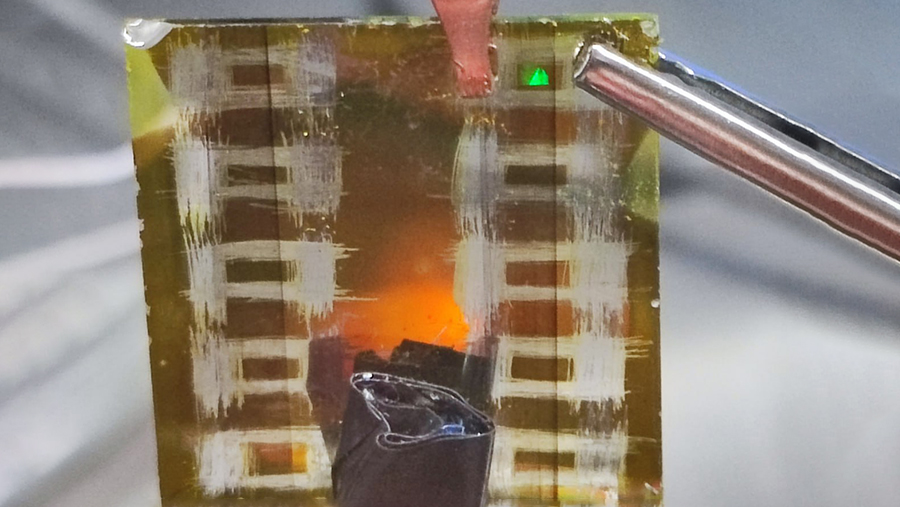
The new platform will also simplify the production of devices — now a single laser is enough to create circuits of conductive tracks, and the whole process resembles coloring a drawing.
— To create a glow pattern, you only need to shine a laser at a specific point of the chalcogenide layer: only this area will enter the crystalline phase, and it is there that the LED will light up when voltage is applied. By moving the laser over the selected zones, you can "draw" any LED glow pattern, so the process resembles coloring. Moreover, the chalcogenide alloy is a non—volatile material, that is, the place illuminated by the laser will remain in the same phase, even if the radiation source is removed," said Artem Sinelnik, head of the study and researcher at the New ITMO Physics and Technology Institute.
Optical computers and ultra-fast electronics
The new platform will help create optically switchable LEDs that are useful as ultrafast radiation sources for displays, sensors, or information encoding and transmission systems, such as potential optical computers, the developers said.
— The main application area of such a platform is optoelectronic circuits and devices where instant light control is required. For example, they can become the basis for ultrafast optical switches in information encoding systems, which are necessary for a new generation of optical computing and high-speed data transmission. Their speed, measured in nanoseconds, is critically important for these technological industries, where speeds must significantly exceed human perception," said Artem Sinelnik.
In addition, such materials are promising for creating highly sensitive and high-speed sensors in which instantaneous response to an external stimulus and fixation of the transition from one state to another are of key importance. In the segment of displays, their direct use to increase the speed of image change is not relevant for the human eye, since humans do not perceive nanosecond delays.
"However, such technologies may find niche applications in the future, for example, in specialized devices for high—speed projection or light modulation, which are in demand in scientific and industrial equipment, rather than in mass consumer gadgets," the scientist noted.

This is a rather interesting and promising work, in which the authors have developed a new platform for controlling electroluminescence using light, Petr Lazarenko, Deputy Director of the Institute of Advanced Materials and Technologies, head of the Materials and Devices of Active Photonics Laboratory at the National Research University of the Russian Academy of Sciences, and an expert at the NTI Sensorica Center at the National Research University of the Russian Academy of Sciences, told Izvestia.
"In the future, the development can be used for ultrafast control of laser diodes — this is one of the most relevant areas today, including for tasks of integrated photonics," the scientist noted.
This is not just an evolution of existing LEDs, but the creation of a fundamentally new class of optically controlled devices, said Roman Ponomarev, NTI expert and head of the PSNIU Integrated Photonics Laboratory.
"In the next 5-10 years, we will probably see their introduction primarily into niche high—performance applications (optical accelerators, lidars), and in the longer term into mass electronics, which will lead to significant changes in the architecture of computing systems if the barrier in the number of switching cycles of such a control cell is overcome," the specialist noted..
At this stage, scientists will continue to work on the platform — they increase the stability and duration of its operation, as well as the effectiveness of luminescence.
The research was supported by grants from the Ministry of Science and Higher Education and the Russian Science Foundation.
Переведено сервисом «Яндекс Переводчик»
