- Статьи
- Science and technology
- Round-the-clock boron: new composite will protect from hidden radiation in space

Round-the-clock boron: new composite will protect from hidden radiation in space

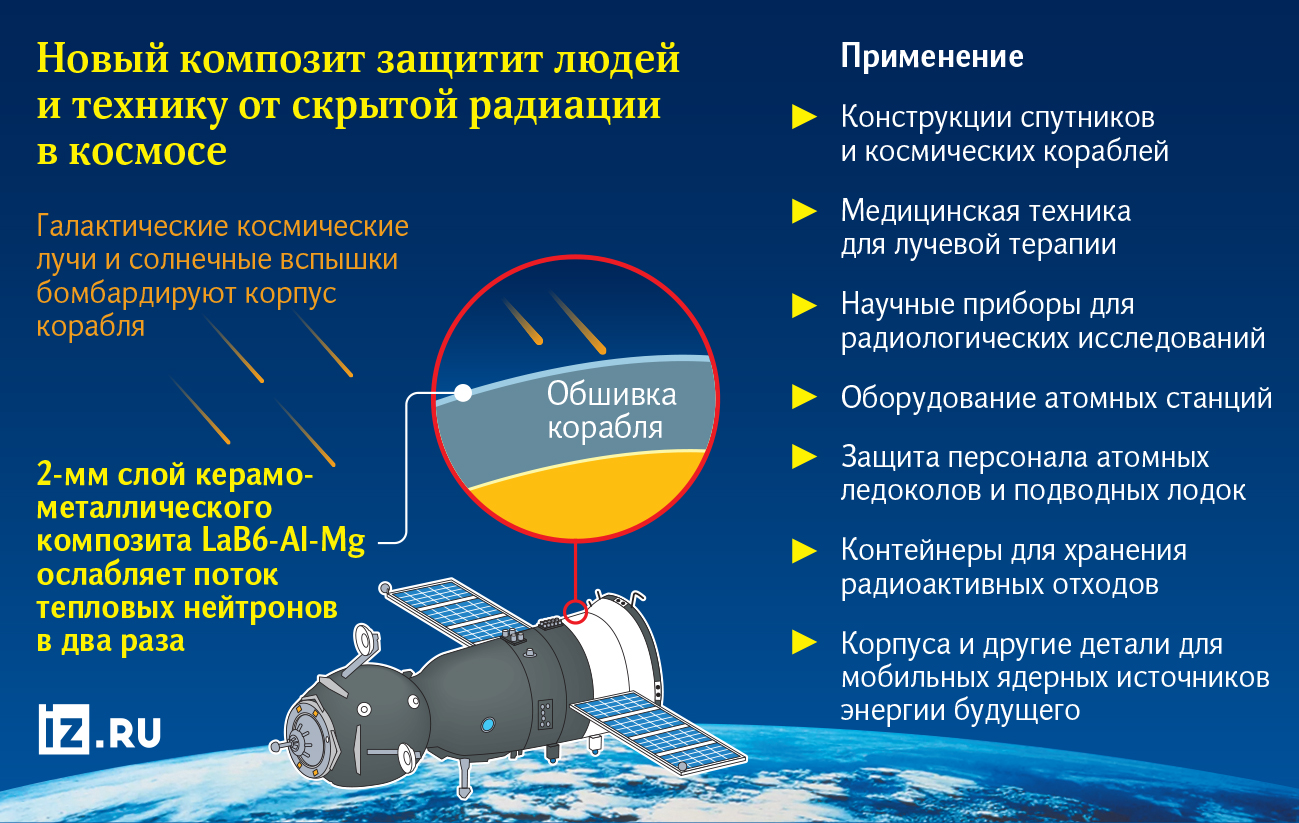
Scientists have proposed a new material to protect satellites and spacecraft from thermal neutrons. These particles are dangerous because they damage cells and DNA in living tissues, and cause errors and failures in electronics. Tests have shown that the material, which is only 2 mm thick, reduces the flow of dangerous particles by two times. At the same time, it is two orders of magnitude cheaper than analogues and easy to process. This makes it promising for creating spacecraft design elements, equipment parts for nuclear medicine, nuclear energy and other fields. For more information about the development, see the Izvestia article.
How does the material protect against dangerous radiation
The development was carried out by specialists from the Institute of High-Tech Technologies and Advanced Materials of the Far Eastern Federal University together with colleagues from Sakhalin State and Tomsk Polytechnic Universities, as well as the I.V. Tananaev Institute of Chemistry and Technology of Rare Elements and Mineral Raw Materials of the Kola Scientific Center of the Russian Academy of Sciences. This was reported to Izvestia by the Ministry of Education and Science of the Russian Federation.
As the researchers explained, thermal neutrons are dangerous components of radioactive radiation, which, in particular, arise as a result of exposure to cosmic rays (high—energy particles) on the structural elements of the spacecraft. These particles are dangerous to humans because they easily penetrate deep into living tissues, damaging cells and DNA molecules. Over time, this can lead to cancer, radiation sickness, and other diseases.

In addition, thermal neutrons in electronic devices can change electrophysical parameters, which causes errors in processor memory and disrupts the operation of microcircuits. This leads to malfunctions in the operation of devices, the readings of which can no longer be trusted. Dangerous particles also accumulate in objects, making them radioactive and unsuitable for further use.
To protect people and equipment, scientists have synthesized a new composite that effectively absorbs thermal neutrons. At the same time, the material has the lightness and strength necessary for use in space structures. The development turned out to be two orders of magnitude cheaper than its foreign counterparts.

— For example, the American Space Agency is developing a material based on boron nitride nanotubes, but its production is extremely expensive — up to $ 1,000 per gram. Our goal was to obtain a composite with similar or better properties, but 100-200 times cheaper. We proposed ceramic-metal composites of the LaB 6-Al-Mg system, sintered using electropulse plasma sintering technology," Oleg Shichalin, head of the research, employee of the FEFU ITPM Laboratory of Nuclear Technologies, Head of the SAKHGU Laboratory, told Izvestia.

He explained that boron in the composition of the material effectively captures neutrons, and the metal matrix provides strength. At the same time, it is suitable for mechanical processing.
Tests have shown that a 2 mm thick layer of material weakens the flow of thermal neutrons by half, the scientist added. The achieved characteristics make the development promising for creating elements of spacecraft, as well as equipment for nuclear medicine, nuclear energy and other applications.
How to test protection on the Russian Space Station
— Methods of protection against thermal neutrons in terrestrial conditions are standard. One of them is to take something thicker and apply it as part of an airtight shell, such as special concretes. Substances that can absorb thermal neutrons are also used. For example, the isotope boron-10 captures these particles and transforms into the isotope boron-11. Such solutions, in particular, are in demand in nuclear reactor control and protection systems. The second approach is more logical for spacecraft, where the mass criterion is important," the director for the development of scientific and technical projects of the unified industry thematic plan of the private institution Science and Innovation (part of Rosatom) told Izvestia Ivan Safonov.

The whole difficulty of the development lies in bringing the material to the industrial stage, he added. This requires experimental justification, certification, preparation of regulatory documentation and confirmation of the declared performance characteristics at specific enterprises. At the same time, the use of new materials in the space industry remains an open question, as it requires a comprehensive understanding of the task. It is possible that in some cases it is more expedient to abandon composite solutions in favor of traditional structures with an increased proportion of the absorber, for example, in a rubber matrix. Such materials, he noted, have already been developed at Rosatom.
— Fast neutrons make the greatest contribution to the neutron component of the radiation dose for astronauts. But thermal (slow) ones can also be dangerous for electronics. In particular, these particles are trapped by the nuclei of materials, which leads to the formation of radioactive isotopes and affects the properties of compact modern microcircuits, disrupting their operation," explained Maxim Litvak, Corresponding Member of the Russian Academy of Sciences, head of the Laboratory of Neutron and Gamma Spectroscopy of the Department of Nuclear Planetology at the Space Research Institute of the Russian Academy of Sciences.
According to him, the advantage of the development is that scientists have found the best way to introduce boron ceramics into an aluminum alloy. The resulting material retains the strength and lightness necessary for spacecraft structures, while absorbing thermal neutrons well.

The scientist noted that the BTN-M2 experiment (the second stage of the BTN-neutron experiment) is currently being conducted on the ISS. It is based on a device with neutron and gamma radiation detectors with removable screens. The installation is designed to test protection against neutron radiation. According to the expert, the new material can be tested as a material for such a screen. This opportunity will be presented at the future Russian orbital station ROS, where they plan to continue the experiment.
— The development may be in demand for the protection of personnel and equipment near nuclear power plant reactors and spent fuel storage facilities, as well as in nuclear submarines and icebreakers. In addition, the new material will be useful in the manufacture of medical equipment for radiation therapy or for radiological research," says Egor Kashkarov, head of the Laboratory of Advanced Materials and Safety of Hydrogen Power Systems at Tomsk Polytechnic Institute.

In his opinion, mobile nuclear energy sources such as small nuclear reactors, new generation "atomic batteries" and others are expected to appear in the future. These technologies will also require compact, reliable neutron and gamma radiation protection systems.

In his opinion, in the future, we should expect the emergence of mobile sources of atomic energy — small nuclear reactors, new-generation "atomic batteries" and other similar solutions. The development of these technologies will require the creation of compact and reliable protection systems against neutron and gamma radiation, he concluded.
Переведено сервисом «Яндекс Переводчик»
