
Stop management: real wage growth will almost stop in 2026

The "salary race" in Russia is almost over — in 2026, the real earnings of citizens will increase by only 2.7%, analysts surveyed by the Central Bank predict (Izvestia has reviewed the results of the study). Their estimate is twice lower than the forecast of the Ministry of Economic Development (5.7%) and 1.5 times less than the current dynamics — 4.4%. Companies no longer have the capacity to raise salaries further, and the labor market is no longer as overheated as it was last year. This situation may lead to a decrease in purchasing power, an increase in shadow employment, and a reduction in income tax and insurance contributions, but it will help contain inflation. Who is at risk of losing income, and who should not worry — in the material of Izvestia.
Why does business stop raising salaries
Next year, nominal wages will rise by 8.4%, while real wages (adjusted for inflation) will rise by only 2.7%. This follows from the results of the October macroeconomic survey of the Central Bank (Izvestia studied it). For the calculation, the regulator used the answers of 26 economists.

At the same time, the Ministry of Energy expects a more significant increase — by 5.7% in real terms, that is, twice as much. The editorial board sent a request to the agency and the regulator.
— The difference in the forecasts of the Ministry and the Central Bank is related to different basic assumptions. The Ministry of Energy expects a faster decline in key and inflation rates in the second half of 2025, which, according to its calculations, will allow real incomes to grow more noticeably. Analysts are more cautious: they see the risks of maintaining high price growth against the background of staff shortages and increased budget expenditures," explained Fyodor Sidorov, a private investor and founder of the School of Practical Investment.
According to him, the events of recent months show that the conservative assessment of analysts interviewed by the regulator is closer to reality. According to Rosstat, in January – August 2025, real wages increased by 4.4%, while the Ministry of Energy expected 6.8%. During this period, the average earnings amounted to about 96 thousand rubles.

A slowdown is indeed inevitable — after a record 9.1% growth in 2024 and 4-5% this year, the economy is reaching a more stable pace, Fyodor Sidorov noted.
The forecast for a minimal increase in real earnings looks quite realistic, agreed the deputy general director of the service "Work.<url>" by Alexander Veterkov. According to him, this is already reflected in the labor market: businesses are facing the limit of opportunities in the salary race. Increasing the payroll becomes unprofitable against the background of increased costs due to high rates, increased tax burden and slowing revenue growth. Therefore, companies are increasingly choosing forms of non-material motivation that do not require direct financial costs, the expert added.

In addition, the first signs of cooling have appeared on the labor market, said Yulia Dolzhenkova, a professor at the Financial University under the Government of the Russian Federation. According to her, companies have become more cautious about hiring, seeking to increase efficiency through internal reserves and cost optimization. A number of organizations have already begun to reduce staff.
In the fall, every tenth company plans layoffs — this was stated by 12% of participants in the survey of services "Work.<url>" and "SberPodbor," Izvestia wrote earlier.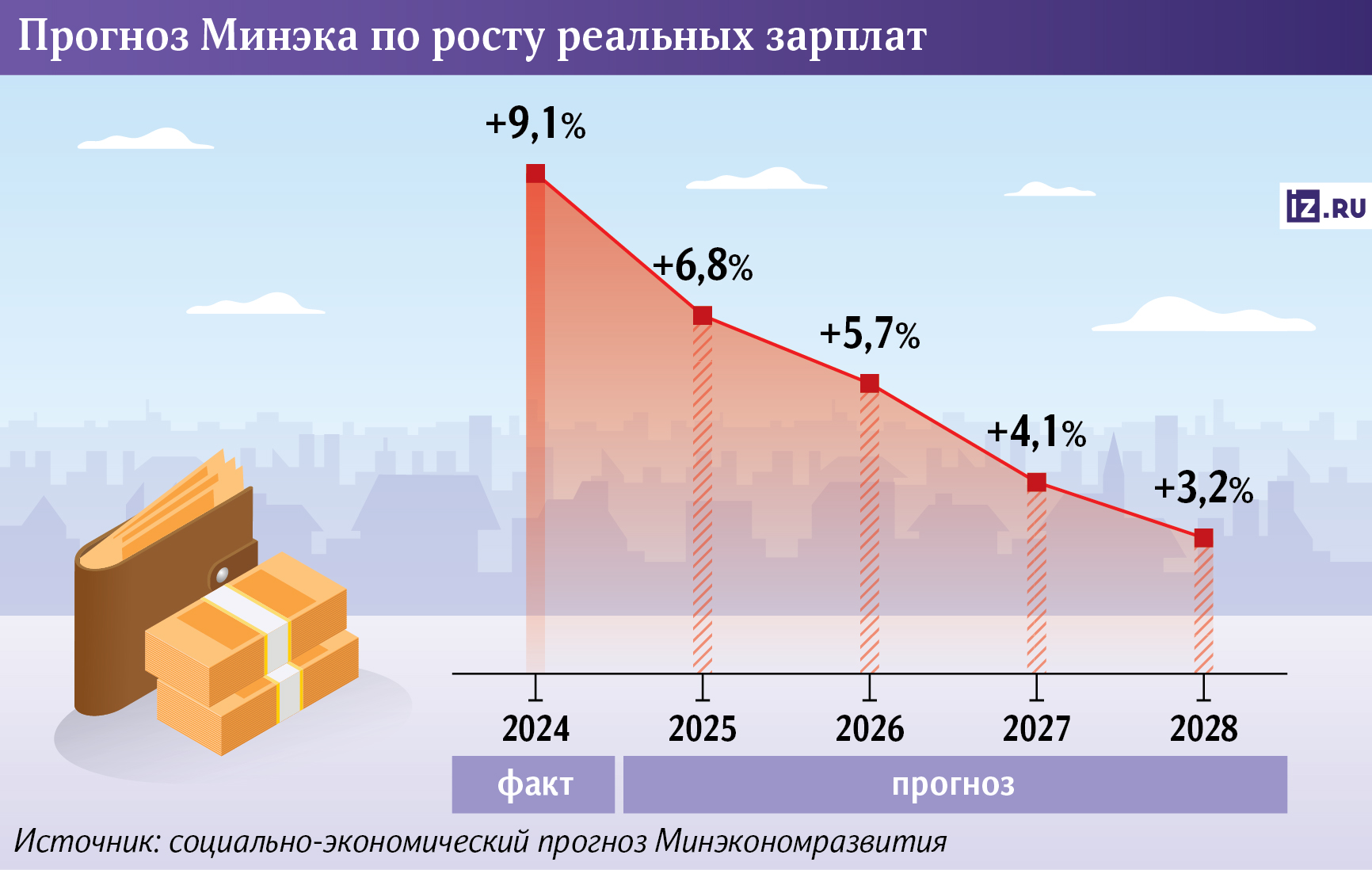
According to Yulia Dolzhenkova, in recent years, previously inactive groups of the population have been involved in the work — some students, women on maternity leave, and pensioners. This has led to an increase in the employed population by millions, but most of these workers are employed in low-paid segments.
Who will get a salary increase in 2026
The end of the "salary race" does not mean that Russians' incomes will stop rising. There are those who will still be in the black. The largest salary growth is expected in the IT sector, especially among AI and cybersecurity specialists - their incomes may increase by 10-15%, predicts private investor Fyodor Sidorov. According to him, in construction and logistics, the earnings of engineers and project managers will also rise faster than the average level due to the acute shortage of qualified personnel. In addition, in the manufacturing industry, the salaries of technical specialists can be raised by 8-10%.

But in retail trade, catering and mass services, growth will be minimal — no higher than inflation, he predicts. In the public sector, unless additional indexation decisions are made, real incomes, according to the expert, will remain approximately at the level of 2025.
Salaries will be raised the most in strategically important and high—tech industries, such as the defense industry and high-tech engineering. Here, revenues may increase by 10-20% or more due to a shortage of specialists, added the deputy general director of the Work service.<url>" by Alexander Veterkov.

At the same time, according to his forecast, earnings growth in the financial sector, construction, trade and logistics will be more restrained and generally comparable to the inflation rate. And in the light industry, revenue growth is almost not expected — low profitability and competition with imports limit the opportunities for indexing. As a result, the gap between the most and least promising sectors of the economy will widen, the expert stressed.
According to the service "Work.<url>", in January – September 2025, the highest earnings offers traditionally developed in the construction and real estate sectors - an average of 98 thousand rubles. Transport and logistics are in second place with 96,000, and manufacturing and the agro—industrial complex are closing the top three with 92,000, said Alexander Veterkov.

The largest increase in salary offers (+20%) was recorded in marketing, advertising and the media, as well as in the service sector. IT and finance are also in the lead — 17% each, the expert added.
According to SuperJob, employers are now prioritizing candidates with proven experience, concrete results, and a high ability to learn and adapt. An important advantage is the availability of related skills that can bring additional value to the company. At the same time, the number of vacancies decreased by 15% over the year, and the number of resumes increased by 19%.
What will stop the growth of real wages lead to?
For most Russians, a slowdown in wage growth will not lead to a decrease in income — nominally, earnings will continue to increase, albeit at a more moderate pace, Fyodor Sidorov believes. However, purchasing power will not grow as noticeably as in the last two years.

According to him, the shortage of personnel in the labor market will continue, especially in industry and construction, but the "salary race" will decline. At the same time, shadow employment in the retail and service sectors may expand, where companies are seeking to reduce the wage bill, but the expert does not expect a mass departure of workers into the shadows.
At the same time, the quality of life of a part of the population may decrease, since the money earned will be able to buy fewer goods and services, especially if inflation accelerates, said Yulia Dolzhenkova, professor at the Financial University under the Government of the Russian Federation. According to her, the reduction in consumer opportunities will affect demand, which can lead to a decrease in production volumes and, in some cases, to staff reductions.

In turn, the desire of businesses to reduce costs will strengthen the development of illegal forms of employment, including through the expansion of informal employment and the use of tax evasion schemes, Yulia Dolzhenkova added. According to her, a slowdown in earnings growth will also inevitably lead to a decrease in income tax and insurance contributions, since they are calculated based on the amount of employee benefits.

However, there is also a positive effect — a moderate increase in wages will help to avoid sharp spikes in inflation and maintain price stability, said Andrei Glushkin, a member of the Council of the MRO Delovaya Rossiya. According to him, it is important that at the same time the state continues to strengthen social support measures, develop employment programs and invest in professional development of workers, especially in the regions.
When incomes grow more slowly, demand for goods and services becomes more subdued, which reduces pressure on prices. The central Bank expects that by the end of 2026, inflation will return to the target level of 4%, Fyodor Sidorov recalled. He stressed that this is more important than accelerating income growth in the short term, because only with stable prices can the economy develop predictably — in the current conditions, this is the optimal balance between supporting household incomes and curbing inflation.
Переведено сервисом «Яндекс Переводчик»
