- Статьи
- Economy
- More — further: in the Russian Federation, they decided to postpone the introduction of the SME+ category

More — further: in the Russian Federation, they decided to postpone the introduction of the SME+ category

The authorities decided to postpone the introduction of the SME+ category, Izvestia found out. There are no plans to abandon it altogether, but the priorities are different now. We are talking about companies that have moved beyond the parameters of small and medium-sized enterprises and are moving into the large segment. The following limits are being discussed: 3.5 billion rubles in revenue and 525 employees. This is about 10 thousand companies, experts believe. The launch of the measure was announced by the president back in 2023 — it was planned for 2025. Why the new category is still needed and whether it will reduce the number of business splits is in the Izvestia article.
When will the SME category appear in Russia?
The launch of a new SME+ business category has been postponed for now, market participants told Izvestia. This status could be given to companies that have already grown out of the parameters of small and medium-sized enterprises, but are not ready to move into the large segment, as they are afraid of losing government support.
Vladimir Putin gave instructions to work out measures for the SME+ category at SPIEF 2023. The mechanism was supposed to be operational in 2025. The authorities actively discussed its launch, Izvestia wrote earlier.

Currently, the definition of the SME+ category has not been legally established, therefore, the federal draft does not provide for support measures for it, the press service of the Ministry of Economy told Izvestia. However, the discussion on the expansion of categories of entrepreneurs and the allocation of those SMEs that have exceeded the threshold of average continues, the department added.
The introduction of the new mechanism was postponed to a later date due to the need for detailed study, said Alexey Kuchmin, a member of the coordinating council of Delovaya Rossiya. The introduction of the measure was postponed, but it will be returned to when there are suitable economic conditions for this, said Elena Dybova, Vice President of the Russian Chamber of Commerce and Industry.

The pilot project is planned to be launched no earlier than 2026, Alexey Kuchmin believes. Nevertheless, an amendment to the law on SMEs, which fixes the new category, is going to be introduced by the end of the year, said Maxim Barashev, managing partner of the BBNP law firm, a member of the Moscow Business Russia.

In the coming months, it is necessary to carry out all preparatory work — to approve the methodology, selection criteria, and support mechanisms, Alexey Kuchmin added.
According to him, the reason for postponing the introduction of the mechanism could be a technical discrepancy between the deadlines and the need for more thorough preparation. For example, it is necessary to clarify the thresholds of revenue and the number of companies, to think over the rules for a smooth exit from the support regime, added Daniil Gonenko, associate professor of Economics and Finance of the Public Sector at the Presidential Academy.
In Russia, there is a gradation of business: micro, small, medium and large enterprises. The first group includes companies with up to 15 employees and an annual income of up to 120 million rubles. Small businesses can number from 16 to 100 people per staff, and annual income should not exceed 800 million. For average employees, the criteria are from 101 to 250 employees, with an annual income of up to 2 billion. SMEs enjoy a number of preferences, including tax incentives, reduced insurance premium rates, exemption from scheduled inspections, simplified accounting, subsidized loans and discounts on rental of state property.

In addition, the introduction of the new category was temporarily postponed due to the prioritization of costs, said Igor Rastorguev, a leading analyst at AMarkets. The state is now focused on fulfilling social obligations and ensuring defense capability — these are fair priorities, the expert noted.
What will the introduction of a separate category of SMEs do+
In 2026-2028, increased financing of basic measures to support small businesses is envisaged — about 200 billion, the press service of the Ministry of Finance told Izvestia. This will ensure, among other things, the creation of industrial and technology parks for small businesses, and continue work on concessional lending and umbrella sureties programs (the government provides guarantees to the bank if the business does not have enough collateral for a loan. — Izvestia). That is, entrepreneurs interested in qualitative growth will receive the necessary support in full, the ministry added.
Nevertheless, the very logic of the SME+ mechanism remains sound — companies that have grown beyond the criteria of a medium-sized business (revenue over 2 billion rubles, staff over 250 people), but have not yet become large corporations, need support for further scaling, says Igor Rastorguev from AMarkets.

The following entry parameters are planned for the new category: the revenue limit is 3.5 billion rubles, and the number of employees is 525 people, said Maxim Barashev from Moscow-based Delovaya Rossiya.
— A specific list of benefits and support measures is under active discussion, but their general vector is already clear. We are talking about creating a "green corridor" for the rapid and sustainable growth of such companies," believes Alexey Kuchmin from Delovaya Rossiya.

According to him, they are discussing, in particular, subordinated loans (loans with deferred payment that will help the company grow without experiencing a sharp increase in financial burden) and concessional loans.
In addition, the expert continued, support measures may include tax preferences — the ability to apply reduced insurance premium rates and the introduction of a special investment tax deduction.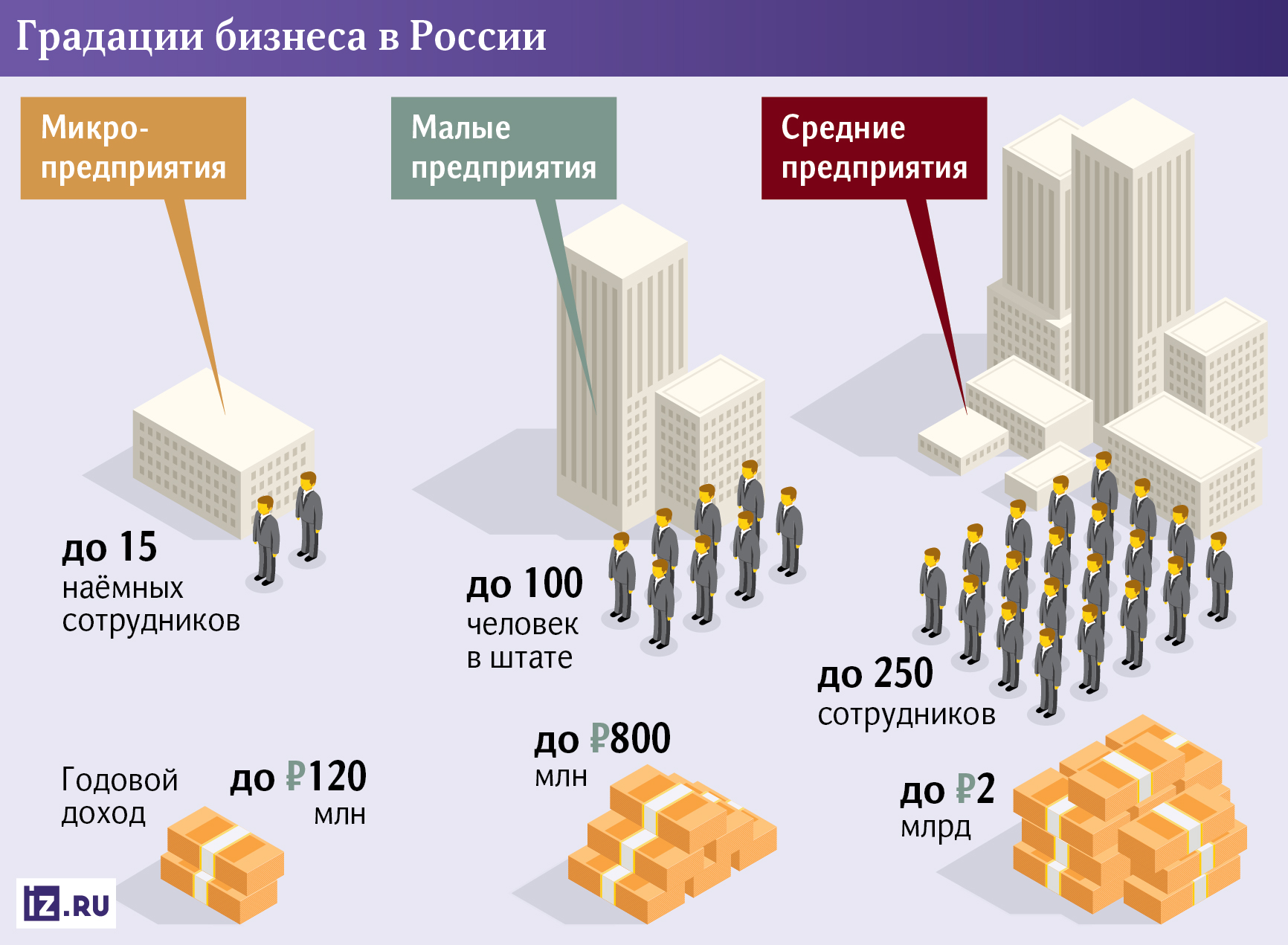
There are about 6.6 million small companies operating in Russia, but the vast majority are microenterprises (96%), according to the Unified Register of SMEs maintained by the Federal Tax Service (Izvestia has studied it). The remaining 4% are accounted for by small and medium-sized companies, which number almost 235 thousand and 22 thousand, respectively. Probably, about 10 thousand organizations will fall under the new category, according to experts interviewed by the editorial board.
The program is likely to include companies in the manufacturing and mechanical engineering, IT and system integration, logistics, construction, agriculture and processing, instrument engineering, as well as medical technology, said Daniil Gonenko from the Presidential Academy.
It is assumed that maintaining the SME+ category will reduce new business splits. The tax amnesty, which has been in effect since 2025, allows companies to legalize themselves by rejecting the artificial separation of structures for tax evasion, Igor Rastorguev from AMarkets drew attention. SME+, in turn, solves a different problem — this regime will create legal conditions for natural business growth without the need to resort to fragmentation.
Переведено сервисом «Яндекс Переводчик»
