
There is a future: what Strugatsky, Clark, Heinlein and Asimov dreamed of

The collection of articles by Vasily Vladimirsky, published since 2011 on various resources, but supplemented and revised for the current edition, is dominated by portraits of American science fiction writers (10 articles out of 20), whose heyday occurred in the second half of the 20th century. Critic Lidia Maslova presents the book of the week — especially for Izvestia.
Vasily Vladimirsky
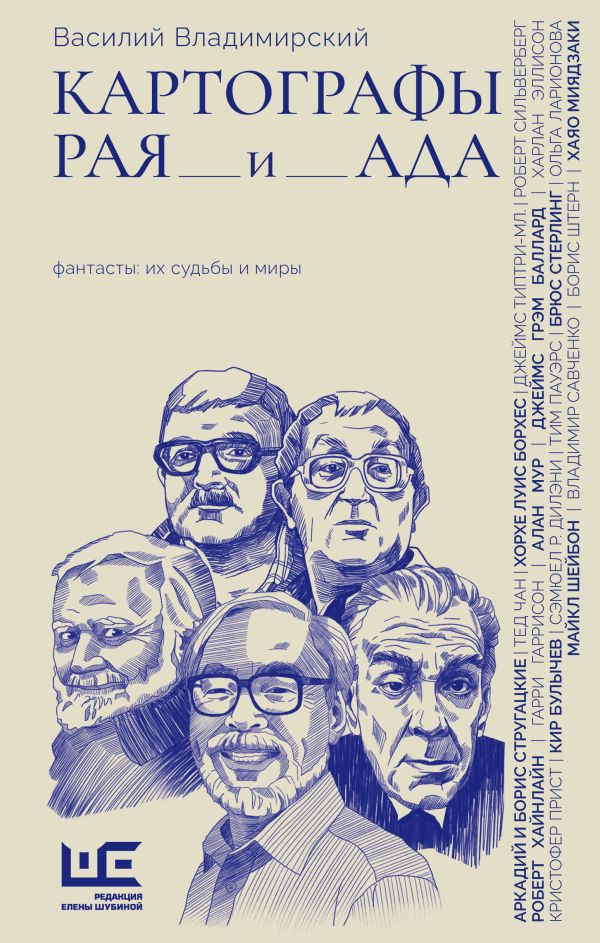
"Cartographers of Heaven and Hell"
Moscow: AST Publishing House: Edited by Elena Shubina, 2025. 347 p.
The book opens with Robert Heinlein, the author of Starship Troopers, one of the three "whales" along with Arthur C. Clarke and Isaac Aizimov, of Anglo—American science fiction of the 1930s and 1950s (while he himself considered literature a forced substitute for truly important socio-political activities). But then there are younger, still alive and full of creative forces writers, such as 62-year-old Michael Chabon, who is actively working as a Hollywood screenwriter, or 57-year-old Ted Chan, whose story "The Story of Your Life" formed the basis of Denis Villeneuve's meaningful drama "Arrival".
Soviet science fiction is well represented in Cartographers of Hell and Heaven, both still actively republished and undeservedly forgotten. In addition to the well-known Strugatsky brothers and Kir Bulychev, Vladimirsky takes into account their contemporaries Olga Larionova and Vladimir Savchenko, as well as Boris Stern, one of B.N. Strugatsky's best students. Probably, in the American-Soviet series, the Argentine classic of magical realism, Jorge Luis Borges, may seem, as Vladimirsky himself admits in the preface, "an inappropriate figure," but it is not difficult to fit him into the international fantasy community, which, if desired, is "permeated by subtle interrelationships, a complex hierarchy of mutual influences, likes and dislikes." And finally, the Japanese Hayao Miyazaki, who is more internationally known as an animation director, represents the Far East closer to the final. But as an inspired visionary, he also fits into the concept of the collection, the title of which refers to the 1960 program essay "New Maps of Hell" by the influential British novelist and critic Kingsley Amis, who explored in detail the expressive means of science fiction.
The issue itself did not receive a separate article in Vladimirsky's collection — his contribution to the development of the genre is reflected in an article about the British luminary James Graham Ballard, the author of such successfully filmed novels as "Empire of the Sun" and "Car Crash". According to Vladimirsky, at the suggestion of Amis, "the largest British publishing house Gollancz, previously indifferent to the so-called pure genre, launched a series of hardcover fiction," where Ballard's post-apocalyptic "Sunken World" about global warming was one of the first to be published in 1962. This groundbreaking work was so different from the "stencil" science fiction of the 1950s that the publishers did not want to compromise it with a frivolous genre definition on the cover, but it was Amis who explained to them that this was also fiction and now it could even look like this.
Such details, intersections of biographies, constellations of "mutual influences, likes and dislikes," "unobvious parallels" and "unexpected relationships" are the main subject of study in Vladimirsky's book, which, of course, does not pretend to be a comprehensive picture of all significant achievements of science fiction and even quotes Kozma Prutkov in his proposal to spit in the eyes of someone "who he will say that you can embrace the immensity."

And yet, Jorge Luis Borges, a favorite of the Soviet intelligentsia, who was "not quite appropriate" in the company of science fiction writers, managed to embrace a lot, if not immeasurably, with his genius. "Borges is like a giant stone in the middle of the road, you can't get around him, no matter how much you fidget: if you start philosophizing in prose, you'll inevitably stumble upon him," Vladimirsky writes in the essay "Mirrors of Borges," noting Borges' allusions, not necessarily consciously, but inevitably woven into the fabric of the narrative by Umberto Eco, Stanislav Lem or Victor Pelevin. — He's been everywhere, seen everything. Writing literature (and even more so writing about literature) without touching on the topics raised by the author of "Fictional Stories" is simply impossible today: wherever you spit, Borges has already left his mark everywhere."

Jorge Luis Borges
Despite the historical attitude towards fiction as a light or even low—grade genre, through the joint efforts of the heroes of Vladimirsky's book, it was able to turn into something more than simple-minded infantile entertainment or a kind of "well-paid muddle" - in the words of one of the most cynical "cartographers of hell and heaven", Robert Silverberg. In the 1970s, he complained that "American commercial science fiction is not the place for a serious writer." It is the 90-year-old Silverberg with his "Majipoor Chronicles" that Vladimirsky calls "one of those writers who bridged the gap between old-school science fiction of the Golden Age and modern SF, full-fledged adult literature."

Nowadays, any writer who tries to draw and construct the future, one way or another, even unwittingly, finds himself in the very role of a preacher that Robert Heinlein so desperately and hopelessly aspired to. It is symptomatic that Vladimirsky's essay on the Strugatsky brothers is called "Educating Educators" and reflects the brothers' constant desire to solve not so much technical issues as philosophical, moral, ethical and pedagogical ones: "A number of "damned questions" that have been bothering the Strugatsky brothers for decades: with enviable regularity, the co-authors returned to them again, again and again again, in almost every one of his works. And the most pressing of these questions is whether it is possible to force a person (and humanity as a whole) to become kinder, more humane, brighter, cleaner?"

However, more and more often literary educators and preachers have to feel their powerlessness and state rather sad things, for example, as in the quote from the Strugatsky story "Ugly Swans", which Vladimirsky uses in various essays — "The future is created by you, but not for you", adapting it not only to the work of Larionova or Miyazaki, but also to human existence in general: "... We are trying to survive in a monstrous world that the titans of the past created for us out of the best intentions."
Переведено сервисом «Яндекс Переводчик»
