Full picture: The scandalous book about the Witcher has been released with a new cover
- Статьи
- Culture
- Full picture: The scandalous book about the Witcher has been released with a new cover


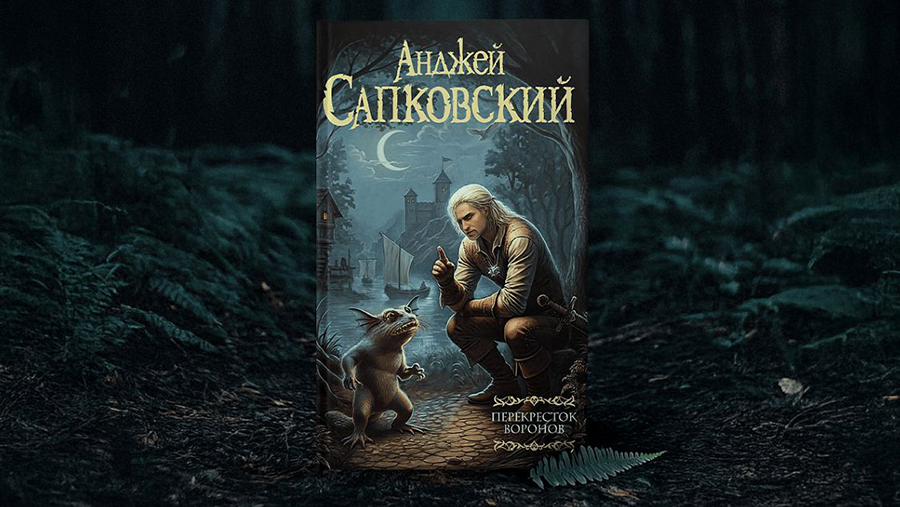
The Witcher: The Crossroads of Ravens is being released in Russia simultaneously with the worldwide English-language release. In the spring of 2025, the book was at the center of a scandal — an illustration created, presumably using AI, was used for the Russian edition. A scandal broke out online, although the fact of using neural networks has not been proven. As a result, the AST publishing house replaced the cover and coordinated it with the writer Andrzej Sapkowski. See the Izvestia article about the new book about the Witcher Geralt and whether it will avoid another scandal.
What the new book will tell you about
Nine books have already been written about the witcher Geralt, also known as the White Wolf and the Butcher of Blaviken: two collections of short stories and seven novels. In addition, he was awarded Polish and American film adaptations, the latter remains one of the most watched Netflix series. Comics and several video games have been released about the hero, including The Witcher trilogy and the Gwent card game.: The Witcher Card Game. Therefore, the release of a new book, the first since 2013, is a major pop cultural event with a multi—million target audience worldwide.
The author, Pan Sapkovsky, created a new book in two years. The original text of the novel was published in Polish back in November 2024, but the world debut in English, Russian and other languages is scheduled for September 30, almost a year after the book was published in the writer's native Poland. According to the author himself, the main incentive to return to his main character after 11 years ("Season of Thunderstorms" was released in 2013) was the appearance of the Netflix series.
—Netflix made an outstanding series based on my story and thus forced me to continue creating new plots and chapters," Andrzej Sapkowski said on social media.
At the end of last year, pirated and low-quality translations of the novel appeared in Russia, some were sold at quite market prices. But Izvestia was the first to learn and tell that the novel would most likely be officially released in Russia, because negotiations were already underway with the writer.

How Geralt became the main witcher
The action of "Raven's Crossroads" takes place long before the events of the main cycle. The young witcher Geralt, so far without any titles or nicknames, has just left the walls of Kaer Morhen and set out to conquer the big world. The journey begins with trouble — in the small settlement of Neuhold, Geralt is accused of murder and sentenced to death. He is saved from certain death by Preston Holt, the elder witcher, who takes Geralt under his wing and offers to teach him the art of craft.
Holt becomes Geralt's mentor, but this image is given without romantic embellishments. He is stern, straightforward, and secretive. Together they travel through the lands of Kaedwen, fulfilling orders, killing monsters, removing spoilage and purifying the lands from magical contamination. For the first time, Geralt is faced with real danger and realizes that theoretical knowledge does not save him in a fight with a flock or in negotiations with local lords.
However, "Raven's Crossroads" is not just a set of adventures. The main conflict of the novel unfolds not from the outside, but inside and is directly related to the figure of Holt, the most interesting in the narrative. His past is connected with the tragic events of the attack on Kaer Morhen, a harsh fortress and remote from civilization abode of witchers, over which clouds have been gathering for years. Geralt faces his first truly adult choice: remain loyal to his mentor or leave, refusing to be an accomplice in someone else's secret.
Easter eggs of the new "Witcher"
"Raven's Crossroads" is filled with references to future events that fans will be happy to learn: here is the first mention of separate swords for monsters and for people, and the origin story of the garter on Geralt's jacket, and even an explanation of why he calls himself "from Rivia." These elements make the novel especially valuable for those who are familiar with the saga, if they do not add depth, then at least they "sew up" gaps in the mythology of the world.
There is much more to fanservice than meets the eye. Some chapters refer to game events, the battle with stryga resembles an episode from a famous trailer, and the origin of the nickname Roach, which the witcher gives to all his horses, is described in a humorous way.

But the main thing in the book is not the details, but the tone. This is not a heroic saga, but a chamber story of growing up. Geralt here is not an impeccable swordsman, not a philosopher with dry aphorisms and not a womanizer, greedy for witches. He makes a mistake, loses his sword and medallion, and finds himself on the verge of despair. This vulnerability makes it alive, "connects" the reader.
Themes of moral choice, pain, doubt, and loneliness run through the entire novel. Unlike later works, where Sapkovsky often plays with scale and politics, here the writer focuses as much as possible on the inner world of the hero. This is a novel about character development, not about fighting monsters.
Russian readers will be satisfied
The Russian edition of the book will be published on September 30, 2025 by AST publishing house. The translation was done by Vadim Kumok, known for other works in the world of The Witcher. The translation language retains Sapkovsky's signature style — ironic, archaic in places, but at the same time easy to read.
The format of the book is closer to a collection of related short stories than to a full—fledged novel: the structure is episodic, with alternating events from categorically different locations and with time jumps. For all terms from the Middle Ages, whether they are names of dueling techniques or administrative positions, there is a full glossary both at the end of the book and in the form of notes.
The book has its drawbacks. First of all, this is the limitation of the conflict, its excessive locality, but at the same time the inexpressive characters of the second plan. If the action is narrowed down, then it should be justified by the details, but this is not the case here. The novel was clearly written for fans who are already immersed in the universe of The Witcher, and this work does not even try to recruit new readers. But fans will now argue whether Sapkowski had the right to add powerful new characters like Preston Holt, if there is simply no place for the Secret Witchers in the canon.

The narrative is full of "surprises": "suddenly" help arrived or "suddenly" villains appeared from underground. A young author can be forgiven for this, but for the most titled writer in the history of modern Poland, it looks like either negligence, or is it really creative old age?
It is impossible to put a new novel on a par with such classics of the cycle as "The Lady of the Lake" or "The Hour of Contempt". "Raven's Crossroads" is like an old map, where the reader finds familiar paths again, but with a different lighting. On the other hand, Sapkovsky, if he wanted to make money, could just release a collection of short stories, but he still honestly wrote a novel, and even on a vulnerable topic — the youth of the main character.
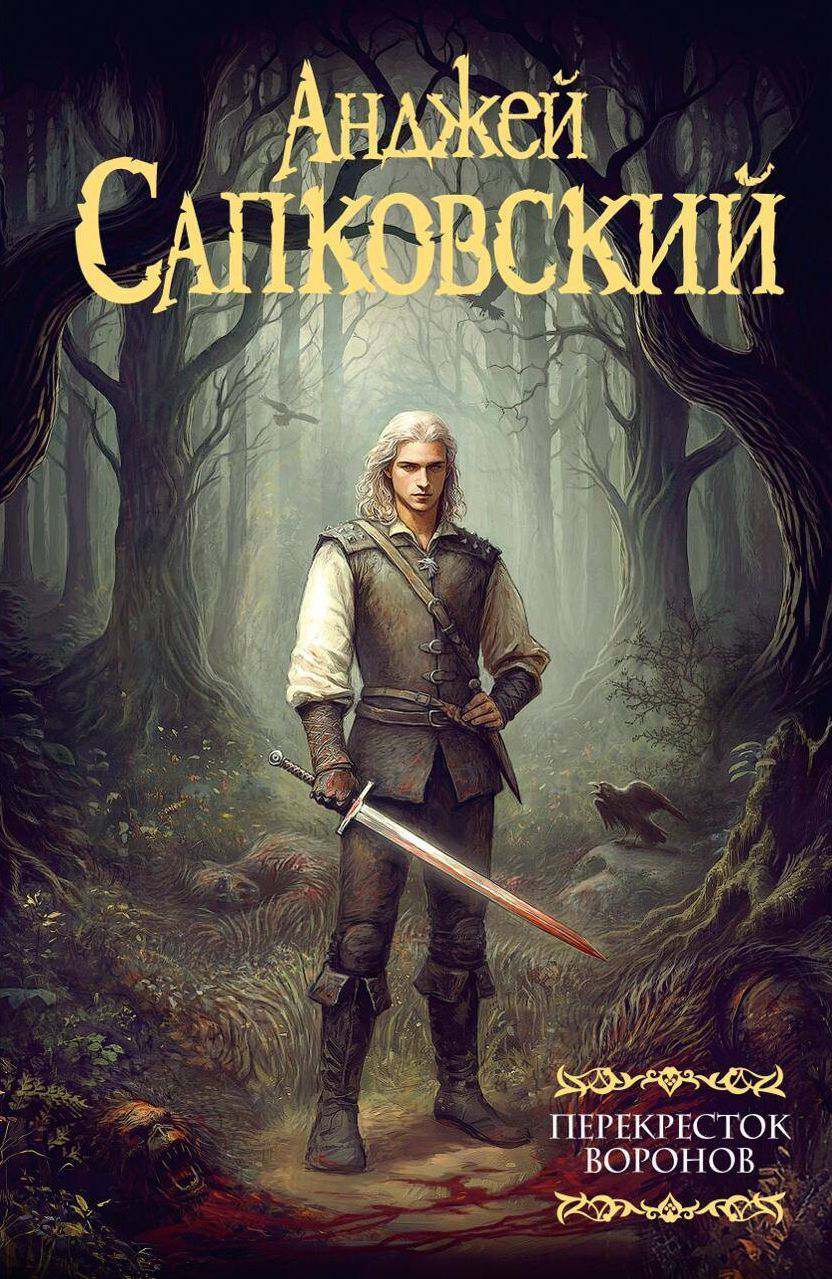
In Russia, this novel received a free "advertisement" in the spring. The cover artist was suspected of using AI and found several confirmations indicating the use of additional neural network tools. After the scandal, AST completely reformatted the cover and changed the artist. According to the publisher, Sapkovsky himself approved the new illustration. It is made in the traditional high fantasy style of the series with a touch of nostalgic retro. A fresh cover with a young witcher surrounded by defeated monsters better fits the spirit of the book, but the AI scandal has not been forgotten and will not be forgotten by demanding geeks. But they are the ones who will read the novel, it is the product for them, and this is its strength and weakness at the same time.
Переведено сервисом «Яндекс Переводчик»
