
To calm the restless: funerals as an ancient cultural tradition

The subject matter of the new book by the medievalist and anthropologist Vladimir Petrukhin can be described as "infernal" — it is this epithet that the author uses, recalling the topic of his PhD thesis "The funeral cult of pagan Scandinavia", which he defended in 1975 at the Department of Archaeology of the Moscow State University Faculty of History. Critic Lidia Maslova presents the book of the week, especially for Izvestia.
Vladimir Petrukhin
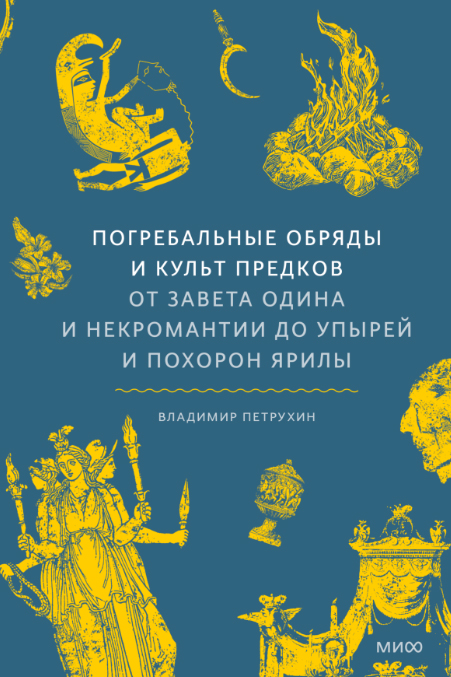
"Funeral rites and ancestor worship"
Moscow : MIF, 2025. 224 p.
Dedicating the book to the memory of his teachers and colleagues, Petrukhin mentions in the introduction, among the senior comrades who blessed him, the famous ethnographer Sergei Tokarev, whose research on funeral worship as an early form of religion influenced Petrukhin's approach to the interpretation of archaeological finds. Thus, Tokarev has an important idea that the whole variety of funeral rites in the history of mankind was associated with two opposing trends.: "On the one hand, it was the desire to preserve the deceased ancestor near the collective, that is, to preserve his body in a necropolis, grave in a camp, etc. On the other hand, there is a desire to send a dead man, and with him the spirits of death, to a distant afterlife."
This ambivalent attitude towards the dead, who, on the one hand, frighten, and on the other, if handled correctly, can act as helpers and patrons for the living, is one of the cross—cutting themes of the book. It describes many ritual ways to maintain good relations with deceased relatives, on whom a person depends no less (or even more) than on the living. This is precisely the meaning of memorial rites, which have similar features among different peoples. Petrukhin traces parallels between the cult of ancestors among the Slavs and Indo-European traditions, such as the worship of pitaras ("fathers") in ancient India, where it was believed that "sacrifice for the dead performed by relatives is the basis for the happiness of the deceased" (this is a quote from the sacred Hindu text "Garuda Purana"). The Romans also tried not to conflict with the dead, to whom the spirits of the dead, mana, came on calendar holidays.: "Their name implied "kind" ancestors, although these natives of the other world could also turn out to be evil. <...> On the days of the ancestors' calendar activity, the family gathered around the hearth, and the head of the family left the house at night to throw them a handful of boiled beans. Perhaps this "feeding" was also a talisman against the invasion of the dead, who had to count the scattered beans."

Petrukhin examines many myths surrounding death and funeral rites among different peoples, but as an employee of the Institute of Slavic Studies of the Russian Academy of Sciences, he separately takes into account the Slavic folklore tradition with its stories about the living dead — vampires or ghouls. Of the most popular cultural traces of this tradition, the researcher primarily mentions Gogol's Viy and Count Dracula. The ghoul from fairy tale No. 363 in the famous collection by A.N. Afanasyev looks like the literary Dracula, who became famous as a seducer of women. And in fairy tale No. 367, there is a plot similar to Gogol's about a resourceful soldier who was saddled by a witch, but was eventually defeated with the help of a wise grandfather who revealed the secret: to defeat a native of the other world, everything must be done the other way around, for example, backing away from the coffin.

A similar magical logic dictates the custom of carrying the dead out with their feet in front of them so that they do not want to return to the world of the living. Nevertheless, numerous similar precedents are discussed in chapter 9, "Natives of the dead and rising from the grave," where Petrukhin states that "the outrages of the living dead" can be called the everyday realities of any society that believes in an afterlife, despite the fact that "the restless dead," in the words of the author of the book, such the same oxymoron as "hot ice". Fortunately, humanity has achieved considerable ingenuity in how to calm the restless dead, appease deceased ancestors and persuade them to benefit the living. For example, one of the most effective ways to keep a beneficent ancestor by your side was to create a new, non—decomposing body for him - in the form of an urn or ossuary for bones.: "Many peoples of the Mediterranean and ancient Europe often gave them an anthropomorphic appearance or made them into homes. Among many peoples, special figurines, dolls, were also considered to be the receptacles of the souls of their ancestors."

The head has always been considered a reliable container of the soul in different cultures, so the customs of ritual storage and use of skulls have become widespread. "In Polynesia, the spirit of the deceased inhabits a mannequin topped with his own dried head," says Petrukhin. "After funeral rites, the skulls are placed in the houses of the dead and continue to take care of them: they bring food, share their dreams and plans with them, etc." Skulls with faces painstakingly restored using paints, clay, plaster and other improvised materials are one of the oldest portrait samples known to archaeologists.

It happens that the dead help the birth of new people, for example, the Sudanese bokkos used to tear up the grave of an ancestor a year after burial, take out the skull and, after washing it, place it in a special house, after which the father of a woman who could not get pregnant could turn to him: "You are an old father, you have been dead for a long time. You gave birth to me before you died. Now I have given birth to a daughter, she has no child. But she's married. You are an old father, and I beg you, give her a child." And in the Old Norse "Saga of the Ynglings" it is told how the supreme god Odin used the embalmed head of the innocently killed giant Mimir, talking with her about the fate of the future, since from the other world the deceased could transmit valuable information unknown to other gods.
"By the way, it would be appropriate to recall the fate of Berlioz, who lost his head, from the famous novel by Mikhail Afanasyevich Bulgakov," Petrukhin shares with the literary association. But besides, reading about the cult of skulls and its diverse, sometimes very sophisticated variations, one involuntarily remembers the slang name of parents among Soviet teenagers — "skulls". This funny association does not contradict the spirit of the Petrukhin book, which may seem infernal and frightening to some, but nevertheless ends with a cheerful catch phrase from Faust about the dry theory and the ever-green tree of life.
Переведено сервисом «Яндекс Переводчик»
