- Статьи
- Science and technology
- The mission is incorrigible: The Americans could have disrupted the Soyuz–Apollo scientific programs

The mission is incorrigible: The Americans could have disrupted the Soyuz–Apollo scientific programs

Scientists conducted 34 scientific experiments under the Soyuz–Apollo program, including five jointly conducted by the USSR Academy of Sciences and NASA. Almost all of them were recognized as successful, however, as the analysis of archival data showed, their effectiveness could have been higher if scientists from the two countries had worked more consistently. Izvestia has received exclusive access to historical documents from the Archives of the Russian Academy of Sciences, which indicate that conflicts and tensions arose due to bureaucratic or technical reasons. In particular, Soviet scientists faced obstacles from administrators in the American leadership of the project. For more information, see the Izvestia article.
What experiments were carried out on board the Soyuz –Apollo
Fifty years ago, on July 17, 1975, the historic docking of the Soviet Soyuz-19 spacecraft and the American Apollo took place in low-Earth orbit. This event launched international cooperation in space. Including in the scientific field. In particular, 34 experiments were carried out during the flight, five of which were joint between the USSR Academy of Sciences and the American space agency NASA.
However, in order for the programs to be successful, scientists had to overcome difficulties. This is evidenced by documents from the Archive of the Russian Academy of Sciences, to which Izvestia has received exclusive access. The problems were related to political confrontation, differences in technical systems in the USSR and the USA, as well as linguistic and psychological barriers.

In addition, Soviet specialists faced delays in providing data from their American colleagues, their inadequate quality, as well as problems with the export of materials from the United States.
— During the Soyuz–Apollo flight, cosmonauts and astronauts conducted joint research for two days. They studied astronomical phenomena, the behavior of microorganisms in space, radiation, and the parameters and chemical composition of the upper atmosphere. The crews also checked the compatibility of the equipment and worked out the interaction," said Olga Selivanova, Deputy Director of the Archive of the Russian Academy of Sciences.

According to her, most of the programs implemented on board the Soyuz–Apollo had breakthrough significance for the future of space science. Scientists are still using many of the developments they have made.
For example, during the "Artificial Solar Eclipse" experiment, an American ship obscured a star, the expert said. This made it possible, for the first time in history, to observe the solar corona for a long time without atmospheric interference, which is important for studying space weather. Then, according to the Universal Furnace program, the crews conducted a series of sintering experiments in zero gravity of new materials.
In addition, radioactive irradiation of germanium and sodium iodide crystals was carried out on board. In the future, this made it possible to develop gamma ray detection detectors for future spacecraft.
— A whole range of innovative microbiological studies was carried out on board the Soyuz–Apollo. For example, in the Microbial Exchange program, scientists studied bacteria from samples taken from the skin of Soviet and American crew members. These studies became the basis for studying the survival of microbes in space and changes in their pathogenicity. Also, in the "Zone-forming fungi" experiment, scientists used a culture of radiant fungi (close to mold fungi and bacteria) as biodetectors. They helped identify high—energy particles that penetrate the ship's skin and damage the cells of living organisms," the historian said.

What obstacles prevented the research from being carried out
At the same time, an analysis of archival documents shows that, despite the fact that almost all experiments on the Soyuz–Apollo project were recognized as successful, their effectiveness could have been higher if scientists from the two countries had worked without obstacles, Olga Selivanova said.
As confirmation, the specialist cited the words of Vladimir Kurt, one of the curators of scientific programs on experimental flight, an employee of the Institute of Space Research of the USSR Academy of Sciences. In particular, in the report on the trip of the Soviet delegation to the United States from June 15 to June 20, 1976, under the program of the experiment "Ultraviolet absorption" (measuring the concentration of atomic oxygen and nitrogen in outer space at the altitude of ships), the specialist noted the "formal spirit of negotiations", which, in his opinion, was set by Robert Thomas Juley, responsible for the coordination of all scientific aspects of the Apollo–Soyuz project by NASA.
"He rejected all our requests, referring to the fact that the EPAS program (the Apollo–Soyuz experimental flight. — Izvestia) It has been completed and all further work should be carried out only under new bilateral agreements," Vladimir Kurt said in the document.

He also noted a meeting on the issue of data exchange, as it turned out that the Americans "did not provide the data in the form envisaged at the negotiations in Moscow (7 bits instead of 9). It was with great difficulty that we managed to persuade the American side to redo the data in the 8-bit + (verification character) code we needed."

Also in a personal letter to Julie, the Soviet scientist stressed that, despite the agreements, the Soviet side had not received the "promised magnetic tapes."
"I believe that it is no longer advisable to process these observations in the Soviet Union, given the more than one-year delay compared to the processing of materials in the United States. <...> This is further aggravated by the low quality of the obtained observational material. <...> Naturally, in such a situation, I ask you to exclude me from co—authors of all publications on this experiment," wrote Vladimir Kurt.

As Olga Selivanova said, similar situations can be traced to other experiments. For example, even at the stage of preparation for the Soyuz – Apollo flight, Konstantin Bushuev, the technical director of the project, reported in a telegram to Glynn Lanny, the American director of the project, that when preparing the accounting documents, "we encountered difficulties in making drawings of the Apollo spacecraft and its compartments due to the insufficient clarity of the copies received from you."
Also, in a memo to Vladlen Vereshchetin, Deputy Chairman of the Intercosmos Council, Yuri Nefedov, Acting director of the Institute of Biomedical Problems, noted that "according to the Microbial Exchange experiment <...>, the Soviet side did not fulfill the obligation clause <...> on the identification of certain groups of microorganisms isolated from astronauts <...> due to the lack of opportunities for the transportation of microbial cultures from the USA to the USSR".

There are many similar examples based on archival sources, Olga Selivanova emphasized. To some extent, this testifies to the scientific feat that scientists have accomplished by implementing joint experiments in conditions of mutual distrust of the parties due to the confrontation between the socialist and capitalist systems.
The relationship between Soviet and American scientists
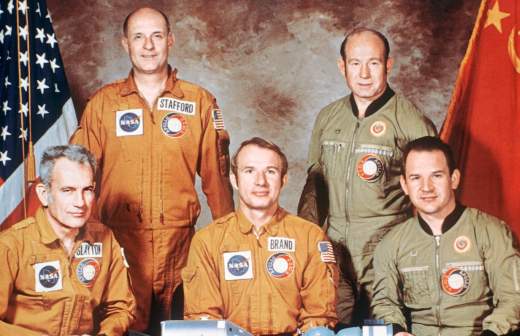
— Relations between Soviet and American scientists were generally friendly and professional, despite the political situation of the Cold War. Scientists sought to cooperate, exchanged knowledge and technology, and personal contacts between them often developed into long-term friendships. For example, astronaut Tom Stafford and cosmonaut Alexey Leonov maintained warm relations even after the mission was completed," explained Galina Nechitailo, Doctor of Biological Sciences, Professor, space biologist, to Izvestia.
The joint experiments were conducted successfully, and both sides recognized each other's contributions, she explained. Professional conflicts were rare, and the main tension arose due to bureaucratic or technical difficulties. This demonstrated that science can overcome political barriers. This allowed us to lay the foundations for future international programs such as the ISS.
At the same time, there were cases when American scientists used Soviet developments, improved them and presented them as their own achievements, which caused discontent among Soviet colleagues, Galina Nechitailo noted.

— The Soyuz–Apollo mission was a difficult task, in particular due to the difference in technical systems. For example, the Americans used the imperial system (miles, feet), and we used the metric system. This also created problems with the interaction of crews and scientists. In addition, the radio frequencies were different — 200 MHz and 296.8 MHz for Apollo and 121.75 MHz and 121.8 MHz for Soyuz. Therefore, the ships were modified to ensure the reception of signals," said Pavel Gaiduk, cosmonautics historian, deputy head of the scientific and exposition department of the Museum of Cosmonautics.
Another difficulty, he added, was the approach of the ships in orbit. The Americans' method involved using a rangefinder, and ours was calculating the maneuver on the Ground. Because of this, we had to develop a four-page collaboration manual. A separate problem was the difference in the atmosphere of the ships. The Soyuz used an air mixture (25% oxygen, 75% nitrogen), and the Apollo used pure oxygen at a pressure of 0.35 atmosphere. An airlock was created for the passage between the ships. It also turned out that Soviet overalls can ignite in an oxygen environment, so they developed fire-resistant PK-12 suits.
Thus, overcoming these difficulties at the stages of preparation and space flight, as well as subsequent contradictions in processing the results, was a feat of Soviet and American specialists, who proved the fundamental possibility of cooperation between the two superpowers at the height of the Cold War, the expert concluded.
Переведено сервисом «Яндекс Переводчик»
