
Hugs in space: how the USA and the USSR met in orbit
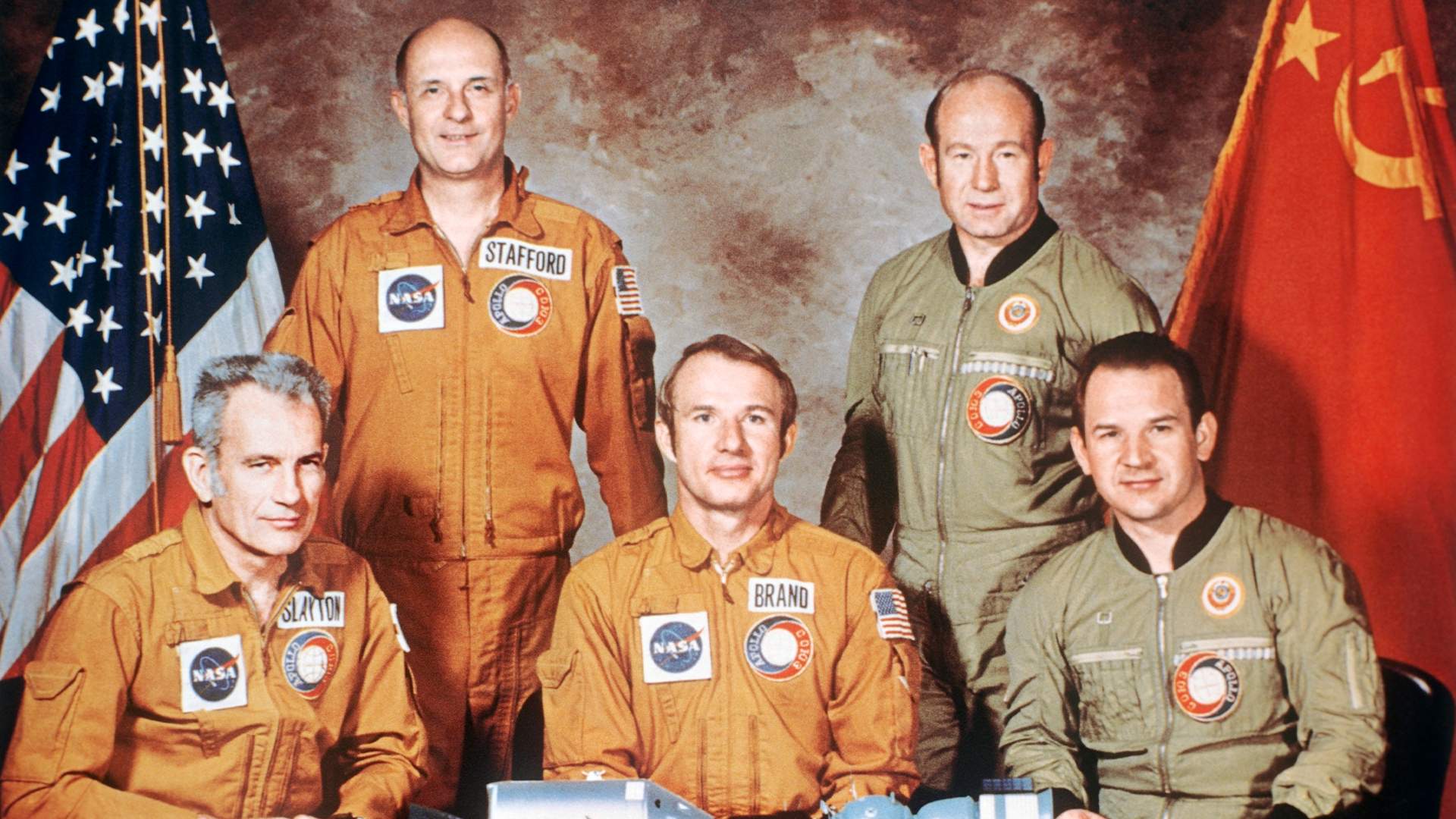
On July 15, 1975, putting aside the prejudices of the Cold War, representatives of the USSR and the United States proved to the whole world that in the future space exploration would become a joint effort of the great powers. The docking of the Soviet Soyuz-19 and the American Apollo was a milestone in the era of detente. Izvestia recalled how it was.
Discharge from earth to sky
In the early 1970s, when the Soviet Union achieved military-strategic parity with the United States, the time for negotiations came to replace the fierce confrontation between Moscow and Washington. Nuclear arms reduction treaties were being prepared, cultural and scientific cooperation was established, and sports competitions were organized between the best athletes of the two superpowers... Leonid Brezhnev, General Secretary of the Central Committee of the CPSU, and Richard Nixon, President of the United States, met as friends and talked about "defusing international tension." It seemed that the cold war was over, the peaceful coexistence of the systems was ahead, and the detente that had begun on earth needed to be transferred to space.

The American Apollo spacecraft and the Soviet Soyuz-19 spacecraft (from left to right)
Cooperation between different systems beyond the Earth seemed inevitable even before the beginning of the space age. Back in 1950, American science fiction writer Fredrik Brown published the novel "Honeymoon in Hell," in which a Soviet girl pilot and an American pilot go to the moon to save humanity. And in Martin Kaidin's novel "Trapped in Orbit" (1964), an American astronaut came close to death during a flight.: His ship had run out of oxygen. But at the same time, the Soviet Vostok is in orbit, which hastened to help the American. The preface to the Soviet edition of the novel was written by cosmonaut No. 2 German Titov.

Preparations for the launch of a joint space flight under the Soyuz-Apollo program at Baikonur, July 15, 1975
The idea of a real docking in orbit was proposed by Thomas Payne, director of the American Space Exploration Administration (NASA), in correspondence with Mstislav Keldysh, President of the USSR Academy of Sciences. Soviet experts agreed with this initiative.

In October 1970, the first working meeting of Soviet and American specialists took place in Moscow. The main issue that they discussed with drawings and calculations, discarding secrecy, was how to combine the means of rendezvous and docking used in the USSR and the USA. No less important was another task — to ensure that both ships would take off into orbit with the same altitude and inclination and be able to get closer. The computer systems for calculating the movement of Soviet and American ships differed. The Americans had to switch to the metric system of measures, abandon the feet and pounds. After much consultation and debate, the altitude was chosen at 225 km, and the inclination of the orbit was 51.80, which was determined by the geographical location of Baikonur. International groups of scientists with two leaders, one Soviet and one American, were created for each problem. During the work, they even created a new English-Russian dictionary of technical terms. There were disputes about which ship to launch first, over whose territory to dock, and on which ship to hold the first meeting. As a result, it was decided that the Americans would be the first to visit our astronauts, and the handshake would take place when they flew over Moscow.

A launch vehicle with a Soyuz-19 spacecraft on the launch pad
The Soviet and American spacecraft had fundamental technical differences. The designers had to adjust a lot to work together in orbit. The most difficult technical task turned out to be the creation of new docking elements that would be suitable for both our Soyuz and the American Apollo, the "Adrogin—peripheral docking units", abbreviated as APAS-75. For its time, it was a perfect technique designed for various force majeure situations that may arise during docking. APAS was developed in the Soviet Union, at the Royal OKB-1. Half of the device remained in the USSR before the flight, and it was installed in the Soyuz—19 spacecraft, and the other half was transported overseas. There, she replaced the standard Apollo docking equipment. Almost everything was ready for the space alliance.
Two ships
On May 24, 1972, during a visit to Moscow, Nixon signed with Chairman of the Council of Ministers Alexei Kosygin the "Agreement between the Union of Soviet Socialist Republics and the United States of America on Cooperation in the Exploration and Use of Outer Space for Peaceful Purposes." The third paragraph of this document stated that a joint flight within the framework of this cooperation would take place in 1975. At that time, the politicians of the two superpowers talked about a "detente" — "defusing international tension." In both the USSR and the USA, propaganda began to adopt a moderately friendly tone towards "ideological opponents." They even started talking about the end of the Cold War. Ties in the economy, sports, culture, and science have intensified. But the decision to reveal their most advanced technological developments to each other became the apotheosis of Soviet-American cooperation in the 1970s.

Filming from the Soyuz-19 spacecraft
Any space flight is a dangerous mission. Cosmonauts were awarded the Stars of Heroes of the Soviet Union for a reason. But docking with an American ship was considered a historic and extraordinary matter. And they chose the most reliable and proven ones for this flight. There was no doubt about the first candidate — Alexey Leonov, who was the first in the world to go into outer space in 1965, was to become the commander. Valery Kubasov, one of the most educated cosmonauts, became a flight engineer. In 1969, he worked in orbit under the program of the world's first simultaneous flight of three ships. The Americans chose the crew no less carefully, relying on a fusion of experience and youth. Commander Thomas Stafford, who participated in the Lunar Program, had already been in orbit three times and was considered one of the best space "pros". Two debutants, Vance Brand and Donald Slayton, went on the flight with him.

Soviet cosmonauts Valery Kubasov and Alexey Leonov (from left to right) during a training session at the Yuri Gagarin Cosmonaut Training Center.
The astronauts had to learn English and thoroughly study all issues related to American space technology. The Americans learned Russian and got acquainted with Soviet equipment. Our designers and their colleagues from the USA exchanged documentation and held endless joint meetings. And cosmonauts and astronauts studied new equipment for themselves.
The ships were undergoing technical modernization. New transitional docking and airlock compartments were constructed for the Apollo and Soyuz spacecraft, in which the astronauts could feel quite comfortable. The Soyuz was equipped with an on-board digital computer. The atmosphere of the American Apollo was such that the synthetic Soviet work suits, which were familiar at that time, became flammable. We had to develop a new fabric, which, by the way, turned out to be the highest quality in the world at that time.
A handshake in orbit
On July 15, 1975, at 15:20 Moscow time, the Soyuz-19 spacecraft with Leonov and Kubasov on board took off from Baikonur. Seven hours later, the Apollo spacecraft was successfully launched from the Cape Canaveral space center with a crew of three astronauts: Thomas Stafford, Vance Brand and Donald Slayton.

Soviet cosmonaut Alexei Leonov (left) and American astronaut Thomas Stafford
For almost two days, the ships maneuvered together in orbit, then approached, and on July 17, at 7 p.m., the time came for the most crucial experiment — docking. Active maneuvering fell to the lot of the Apollo. The maneuvers were observed by specialists from the Soviet long-range radar surveillance station "Danube-3". There were some emergencies. During one of the touches, the ships began to "walk", and only the skill of the astronauts made it possible to avoid disrupting the program.

Stafford and Slayton's friendly rendezvous with the Soviet cosmonauts aboard the Soyuz was to take place as the ships flew over Moscow. The Americans stopped by to visit Soviet friends. Ballistics calculated everything, the astronauts performed the task exactly, but — a mystery — something did not come together. And they shook hands as the ships flew over the Elbe, which gave the journalists a reason to remember 1945 and the fraternization of Soviet and American allied soldiers on the banks of this German river. The hosts hugged the guests and exchanged souvenirs.
The Americans were sure that their ship was more comfortable and more powerful. Indeed, in the USSR at that time, they relied on the improvement of orbital stations, the ships played rather an auxiliary role. But the living conditions of the Soyuz surprised the guests. First of all, it was better to breathe on a Soviet ship. Secondly, everyone was delighted with the toilet, designed according to the principle of a vacuum cleaner. The Apollo used a much less convenient model. It is no coincidence that latrines on the International Space Station are designed according to the Soviet principle.

Alexey Leonov (left) and Valery Kubasov before the start
The flight was not limited to friendly conversations, hugs and jokes. The International space crew has conducted many scientific experiments. Kubasov photographed the solar corona, and the Apollo, being in the line of sight of the Sun, artificially created a solar eclipse. Photometric image processing made it possible to explore those areas of the Sun's corona that had previously remained inaccessible to earthlings. The astronauts studied aluminum and tungsten to obtain a material from components with different specific gravity, germanium and silicon to test how single crystals of semiconductors are formed. Leonov and Kubasov tracked the crystallization of powdered aluminum in space conditions.

The crew of the Soyuz-19 spacecraft after landing
For almost two days, Soyuz and Apollo flew in orbit in an embrace, turning into a single space laboratory. Representatives of the USSR and the USA visited each other four times. But there was still undocking and a second docking, in which Soyuz was to play an "active" role. Another dangerous experiment with a happy outcome. The ships flew in a docked state for three more hours, after which they separated, but the astronauts and astronauts remained friends forever.
The Cosmic Brotherhood
In both the USSR and the USA, the space brothers were greeted as real heroes. They met with the heads of state, Leonid Brezhnev and Gerald Ford, and spoke to scientists, demonstrating to the whole world that they had found a common language. At that time, millions of people on all continents perceived the "handshake in space" as a guarantee that the two powers had overcome the danger of atomic war. It was impossible to imagine a more spectacular symbol of relaxation.

Since then, meetings between Soviet cosmonauts and American astronauts have become regular. The next time the unique equipment for docking spacecraft from different countries was needed was 20 years later, in June 1995, when the American Atlantis docked at the Russian Mir orbital complex. Modern APAC modifications, which are manufactured in Russia, allow for docking with spacecraft and stations of various systems. Cosmonauts and astronauts, despite the difficult political relations between our countries, have never had contradictions, only respect and mutual interest in professional developments. And today, no matter how the political relations between Russia and the United States deteriorate, representatives of our countries are working together on the International Space Station. Global challenges such as deep space exploration, a flight to Mars, and the creation of a new type of space station can only be solved by combining the technologies and experience of Russia and the United States, two countries that are traditionally leaders in the exploration of interplanetary space.
The author is the deputy editor—in-chief of the magazine "Historian"
Переведено сервисом «Яндекс Переводчик»
