- Статьи
- World
- Block therapy: at the end of the summit, NATO did not mention expansion for the first time since the 1990s

Block therapy: at the end of the summit, NATO did not mention expansion for the first time since the 1990s
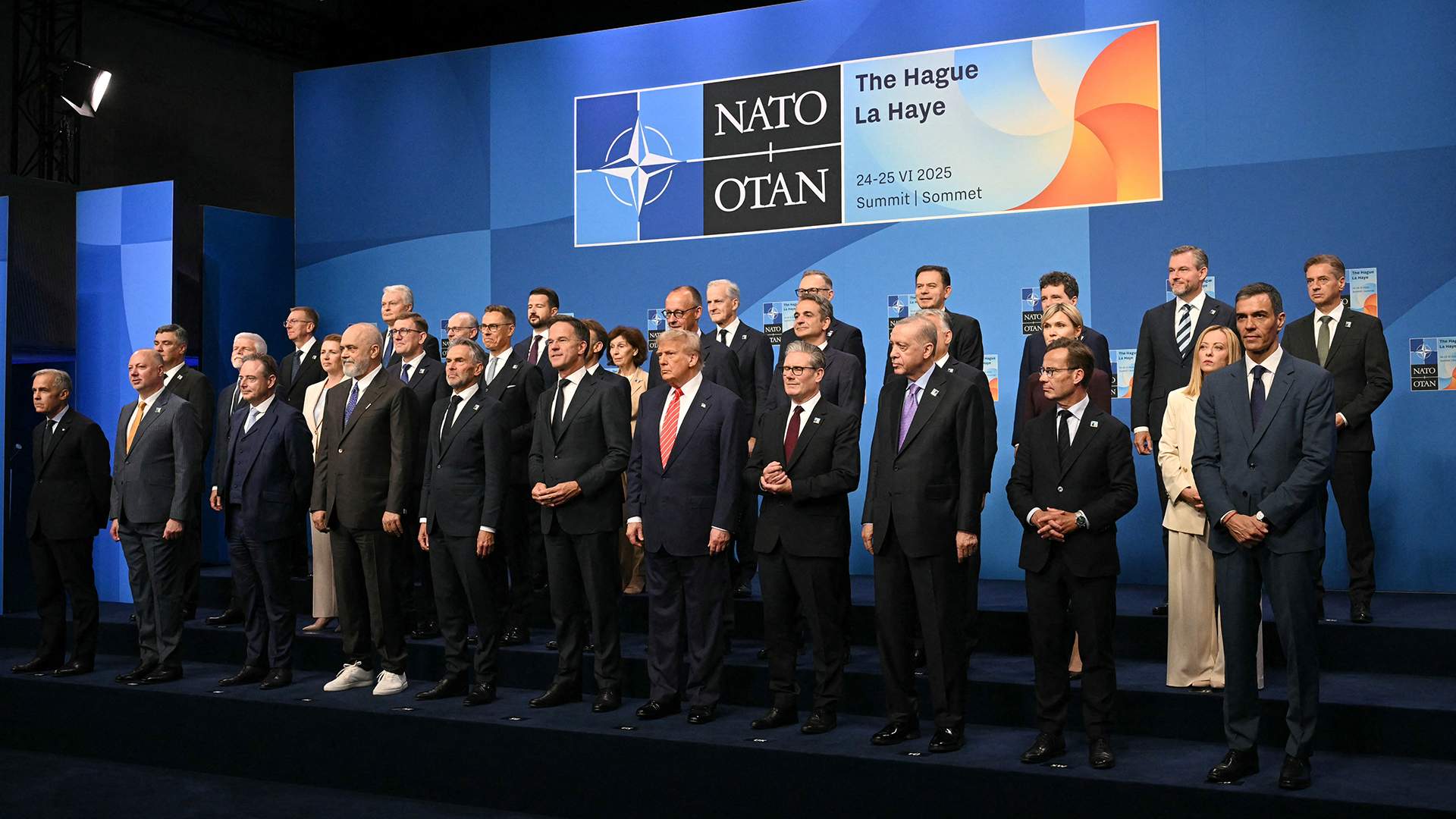
For the first time since the 1990s, NATO did not mention in the final declaration of commitment to an open-door policy, Izvestia found out. For more than 30 years, this provision has been present in all the final documents of the alliance. The expert community believes that this was done for tactical reasons, so as not to annoy US President Donald Trump, who opposes Ukraine's membership in the bloc. At the same time, NATO does not abandon the open-door policy. The alliance is developing cooperation with post—Soviet countries, including Armenia, Russia's CSTO ally. Russia is categorically opposed to the expansion of the alliance, Russian Deputy Foreign Minister Mikhail Galuzin tells Izvestia. In particular, according to him, the most reliable and effective security guarantees for Yerevan are bilateral agreements with Russia and within the framework of the CSTO.
NATO's Open Door Policy
The final declaration of the NATO summit, adopted in The Hague on June 25, lacks a statement on the alliance's commitment to an open-door policy. The five-point document contains provisions on plans to increase military spending to 5% by 2035, on collective defense, as well as on the time and place of the next summits.

NATO Secretary General Mark Rutte speaks at the opening of the NATO Leaders' Summit in The Hague
Izvestia analyzed the final declarations of NATO, adopted since the 90s of the last century. The open door policy is not mentioned in the document adopted at the Rome Summit in 1991. And there is an explanation for this. Moscow discussed the issue of the inadmissibility of NATO expansion with the leadership of the alliance back in the late 1980s and early 1990s. This happened in the context of negotiations on the unification of Germany. The West agreed that the expansion of NATO's sphere of influence was unacceptable to the USSR. However, then the West decided not to adhere to the agreements with Moscow, which, however, were not fixed on paper.
— Not one inch to the east, we were told in the 1990s. So what? They cheated me. They just brazenly deceived us — the five waves of NATO expansion," Russian President Vladimir Putin said earlier.
As a result, the topic of expansion appears in all subsequent communiques, including the principle of open doors in accordance with Article 10 of the Washington Treaty, which was enshrined in the final document of the 1994 meeting — it was the first summit of the North Atlantic Alliance states after the collapse of the USSR. The topic of enlargement has become a particularly strong irritant since 2008, when at the Bucharest summit its participants stated that Georgia and Ukraine would be able to become NATO members if they comply with the standards and principles of the alliance. Since 2014, when the Ukrainian crisis broke out, the North Atlantic Alliance has regularly talked about accepting two post-Soviet countries into its ranks.

The only exception was in 2017, when an extraordinary summit was held in connection with the coming to power in the United States of Donald Trump, while the parties did not accept the final document. But it was in 2017 that Montenegro officially announced the completion of the procedure for joining NATO, which became the 29th member of the bloc. According to former Secretary General of the alliance Jens Stoltenberg, this was evidence of the continuation of the open-door policy and an incentive for other candidate countries to join NATO.

Against this background, the question arises: is what happened in The Hague a change in the bloc's policy or just an attempt not to anger the US leader, who plays a key role in it.
"Everything was done at the NATO summit not to anger Trump," Mikhail Mironyuk, associate professor at the HSE Department of Politics and Management, explained to Izvestia. — NATO has a long history. The alliance has outlived many politicians, and it will outlive Trump. No, there is no abandonment of the open door policy.
— Consensus is needed to include this point in the declaration. The United States was against it. That's all. This does not mean that the position of other allies is changing," Thomas Graham, distinguished fellow at the Council on Foreign Relations and former special assistant to U.S. President George W. Bush on Russia and Eurasia, told Izvestia.

However, some experts do not rule out that NATO's expansion policy may change in the future. After all, European countries, mainly Hungary and Slovakia, are also opposed to Ukraine's accession to the alliance. Budapest, by the way, does not support Kiev's accession to the EU. On June 26, Hungarians blocked the decision of the European Union summit to start negotiations on Ukraine's admission to the community. Such major members of the bloc as Germany, France and the United Kingdom also do not see the possibility of accepting Kiev into NATO.
— So far, this is mainly a reluctance to contradict Trump. But many in Europe also do not want to accept Ukraine. So a tactical decision can turn into a strategic one," Andrei Kortunov, an expert at the Valdai Club, told Izvestia.
In 1999, Hungary, Poland, and the Czech Republic joined NATO. In 2004, Bulgaria, Latvia, Lithuania, Romania, Slovakia, Slovenia and Estonia joined the alliance. In 2009— Albania and Croatia. Montenegro joined NATO in 2017, and North Macedonia in 2020. Finland became a member of the organization in 2023, and Sweden in 2024.
NATO's relations with post-Soviet countries
Currently, Georgia, Ukraine, and Bosnia and Herzegovina (BiH) are candidates for NATO membership. So far, only the latter has prospects of becoming a full-fledged member of the alliance, although Republika Srpska, the entity of BiH, opposes and without its consent, the country's accession to the bloc is impossible. In 2010, Bosnia and Herzegovina received the so-called NATO membership action plan.
Ukraine's desire to join the bloc is enshrined in the country's Constitution. In addition, the Ukraine–NATO Council was established in 2023, which provides for regular consultations between Kiev and the members of the alliance. Ukraine's refusal to join NATO is one of the conditions for resolving the crisis, which was fixed in the draft peace treaty of 2022. The same requirements are contained in the memorandum that Russia handed over to Ukraine after the second round of negotiations in Istanbul in early June.

— The position of the Russian Federation was clearly stated by the President of Russia on June 14 last year in his speech at the Ministry of Foreign Affairs: one of the key elements of the future settlement of the Ukrainian crisis should be the consolidation of Ukraine's non-aligned, neutral and nuclear-weapon-free status. As the founding document says, the Declaration of independence of Ukraine, adopted back in Soviet times," Mikhail Galuzin, Deputy Foreign Minister of the Russian Federation, told Izvestia.
Meanwhile, the expansion of the bloc in Transcaucasia may well provoke a new round of escalation between Georgia on the one hand and Abkhazia and South Ossetia, which gained independence in 2008, on the other. The expansion of the alliance to the east is still unacceptable for the Russian Federation.
— We consider unacceptable the attempts of NATO to draw post-Soviet countries into its ranks. Such attempts pose a threat to our security in themselves," Mikhail Galuzi said.
Armenia, which is a member of the CSTO, is also showing interest in cooperation with the alliance. So, in early June, the Deputy Chief of the General Staff of the Armenian Armed Forces, Major General Artur Yeroyan, took part in a meeting of the NATO Military Committee. "We look forward to building a stronger partnership and enhancing our defense capabilities," the Armenian Foreign Ministry said in a statement in 2024.

The opening ceremony of the Armenian-American exercises
In the same year, the republic and the alliance held joint exercises. The Eagle Partner military exercises were held in Armenia with the participation of the Armenian and American military. Then Yerevan refused to hold all other exercises, including with the participation of Russia. Nevertheless, the republic still remains a member of the CSTO, despite the fact that in February 2024 it froze its membership and did not pay the contribution for that year. At the same time, the concept of "freezing" of participation is not fixed in the organization. Yerevan will make a "final decision" on CSTO membership if the member states, including Russia, do not make a political statement regarding "Azerbaijan's actions against Armenia in 2021 and 2022," Deputy Foreign Minister Vahan Kostanyan said on June 26.
— We believe that the most reliable and effective security guarantees for our ally Armenia are, in our opinion, bilateral agreements with Russia and agreements within the framework of the CSTO. And, of course, Armenia remains a member of the organization, and all CSTO security guarantees apply to it," Mikhail Galuzin emphasized in an interview with Izvestia.

The 102nd Russian military base with garrisons in Gyumri and Yerevan is located in Armenia. Protocol 5 was signed between the parties, according to which the Russian base will be located in the republic until 2044. In the event of a break in military cooperation with the Russian Federation, Armenia cannot unilaterally demand the withdrawal of the base from its territory.

Military personnel on the territory of the 102nd Russian military base of the Southern Military District in Gyumri, 2013
Moldova is also trying to strengthen cooperation with NATO. After the Action and Solidarity party came to power, the republic has been actively developing a dialogue with the bloc, in particular, conducting exercises with certain Western countries. Officially, the republic adheres to a neutral status, but the obvious anti-Russian attitude of the current ruling elites actually downplays the importance of the provisions that are enshrined in the Constitution. However, it should be borne in mind that the adoption of Moldova may be problematic due to the territorial conflict between Chisinau and Transnistria. Despite the fact that NATO documents do not officially prohibit the inclusion of a country that has territorial disputes, in fact, it is risky to take on a state where war can break out at any moment.
Переведено сервисом «Яндекс Переводчик»
