Travels from St. Petersburg to Moscow: Bryullov's masterpieces exhibited at the State Tretyakov Gallery
- Статьи
- Culture
- Travels from St. Petersburg to Moscow: Bryullov's masterpieces exhibited at the State Tretyakov Gallery

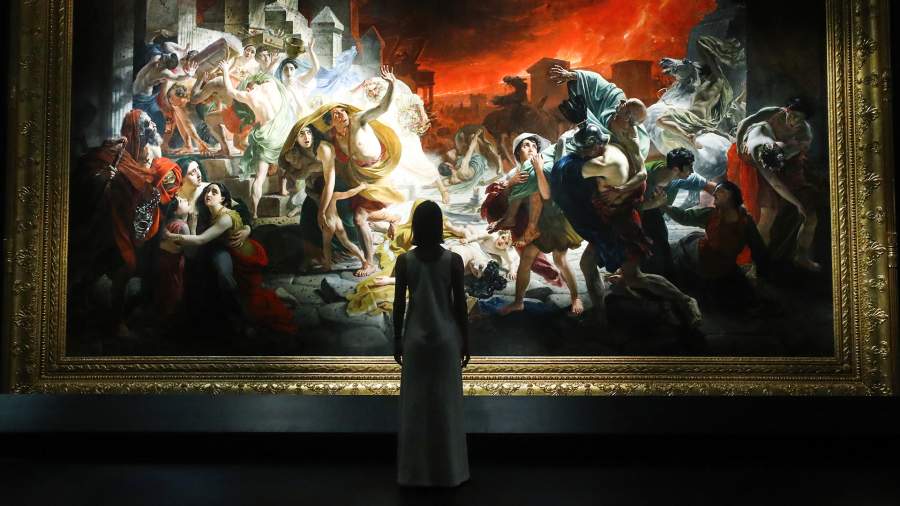
"The last day of Pompeii" — in Moscow. Along with it, there are many other works by Karl Bryullov from the state collections of Russia, Armenia and private collections. Following the Russian Museum, the Tretyakov Gallery organized a retrospective of the great painter. And although a number of key works are represented in both projects, it must be admitted that the GTG turned out to be a completely different exhibition. Izvestia rated her among the first.
Records, Carl!
Shortly before the opening of the Moscow retrospective, the Russian Museum reported on the attendance results of its "Great Charles". With a crowd of 477,000, the exhibition proved to be the most popular in the history of the institution and an all-Russian record holder over the past five years. Even the high cost of tickets did not prevent popularity: 900 rubles on a weekday, 1000 on a weekend (although discounts were introduced towards the end).
At the Tretyakov Gallery, the price will always be the same — 900 rubles (if there are no benefits). And, of course, it's very interesting to compare the results with timing later. On the one hand, the echo of the success of the St. Petersburg project will clearly play into Moscow's hands. On the other hand, the off—season is ahead, when the townspeople will leave for dachas and vacations; besides, many have already visited the exhibition in the Northern capital and it is not a fact that they will want to go to the same name again.
However, it is worth going anyway, even for those (and maybe above all those) who have seen the exhibition at Mikhailovsky Castle. The Tretyakov Gallery staff made completely different accents, showed many things differently, exhibited what they did not exhibit in the Russian Museum, and the architectural and design solution here is radically different. The latter is both a plus and a minus at the same time.
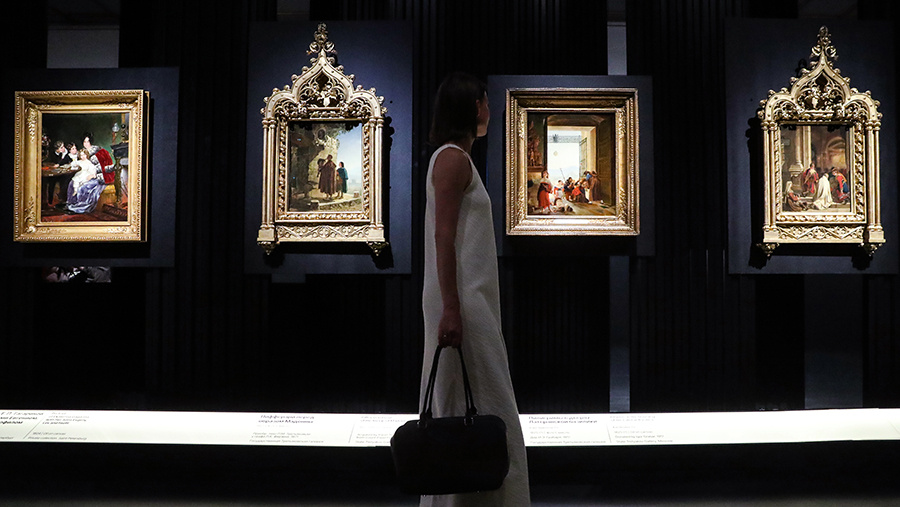
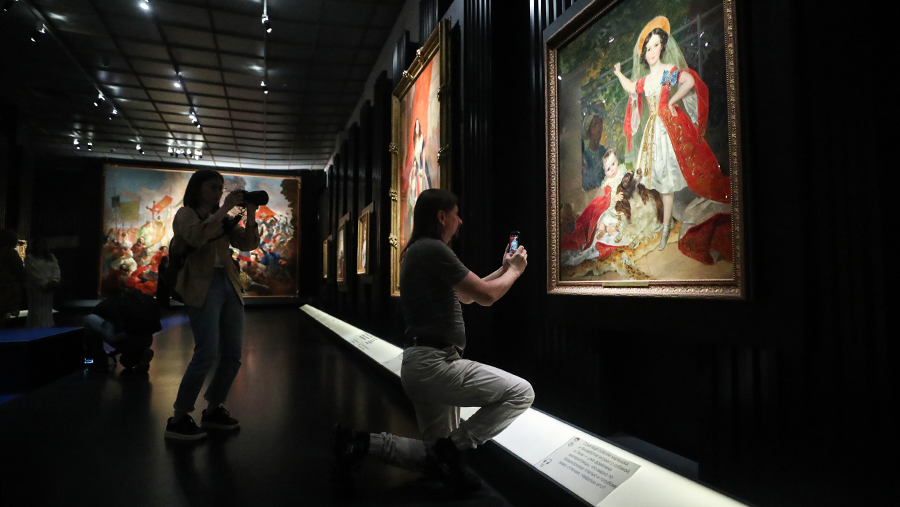
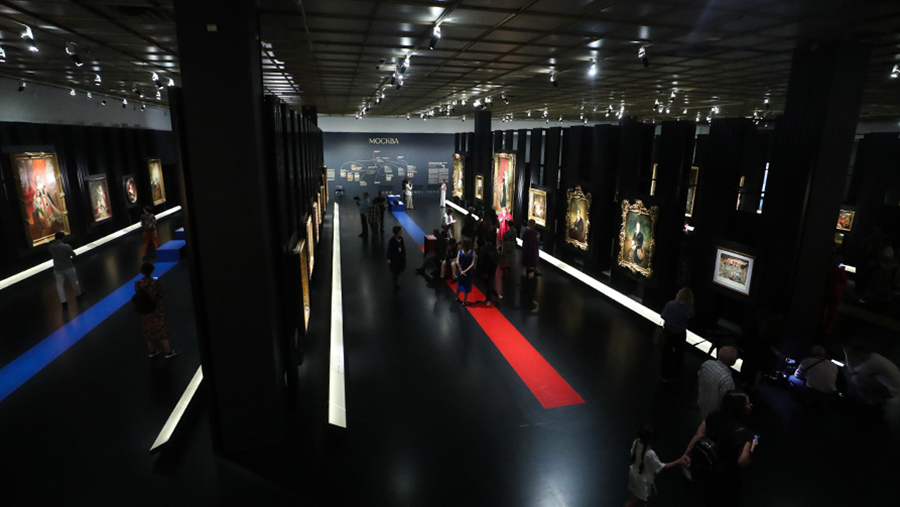
Yes, Bryullov's paintings looked very impressive in the palace interiors — this is literally her native habitat. Moscow contrasted the imperial conservatism and splendor of St. Petersburg with a minimalistic quasi-colonnade in fashionable semi-darkness. All things are distanced from each other, captured by rays of light. And it helps to appreciate art as such — without any outside influences. Instead of a holistic impression ("wow, it's beautiful wherever you look!"), focus on specific works.

Battle of the Giants
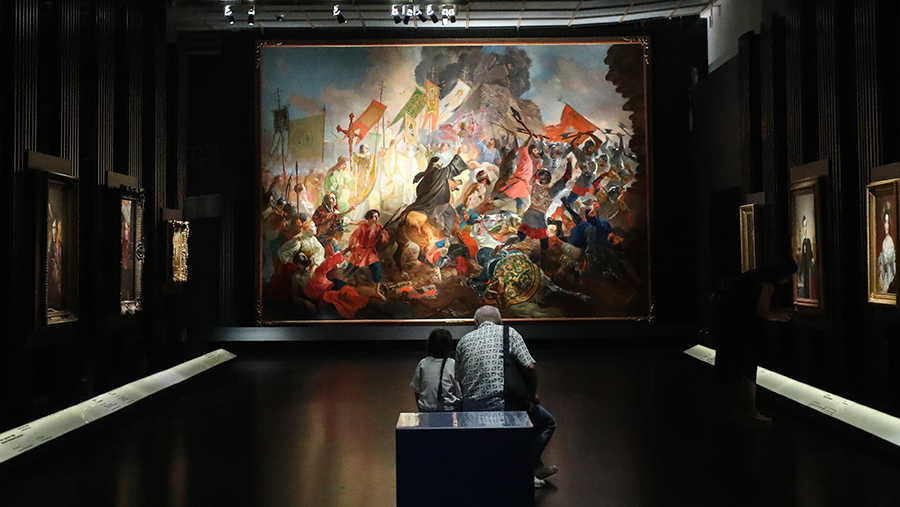
The exhibition is located in the New Tretyakov Gallery, the very hall where all blockbusters used to take place, from Serov and Aivazovsky to Polenov and Vrubel. This space is completely neutral, although it has one advantage: a balcony with a view of a large wall. It was there that the restored curtain of the Polovtsian Dances was hung at the Roerich exhibition. It would be logical now to place there the "Last Day of Pompeii" or the grandiose ceiling of St. Isaac's Cathedral, one of the pearls of the "Great Charles" at the State Museum of Fine Arts. But no, the ceiling lamp did not come to us at all, and "The Last Day of Pompeii" was placed at all unobviously, putting it next to "The Siege of Pskov by Polish king Stefan Batory in 1581" — another Bryullov giant.
From the point of view of the impact on the viewer, such a decision is at least controversial. It was no match for the powerful dramatic reception of the Russian Museum, when we climbed up a narrow corridor and at the end of the way the main creation of Bryullov opened in all its splendor. Admittedly, the juxtaposition of two giant canvases side by side is losing for both of them. "The Last Day of Pompeii" loses its exclusivity, and in "The Siege of Pskov" the compositional imperfection becomes all the more obvious.: the artist himself considered this thing a failure.
In Mikhailovsky Castle, although they were not far from each other, they were still in different halls. They were pointedly separated in space. At the Tretyakov Gallery, it's like we're being asked to figure out why one thing is a masterpiece and the other isn't. And this, perhaps, is the essence of the Moscow project as a whole.

Creative cuisine
At the State Tretyakov Gallery, they look at Bryullov with the eyes of a scientist, an art critic. For example, there are many more sketches of the "Last Day of Pompeii" (although for some reason some of them were sent to a completely different part of the hall, as far away from the canvas itself as possible). Moreover, the museum made a film where, using the example of preliminary studies, they tell in detail how the textbook composition grew and polished.
Next, a separate section — on the very balcony transformed into a corridor — is devoted to the unfinished works of Bryullov. The artist was known for often abandoning his work. For viewers who are deeply interested in art, this is a rare opportunity to get into the studio of a genius, to see with their own eyes how his image was formed. Here, for example, is a sketch of a "Horse": the front legs are outlined, there are no hind legs at all, but the muzzle with expressive eyes and the fur on the neck are written out with all care. Or "Sleeping Juno and the Park with baby Hercules." The piquant plot: the naked beauty and the crumpled pillow under her clearly interested the painter much more than the rest of the characters.
The topic of creative cuisine includes a section dedicated to the paintings of St. Isaac's Cathedral. Instead of a ceiling lamp, Muscovites will see a lot of sketches of individual characters and sketches of a number of group compositions, where, for example, the faces are not worked out. That is, it is rather the path to a masterpiece, rather than the masterpiece itself.

Travel from St. Petersburg to Moscow
Coincidentally or not, the rhyme here reads with the theme of the path, which has become the key to the entire exhibition. The name of the project is "Karl Bryullov. Rome – Moscow – Petersburg" just points to the geographical component — the desire to show the work of the master through reference to important cities and regions for him. It's clear with St. Petersburg. But you can't do without Italy when talking about the most Italian painter in Russia. And even without Moscow, where he lived for several years (and, by the way, met Pushkin), although this paragraph in the title looks more like an allusion to the current arrival of Bryullov's legacy in the capital, led by "The Last Day of Pompeii."
Whether to consider the famous "Horsewoman" opening the exhibition as another "road" hint is up to the viewer to decide. This has already become a trademark for the Tretyakov Gallery: at the beginning of the blockbuster, they put on the most hit, most iconic canvas of the hero from their own collection, whether it be Vereshchagin's "Apotheosis of War", Vrubel's "Swan Princess" or Bryullov's "Horsewoman". Although, let's note, you have to reach it by walking along a long wall. Well, who said that everything should be in the palm of your hand?
In general, one can argue for a long time which Bryullov exhibition turned out to be better — Moscow or St. Petersburg, where the design is more correct and the drama is more advantageous for the material itself. But in the end, it's not that important. The main thing is that the "Last Day of Pompeii" arrived in Moscow (for the first time — in a restored form). That we saw a number of works that were not exhibited in the Russian Museum, including those from private collections. That this is just a different view of Bryullov — less "theatrical" and more scientific. It's been a long time since these avant-garde-oriented walls have seen such a concentration of intoxicating "melodic" classical beauty. So, anyway, we have to go. And it is better not to postpone the meeting with Pompeii until the last day. The queue for Serov may well be reincarnated in the queue for Bryullov.
Переведено сервисом «Яндекс Переводчик»
