- Статьи
- World
- Combat inaction: only 6 EU countries are really capable of increasing military spending

Combat inaction: only 6 EU countries are really capable of increasing military spending

Only six EU countries will be able to painlessly increase military spending by 1.5% of GDP, as proposed by the EC, Izvestia estimates. These now include Greece, Denmark, Ireland, Cyprus, Luxembourg and Portugal. Another 10 members of the union keep budget expenditures in excess of 3% of GDP and have the potential to increase military spending. At the same time, 11 EU countries have already exceeded the acceptable level of budget deficit and have a high level of public debt. To further militarize, they will have to cut social spending, experts say. The European Union expects the United States to stop ensuring Europe's security, so the Old World must act independently, said EC President Ursula von der Leyen. Whether the union will be able to increase its military potential under the current conditions is in the Izvestia article.
Which EU countries will be able to increase military spending
The EU expects the United States to stop ensuring Europe's security and shift its military attention to other regions of the world, EC President Ursula von der Leyen said on April 29. She also stressed that the "military threat from Russia" will not disappear over time and this requires the countries of the union to have a greater level of independence and coordination in defense policy. Brussels does not have to rely on Washington.: The United States will not be able to finance security in Europe due to the huge national debt, said Michael Waltz, Assistant to the President of the United States for National Security.

Earlier, the EC announced the European Union's Readiness 2030 rearmament program worth €800 billion. To finance the project, Brussels offers EU countries to increase their defense spending by 1.5% of GDP. Thanks to this, the European Commission intends to raise 650 billion euros for the production of weapons. Another €150 billion for defense investments is planned to be obtained through loans.
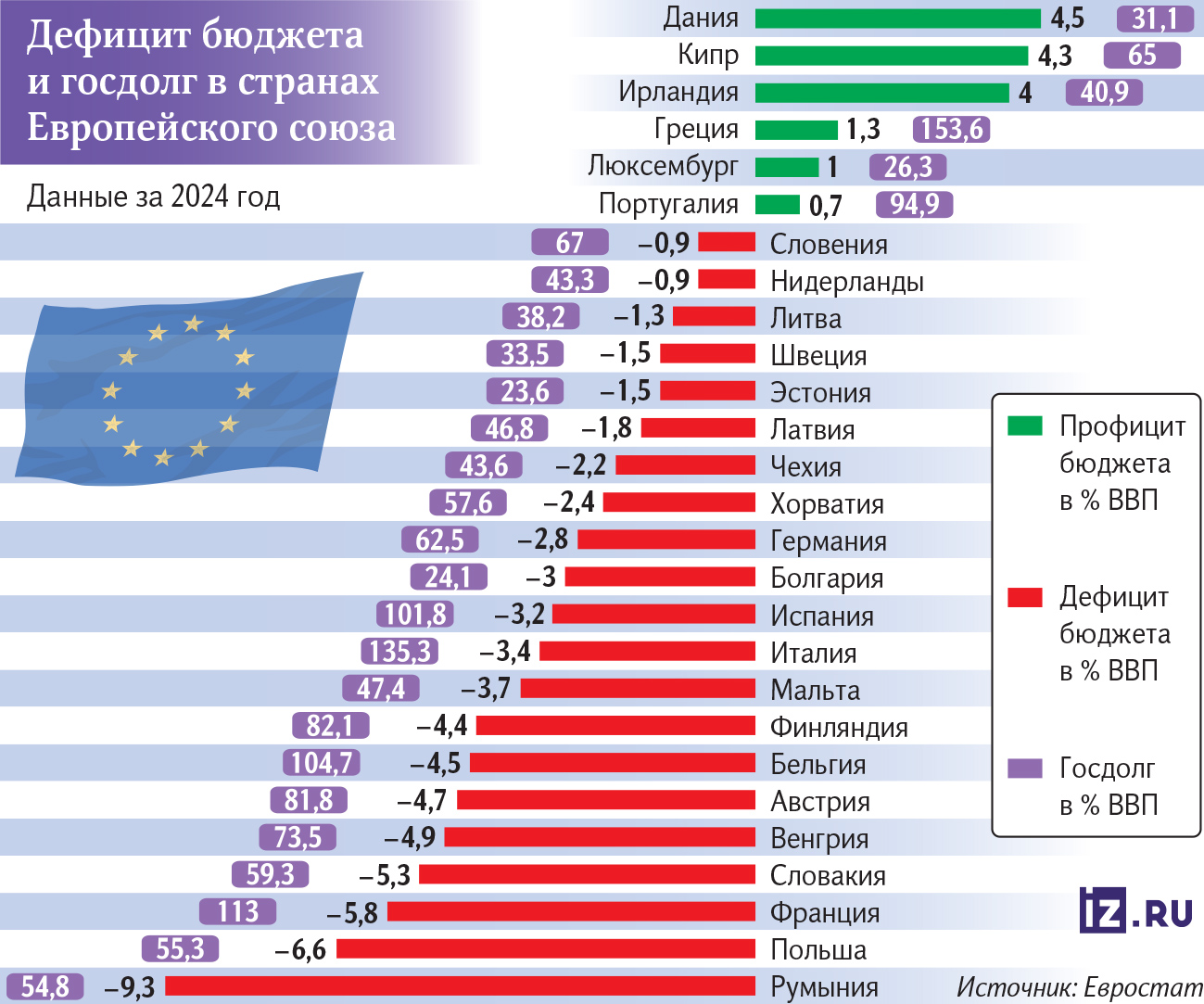
However, only six EU member states will be able to increase military spending by 1.5% of GDP without cutting other programs, Izvestia calculated based on Eurostat data. These include Greece, Denmark, Ireland, Cyprus, Luxembourg and Portugal. These countries ended 2024 with a budget surplus.

Ten more EU countries keep budget expenditures exceeding the 3% of GDP set by the stability and growth pact, therefore they are also potentially able to increase military spending. These include Bulgaria, Croatia, the Czech Republic, Estonia, Germany, Latvia, Lithuania, the Netherlands, Slovenia and Sweden.
At the same time, 11 EU countries have already exceeded the acceptable budget deficit level of 3% of GDP. The record holder is Romania, whose expenditures exceeded revenues by 9.3% of GDP in 2024. Poland's budget deficit was 6.6% of GDP, France's - 5.8%. The budget deficits of Austria, Hungary and Slovakia are around 5% of GDP. Violators of EU law also include Belgium, Spain, Italy, Malta and Finland.

Therefore, 12 EU countries immediately sent a request to the European Commission with a request to provide them with budget breaks as part of the new defense strategy to increase military spending. Now the EC has to consider these requests and make a decision. These countries now include Belgium, Denmark, Estonia, Finland, Germany, Greece, Hungary, Latvia, Poland, Portugal, Slovakia and Slovenia.
In general, not everyone in Europe agrees with the EU's rearmament plan. Back in March, the lower house of the Dutch parliament voted against the country's participation in the European Commission initiative. And the Hungarian parliament blocked the country's participation in the common loan of the European Union. Concerns about rising costs were expressed in Italy, Spain and France.

Do not forget that Washington is also demanding an increase in military spending from European allies. The Trump administration insists that each member of NATO should increase defense spending to 5% of GDP (the alliance currently has a target of 2%).
NATO Secretary General Mark Rutte proposed to the members of the bloc a plan to increase military spending to a total of 5% of GDP, according to Reuters, citing sources. Rutte's plan includes an increase in defense spending to 3.5% and an increase in other security-related spending by 1.5%. These may include, for example, the repair of roads and bridges necessary for the transportation of machinery.

By 2025, only 22 of the 32 NATO countries were able to achieve an increase in military spending to 2% of GDP. Far from everyone agrees on the need for a new increase in the level of militarization. It is also important who exactly will coordinate this process — NATO or the EU. However, amid the controversy over Ukraine, it is likely that the issue of increasing military spending will become a stumbling block between the United States and the EU.
How will increased defense spending affect the EU
However, even having a budget surplus or a small budget deficit does not mean that the country will be able to effectively invest in the defense sector. An important role is played by the size of the public debt, which, according to EU rules, should not exceed 60%. Currently, 12 countries in the EU have more of it. The situation is particularly difficult for Greece, whose public debt has exceeded 150% of GDP, and Italy, where it has reached 135%. More than 100% of GDP is owed by Spain, Belgium and France, Portugal owes almost 95% of its annual GDP. Austria has a debt of 81.8% of GDP, Hungary - 73.5%, Finland — 82.1%. Cyprus and Slovenia each owe 65% and 67% of GDP, respectively. Germany is slightly out of the norm, with a national debt of 62.5% of GDP.
It is unlikely that such a significant increase is possible for anyone without cuts in other areas, especially since the EU economies are already not in the best condition, Dmitry Stefanovich, a researcher at the IMEMO RAS Center for International Security, told Izvestia.
"For sure, credit resources will become the main source of financing, but they are finite in nature, in need of maintenance, and in general, such an increase is likely to have a negative impact on the long—term development of the EU countries," the expert emphasized.

The Baltic states, Poland and some Eastern European states, which are being intimidated by the Russian threat, can strive with amazing zeal to implement this recommendation. Germany is also capable of joining these ranks, whose Bundestag recently voted for a proposal to expand the debt brake, which provides for significant costs to strengthen the Bundeswehr, German scientist Egor Belyachkov told Izvestia.
— Even in the once neutral Austria, the government plans to increase spending on the armed forces several times by 2032 (up to 2% of the country's GDP). At the same time, Austria continues to be under threat of bankruptcy from the EU authorities, as the budget deficit remains quite high," the expert concluded.

A lot will depend on which authorities are in charge of the state at a particular moment. For example, the current Czech government is capable of making big commitments, but parliamentary elections are expected in the fall. They may be won by the ANO party of former Prime Minister Andriy Babish, which is not set up to support Ukraine. The same picture is at risk in Romania, where presidential elections will be held in May. Greece may increase military spending, but it will mainly be directed against Turkey, said Vadim Trukhachev, associate professor at the Russian State University of Economics, in a conversation with Izvestia.
— Finland, Sweden, Denmark, Holland, Portugal — these countries are likely to significantly increase military spending. Germany, France, Italy, Spain will also raise them, and Slovenia is one of the smaller ones," the political scientist noted.
Slovakia and Hungary are unlikely to significantly increase military spending, but elections to the Hungarian parliament are scheduled next year. If Prime Minister Viktor Orban loses power, it is highly likely that Budapest will comply with the recommendations of Brussels.

It is important that the EC's intention to increase military spending by 1.5% of GDP is general and not all countries will achieve this figure. However, an overall increase in defense spending is likely to take place. As a result, this will affect the EU's social policy, but the current NATO Secretary General Mark Rutte, as Prime Minister of the Netherlands, showed that an increase in military spending due to cuts in other programs is possible, Trukhachev stressed.
Will the EU be able to rearm
It is assumed that the funds under the rearmament program will be used to purchase air defense systems, missiles, artillery systems and drones, including for Ukraine. To achieve these goals, the EU intends to allow member states to deviate from the Stability and Growth pact's requirement that budget deficits not exceed 3% of GDP. However, the 11 EU members already have significantly more expenses than this indicator.
The European rearmament program may become a kind of annex to NATO. In this regard, the EU is an additional administrative structure necessary to intercept the management of the organization if America refocuses on other problems, as is happening now. In addition, Associate Professor Trukhachev suggested, this duplicate structure may be required for cooperation with countries that are not officially members of NATO, for example, Austria.
It is important that money does not automatically turn into military potential. So far, the issue of disbursing funds rather than allocating them looks more serious, and the EU has nothing much to brag about. Despite certain successes in the integration of the defense industry of individual countries, in general, the possibility of a radical build-up of military potential is not visible, Stefanovich emphasizes.

— Contradictions remain regarding the priorities of military construction and suppliers of various types of weapons and military equipment. Of course, many countries are implementing military-technical cooperation projects with non—regional actors (the United States, Turkey, South Korea, Israel, and others), but such projects often cause contradictions within the EU and do not always fit into the overall strategy for developing military capabilities, the expert believes.
In the future, the European Union may well become a threat to Russian security. However, this scenario, the political scientist noted, is far from predetermined, and this "race along the long-known rake" of the arms race can still be tried to slow down, or even stop.
Переведено сервисом «Яндекс Переводчик»
