Skip the shot: unemployment is falling only in the Volga region and the Far East


Against the background of a general increase in unemployment, which began again in 2025, it continued to fall in some regions — in the Volga region and the Far East, the Central Bank recorded. The shortage of personnel is more acute in some regions, because people from there, all other things being equal, leave for the capitals, and enterprises still need staff in a growing economy. Such a low unemployment rate in the whole country leads to an increase in salaries, which employees benefit from. On the other hand, the business shifts personnel costs into prices, resulting in inflation. How long the shortage of personnel will last is in the Izvestia article.
Unemployment in Russian regions
The unemployment situation in the regions is uneven, it follows from the data of the Central Bank, which was studied by Izvestia. In February, the indicator fell in the Far East (from 2.2% to 2.1%) and in the Volga-Vyatka region (from 1.7% to 1.6%). The regulator divides the subjects based on its own regional division, however, in general, these districts correspond to the Far Eastern and Volga Federal Districts.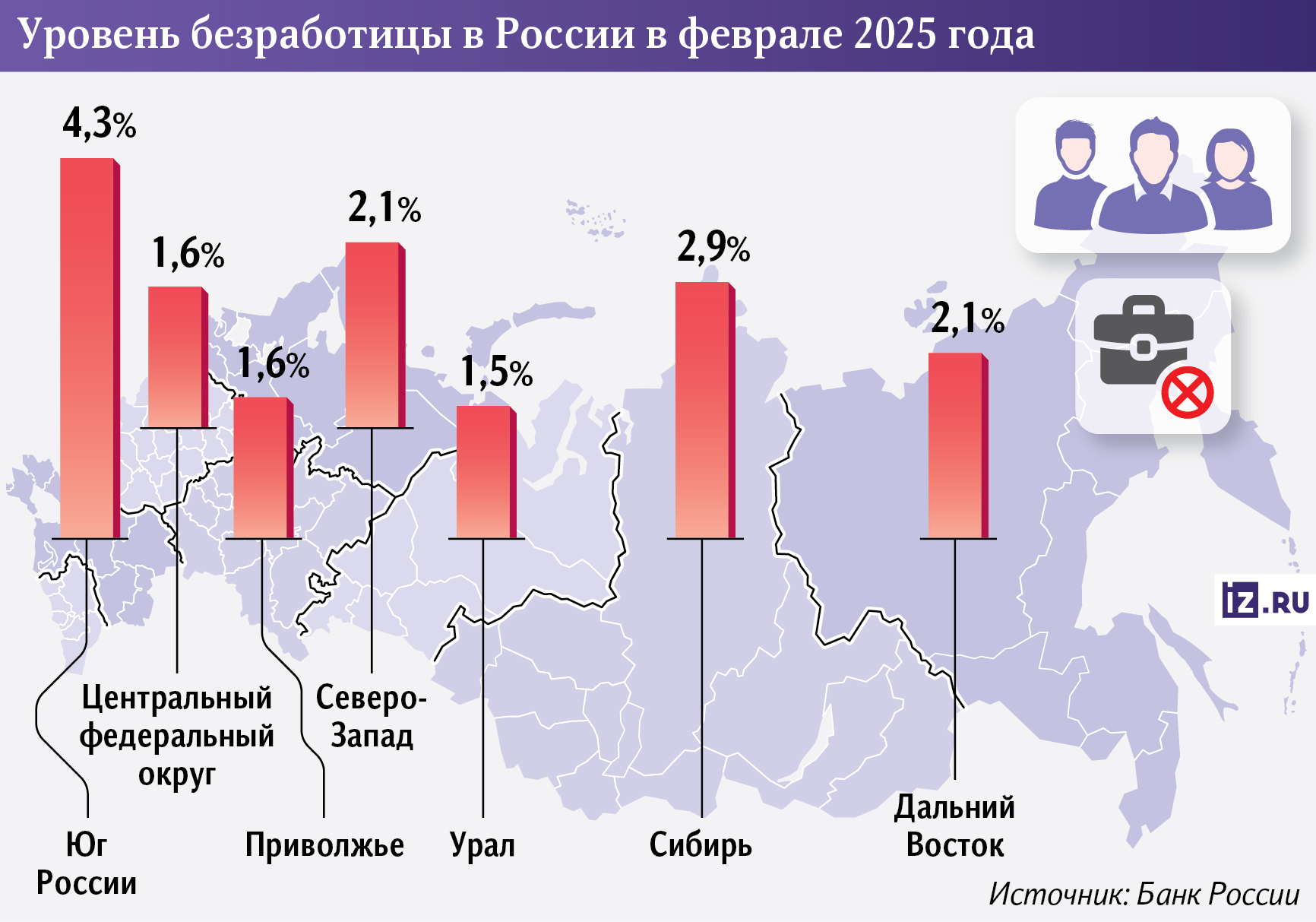
According to the Central Bank, the highest unemployment in February was in southern Russia (4.3%) and Siberia (2.9%). The lowest rate was in the Urals (1.5%) and only slightly higher in the central part of Russia (1.6%).
At the same time, the overall unemployment rate in the country began to rise this year for the first time since 2023. In January, the figure was 2.4% against a record low of 2.3% in December. The following month, it remained at the same level, according to Rosstat data.
Unemployment is currently at a low level: most job seekers have a place to work today, the SuperJob press service reported. People still enter the labor market in search of better conditions, but in general, the demand for employees is much higher than the supply.
First of all, the aging of the population affects the reduction of labor resources — some workers are already retiring, and the new generation is quite small due to the demographic pit of the 1990s, explained Farida Mirzabalayeva, associate professor of the basic Department of the Russian Chamber of Commerce and Industry "Human Resource Management" at Plekhanov Russian University of Economics. Secondly, partial mobilization and a certain outflow of qualified personnel outside the country have an effect. She added: at the same time, the growing need for import substitution and the development of defense plants and dual-use enterprises are attracting workers to themselves.

The situation has begun to level out on the national average, but perhaps this is the influence of seasonal factors, suggested Anna Gondusova, head of Product Development at Alfa Capital Management Company. More significantly, the fact that recently, with the barrier level of the key interest rate, the cost of lending to companies has proved to be unaffordable, which has limited their opportunities for development and expansion. This put on a certain pause the replenishment of staff and the constant indexation of salaries.
Why is the indicator falling in the Far East and the Volga region
The regional imbalance in the labor market is reflected in the difference between the supply and demand of labor. The leading regions with the highest population and the most active demand for labor are the Central, Volga and Northwestern Districts, SuperJob added.
At the beginning of 2025, unemployment continued to fall in the Far East and the Volga region, as the demand for labor from local companies continues to be stable, but people from there, all other things being equal, leave for the capitals, since the infrastructure and standard of living in large cities are usually better, explained Alexey Tarapovsky, founder of Anderida Financial Group.
In particular, logistics has been actively developing in the Far East over the past few years due to the reconfiguration of trade flows to the Asian region. And the Volga region is generally a large region close to the center of Russia, where 25 million people live, and both production and services are highly developed there, the expert added.
In addition, some labor markets, for example in the Far East, have been experiencing a shortage of personnel for a long time, Farida Mirzabalayeva from Plekhanov Russian University of Economics continued. Under the current conditions, even with a slight outflow of specialists, they respond by reducing the unemployment rate. These markets are less attractive for a number of reasons — salary levels, infrastructure development, development and employment prospects, the expert added.
Therefore, in order to increase the effectiveness of employment policy, it is necessary to take into account regional peculiarities and to develop targeted measures aimed at supporting specific industries and groups of the population, says Veronika Malygina, an independent HR expert.
Where are salaries growing the most now
The greatest shortage of personnel is now observed in construction. It is this area that ranks first in terms of the number of vacancies, the SuperJob press service reported. This is largely due to a decrease in the flow of migrants. Industry is in second place in terms of demand for personnel. The most sought—after category is skilled workers. Next are the transport and logistics industry, retail and IT.
The wage race continues, especially in industry and construction, SuperJob emphasized. The growth rate of rewards there is higher than in IT.
Another important feature of the labor market today is the discrepancy between the structure of supply and demand in terms of qualifications, the recruitment agency added. Most of all, workers and handymen are needed, and people with higher education predominate among applicants. As well as professionals with at least five years of experience who are looking for a more profitable location.
Despite the fact that unemployment has started to rise slowly in Russia as a whole, it is still far from a "balanced" level. Before the pandemic and the imposition of sanctions, experts called 4-6% unemployment the norm in the Russian Federation, and significantly more in oversupplied areas, Farida Mirzabalayeva from Plekhanov Russian University of Economics reminded.

On the one hand, low unemployment means an increase in household incomes, stability, and consumer confidence, said Alexander Stepikov, an independent HR expert and founder of the EQ school. On the other hand, these are huge challenges for business. There are not enough people, so we have to increase motivation and review internal processes. It is especially difficult for small companies in this regard.: they have fewer resources and opportunities to retain the team.
Because of this, the role of large business structures, which are better prepared for such conditions, is now increasing. And small businesses will either have to adapt or leave the market, the expert concluded.
In the end, the business compensates for the increase in personnel costs by increasing prices for the final product, Veronika Malygina summarized. And this means an acceleration of inflation. The Central Bank is trying to stop this trend by raising the key interest rate, which is already at a record high of 21%.
However, in 2025, the unemployment rate may still rise to 2.6%, analysts surveyed by the Central Bank predicted. Then the labor market will begin to come into balance, Izvestia wrote.
Переведено сервисом «Яндекс Переводчик»
