
Cash cleared: cash volume in 2025 dropped to a record in three years

The volume of cash in circulation in early 2025 fell by more than a trillion rubles, to 17.4 trillion. This is a record decrease in three years — since the beginning of the CBO, follows from the statistics of the Central Bank (it was analyzed by Izvestia). The reason is the high key interest rate, which is why people carry money for deposits. On the other hand, they fear that the funds will become worthless due to high inflation. Non-cash payments are also developing, in particular, banking services in new regions, for which cash has been mainly printed in recent years. Cash is dispensed with during quieter periods when there are no economic shocks. Whether the volume of cash in circulation will continue to decrease and how the Central Bank's rate will affect it is in the Izvestia article.
Why has the volume of cash in circulation dropped in Russia
In Russia, the volume of cash in circulation has decreased significantly. From January to April 2025, the indicator fell by 1.08 trillion rubles, to 17.4 trillion, according to statistics from the Central Bank. This is a record decrease since the beginning of the special operation in Ukraine. Then, from March to June 2022, the volume dropped by 1.8 trillion rubles after a sharp increase.

The current reduction in the volume of cash in circulation differs from the seasonal dynamics of previous years, the press service of the Bank of Russia confirmed to Izvestia. They explained that this is due to attractive interest rates on deposits, which increase the population's propensity to save. The yield on deposits exceeds both actual inflation and expectations for price increases, the Central Bank stressed.
At the peak of the rates, the maximum yield on deposits reached 24%, and on individual offers — up to 30%, the VTB press service reported. They added: now you can deposit money at 20%.
The annual increase in ruble deposits of the population amounted to 30%, the Central Bank said. At the beginning of 2025, the volume of deposits of Russians reached 39.5 trillion rubles, said Kristina Aksenova, head of the department for the development of digital channels and bank cards at BBR Bank. Over the past year, it has grown by almost 11 trillion.
At the same time, since the beginning of 2025, the amount of citizens' funds in banks has increased by about 1.5-2 trillion (they are growing not only due to cash, but also due, for example, to salaries), added Vladimir Chernov, analyst at Freedom Finance Global. According to him, this is also due to the attempts of the population to protect their savings from high inflation.
In 2025, the Central Bank predicts a 7-8% price increase, the AKBF investment company (formerly Ak Bars Finance) recalled. This reduces the purchasing power of cash and encourages citizens to look for ways to save money, including bank deposits and investments.

The appearance of high-yield savings accounts could also help increase the inflow of money from the population, since such a product allows you to maintain the liquidity of investments, said Vladimir Evstifeev, head of the analytical department of Zenit Bank.
The trend of Russians' growing interest in savings products was also confirmed by the Postbank. Since the beginning of 2025 alone, the number of deposits opened by customers in the bank has increased by 44%. And the average amount increased by 4%, to 485 thousand rubles, said Alexey Okhorzin, Deputy President and Chairman of the Board of the Postbank. However, according to him, customers' attention has shifted from short-term to medium-term products.

After the start of the special military operation and the imposition of sanctions, there was a record demand for cash (1.4 trillion rubles for February 25 alone). The central Bank sharply raised the key rate to 20%, which led to deposits with yields even higher than this level. As a result, the volume of cash in circulation dropped sharply due to the fact that the Russians sought to record high returns amid uncertainty, the AKBF recalled.
In 2022, the effect of the fall in cash volume was more pronounced, because the Central Bank raised the key rate strongly and suddenly - immediately from 9.5% to 20%, explained Vladimir Evstifeev from Zenit. In addition, it took only five months for it to return to pre-crisis levels. The current situation is characterized by the duration of the key rate increase cycle (from July 2023) and its retention at the level of 21% (from October 2024).
In addition, in 2022, the population returned previously withdrawn cash to banks, which increased the reduction effect, the AKBF added. In 2025, there were fewer accumulated reserves, so the effect was less pronounced.

Presumably, now people have begun to trust the banking system more and believe that the situation is less risky today, said Vasily Kutyin, Director of Analytics at Ingosstrakh Bank. He clarified that financial organizations successfully cope with geopolitical risks and have learned how to work effectively in difficult macroeconomic conditions.
When will the Central Bank lower the rate and how will it affect cash?
The share of cash in savings and investments (excluding pension and insurance products) is now at a historic low over the past six years, VTB stressed.
The development of financial technologies has a long-term impact on the volume of cash in circulation, which is why non-cash payments are growing, the press service of the Central Bank noted. Citizens are getting used to paying by wire transfer, payment services and e—commerce are actively expanding - we can say that cash is becoming "out of fashion," agreed Kristina Aksenova from BBR Bank. The active expansion of loyalty programs for customers also encourages the use of card payments.

At the same time, this is a plus for the state, as transferring the maximum possible amount of transactions to non-cash allows for greater transparency, complicates illegal transactions and increases tax collection, Kristina Aksenova added.
Part of the decrease in cash could be due to the improvement of the banking system in new regions, said Vladimir Chernov from Freedom Finance Global. He explained that after their annexation to Russia in 2022, a large amount of cash was released to secure them. However, now banks have actively introduced their services there, they have opened their branches there and developed digital services. Therefore, the cache is partially transferred to the accounts of citizens.
It is likely that after the Central Bank begins to reduce the key rate (and the market expects this in 2025), public funds in banks will continue to grow, predicts Vladimir Evstifeev from Zenit Bank. The fact is that Russians will try to fix the increased profitability of deposits in the medium term. However, after several steps to reduce the rate, the opposite effect may appear, and the amount of cash will begin to grow.

In 2025, the key rate will be at the level of 19-22%, and in 2026 it will drop to 13-14%, according to the AKBF. In 2025, they expect cash to grow by no more than 1 trillion rubles for the entire year.
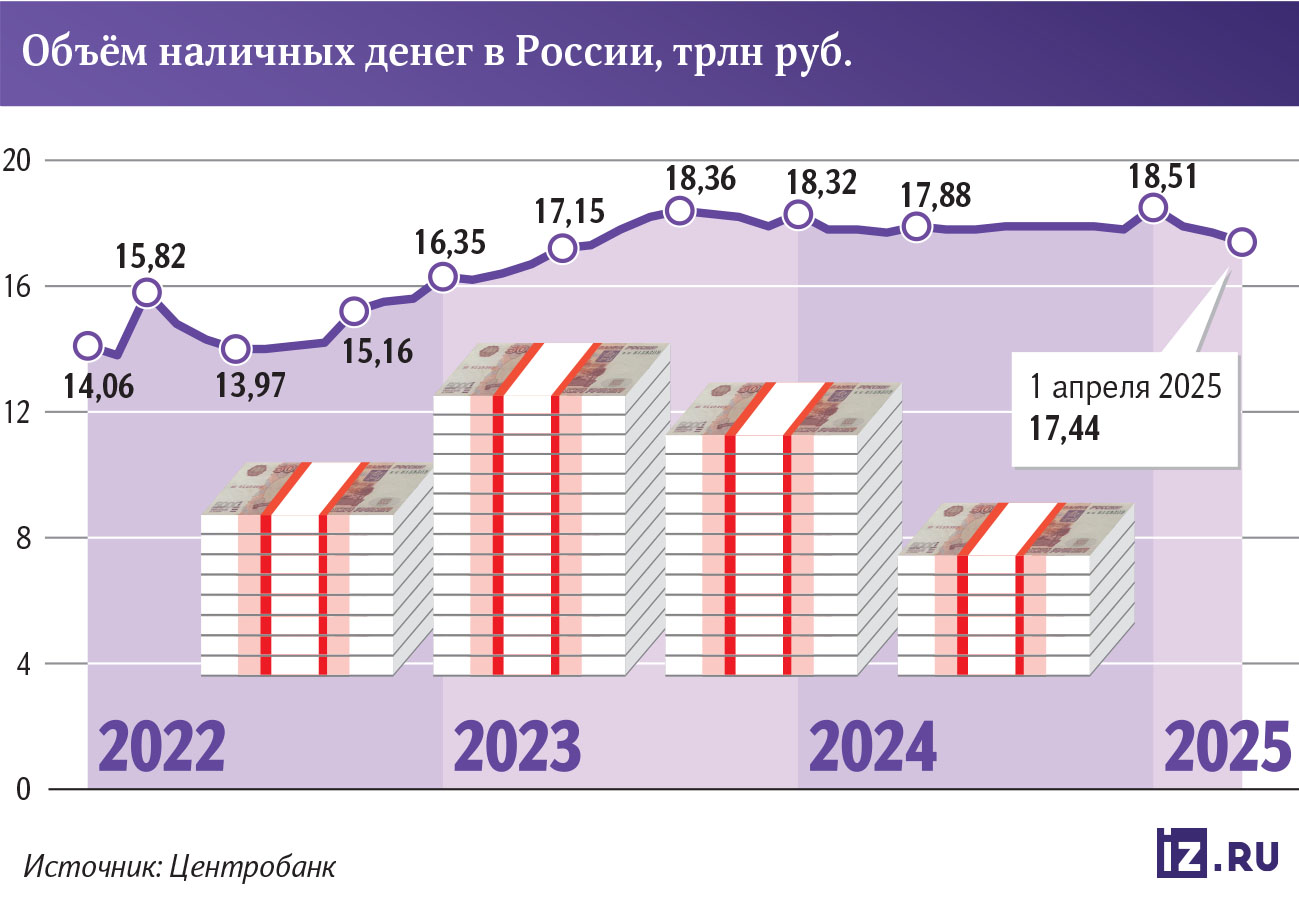
However, according to Vladimir Chernov of Freedom Finance Global, by 2026, the volume of cash in circulation may, on the contrary, decrease to 16-16.5 trillion rubles if current trends continue. At the same time, a complete abandonment of cash is unlikely, because part of the population, especially the elderly and in remote regions, continues to use physical money, the expert explained.
Переведено сервисом «Яндекс Переводчик»
