
The Hopeless Narrator: Where Ajax's brother sailed

"The Voyage of the Tevsier" by Roman Shmarakov, one of the contenders for the title of "Russian Umberto Eco", was announced as a reinterpretation of the poetic chivalric "Novel of Three" written in the XII century by the French trouver Benoit de Saint-Maur. Critic Lidia Maslova presents the book of the week specifically for Izvestia.
Roman Shmarakov
"The Voyage of Tevsier"
St. Petersburg : Azbuka, AZBUKA Publishing House, 2026. 256 p.
Shmarakov places in the center of the plot the skilful, brave and cunning warrior Teusier, who after the war returns to his native island of Salemin to his father Talamon, alas, without his brother, who died at the walls of Troy — the much more hyped Greek hero Ajax, sung in the Iliad. Talamon reacts briefly to Teusier's lengthy account of Ajax's death: "Get up, go away." At first, Tevsier hopes to soften his father's anger, believing that "he is not to blame for the death of Ajax, because, he said, you cannot keep track of a person if he has lost his mind, because when his mind leaves him, cunning remains." However, when Talamon throws the first spear in the direction of Teusier's tent outside the city, the son realizes that his father's mood cannot be changed, and his reputation in his homeland is hopelessly damaged, and sails with his men wherever they look, saying: "Let's go where we are not known."
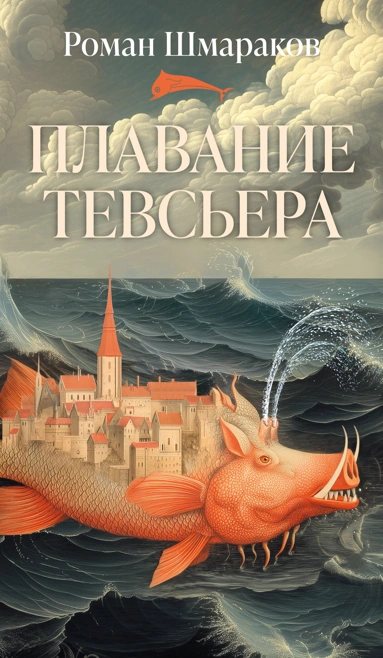
The voyage of the Tevsier as such ends very quickly, but paradoxically it continues: the land on which the shipwrecked hero is thrown turns out to be the back of a giant whale "swimming tirelessly" — it contains not only a diverse natural landscape, but also an extensive social infrastructure. You can imagine the size of a whale and the mores of its inhabitants from the story of an old-timer fisherman who met Tewsier: "... you and I are on its left side; if you go in that direction, you will reach the mouth by Saturday; just don't go there: the bridge is big in those parts, but there are few good markets. God created him that way, but I don't know why. A lot of people live on it: some were blown away by a storm, like you, and others were already born here; there are honest people, and there are all kinds."

A similar floating structure is vividly described in the fairy tale "The Hunchback Horse," but in general, the idea of a world resting on the back of a giant waterfowl is one of the most popular mythological archetypes that Shmarakov likes to play with, refreshing them, mixing them in unexpected combinations and wittily modernizing archaic linguistic elements. At the same time, thanks to Shmarakov's humorous manner of narration, well—thumbed old things begin to look like they've just been invented, and the moral of an old medieval fable or its accompanying arguments, "remarks aside," acquire a philosophical meaning that is quite relevant for any time: "I've known people who thought that fame was like sunlight on a dead man, and at the same time these are the ones who died in battle, as a decent person should; sometimes you get into such a mess that you don't even have time to remember your opinions."

The dramatic core of "Teusier's Voyage" is the hero's desire to avoid the fulfillment of a prophecy he did not like very much, which he heard in the forest from a "difficult bird", an arrogant and self—willed mythological creature with a female face, to which the hero broke his leg with a stone protecting two poor swineherds: "She has long settled in these parts, and with no one But she had no peace. She lived on robbery, and if you heard her screams at someone's wedding or childbirth, then this sign has never happened." In a couple of small chapters, into which the novel is divided, Tevsier is seriously concerned about an unpleasant prediction: "... this jackdaw told me things that I would like to avoid." But gradually, the threat looming over the hero is somehow lost sight of and forgotten amid the overlapping stories that secondary and third-rate characters rush to share, taking turns, and sometimes even vying with each other, in the role of an "unreliable narrator," questioning other people's "stories" and insisting on the truthfulness of their own. At the same time, the more unreliable the narrator looks, the more insistently he swears to be reliable: "... I'm just telling you how it was, without omitting or adding anything; that's what you should do when you talk to honest people, and there's nothing you can do about it."
All of Shmarakov's books are devoted to the study of various narrative practices and strategies in which the ability to mix truth and fiction in the right proportions is important. For example, we can recall the novel "Alkina" from 2021, which examines the technique and philosophy of public speaking from different angles. The characters of "Tevsier's Voyage" do not pretend to professional eloquence, they do not have the goal of demonstrating the magical power of words, they solve more utilitarian tasks or simply while away their allotted time. Sometimes the exchange of stories takes on the character of a competition (also a characteristic Shmarakian technique), for example, when a peasant selling chickens in high demand decides to give the advantage to the narrator who scares him the most. However, during the competition, the otters that got out of the river manage to eat the coveted chickens — ironically, which plays a man in Shmarakov as ruthlessly as in ancient Greek tragedies.

The trickster Tevsier himself does not strive for the reliability of the story, he is determined to remain incognito, and therefore, when asked by the inhabitants of whale's back about what he can do, he modestly answers, just in case, that "God has not mastered him in anything." In fact, the Trojan veteran skillfully wields not only his tongue, spear and sword (one of the final chapters describes his brilliant performance at the tournament under the pseudonym Knight of the Pawned Armor), but is ready to use as a weapon anything that comes up, for example, a bolt pulled out of an eyelet, and in extreme cases he knows how to do with a newly removed one. She was twirling a goat's leg: "Tevsier, seeing nothing better, wrapped his hand in some kind of cloth, grabbed the goat's leg and went to wave it left and right. Doroskalov's people rushed at him, who was with what, because it was pre-dawn and others were still dozing side by side, but no one was preparing to fight, but the Courier killed and burned many of those who meddled with him."

Tevsier also tries not to advertise his knowledge about the course of the Trojan War. In one scene, at the request of the audience gathered at dinner in the castle, the hero, like Chapaev, who illustrated the fighting with potatoes, presents his version of the fall of Troy using the example of a dish with game paste: "Teusier said that at first they set up their camp as far from the Trojan walls as the one over there. the pie, but then (and he motioned for it to move, and the people waiting for his story did it quickly), thanks to their valor and military skill, they approached the city closer and closer, and then they attacked him (and then he attacked the pie) and let's destroy everything that was in it, with After all, there's not much left of the city yet; that's about how it turned out, and anyone who says it was different is lying."

The theme of artistic lies is one of the main ones in The Voyage of Tevsier, where many obviously lying narrators emphasize their conscientiousness, proving it in various ways: "... and I'm not the kind of person to tell the most truthful story without any benefit to lie out of the blue." However, the biography of Tevsier illustrates in the most vivid way the benefits of lying, and not only material (as one of the characters in Alkinoy said, "a man who lies well should not be deprived of money"), but also existential: the more unreliable the narrator, the stronger and more reasonable his hope of escaping the dangers that lie in wait for a person in sailing on the stormy sea of everyday life.
Переведено сервисом «Яндекс Переводчик»
