
American Takeover: How the United States fought with Mexico

For two and a half centuries, there has been a country that we often refer to by the name of the continent — simply America. And all these years, the United States has been at war. With the Aborigines, sweeping away Indian civilizations, with the British, with the French and, of course, with the neighbors in America. On May 13, 1846, the United States declared war on Mexico. Izvestia recalled how it was.
The country of the Aztecs
Since the early years of the existence of the independent United States, American politicians and businessmen have been inspired by missionary ideas. They had no doubt that they had built an ideal society based on rational laws — and they must carry this "truth" the further the better. But the guiding star of the American "hawks" has always been profit. After all, the USA is, first of all, a country of big business. Politics and the army serve his interests in many ways.

Memorial to the Indians of Mexico, Nuestra Senhora de Guadalupe Basilica, pilgrimage site in Mexico City, Mexico, Central America
Mexico has been a colony of Spain for three centuries. At the beginning of the 19th century, this territory was shaken by uprisings, the driving force of which were mestizos and Indians, and the anti-colonial movement was led by Catholic priests.
Mexico, which gained independence from the Spanish Crown in 1821, initially had a larger territory than the United States. At the beginning of the 19th century, she owned the vast, almost uninhabited and fertile provinces of California, New Mexico and Texas, where thousands of immigrants rushed in search of profit. At first, they were satisfied that they had become citizens of Mexico rather than the United States. But these territories of the Mexican border provinces have long been of interest to Americans — even during the period of Spanish rule.

The first U.S. envoy to Mexico City, Joel Poinsett, proposed the incorporation of several Mexican provinces back in 1822. The Mexican authorities, of course, could not agree with these plans.

And then, of course, not by chance at all, curious events began. In the Aztec country, slavery was abolished earlier than in the United States. In Texas, wealthy immigrants from the United States refused to comply with this law. They needed slaves, whose descendants are now politically correctly called African Americans. They were not satisfied with their existence under Mexican law. In 1835, Texas, under the auspices of Washington, declared itself an independent state. It was a serious blow to Mexican statehood. The states were in no hurry to absorb Texas, but after ten years they still annexed it.
The Americans offered Mexico a deal. They intended to buy several Mexican provinces. They offered $25 million for rich California, and a modest $5 million for New Mexico. The Mexicans proudly refused. Then the heirs of George Washington began to look for a reason to invade a neighboring country.
Treasure Hunt
The war began with a provocation. American troops entered Texas and crossed the Rio Grande border River, where they came under fire from Mexican troops. US President James Polk angrily declared that Mexico had "invaded our territory and shed American blood on American soil." This was the reason that on May 13, 1846, on the seventieth anniversary of the establishment of the United States, the US Congress decided to declare war on its neighbors.

The Rio Grande River, marking the border between Mexico and the United States, is located at the northern tip of the Chihuahua Desert.
Initially, Mexico outnumbered its neighbors in terms of army size, although it was much inferior in terms of weapons and ammunition. But in a few months, the Americans managed to form not only well-equipped, but also numerous troops that were capable of large offensive operations. Thousands of volunteers joined the US Army. They dreamed of seeing the legendary "treasures of Montezuma" and settling scores with the former Spanish Empire. Everyone dreamed of getting rich on land piracy.
Mexico hoped for the help of Britain, which had long intended to rein in its former colony. But England helped them, mostly mentally.
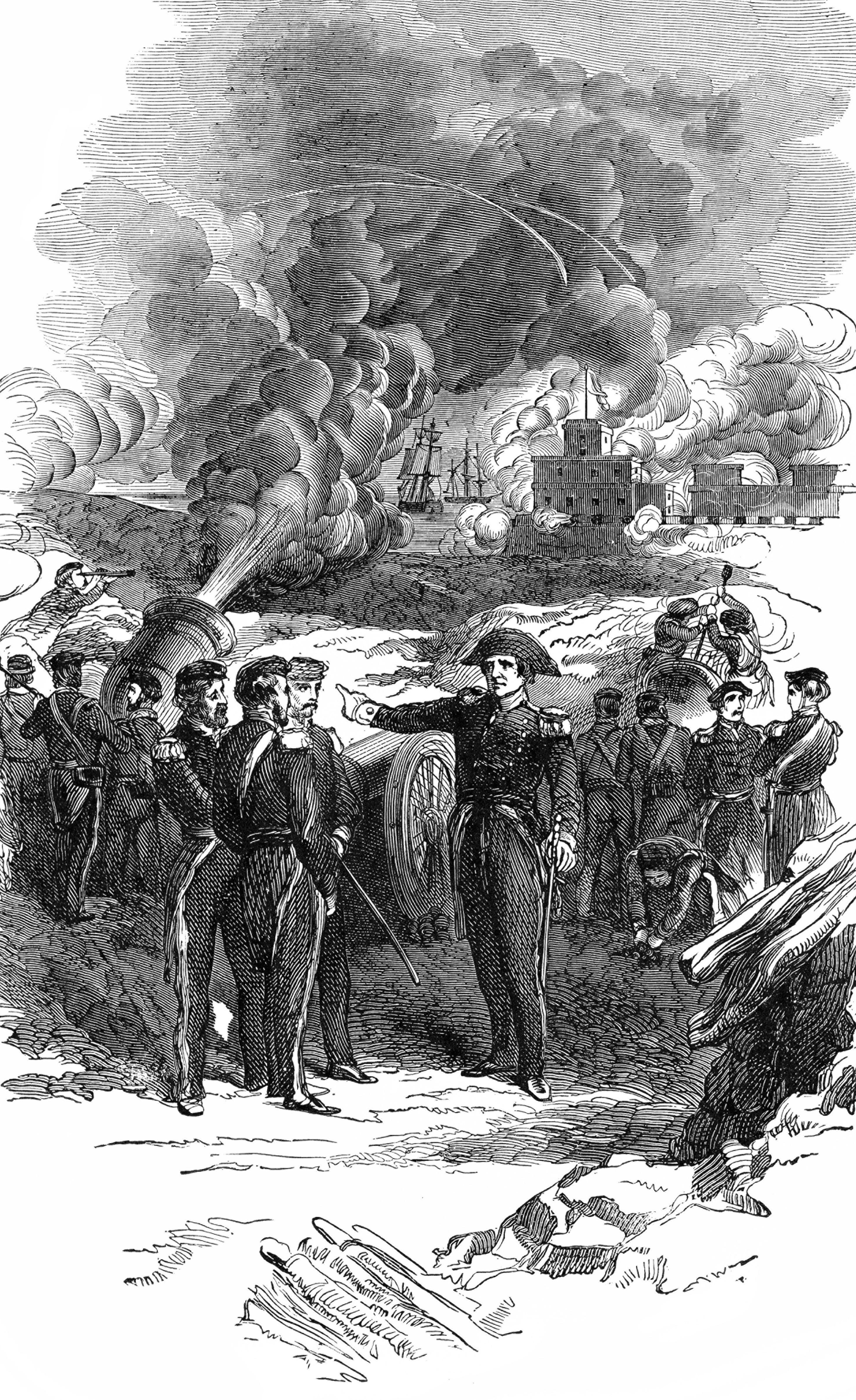
The significant superiority of the Americans in the navy had an effect. The Mexicans had no warships at all. They could not do anything against the raid of the American squadron in California. The Mexicans continued to resist. By the fall, they had retaken Los Angeles, the largest city in the region, with an unexpected guerrilla raid. The Mexicans held out there for several more months. During the negotiations, the United States demanded that more than two-thirds of Mexico's territory be transferred to them, not counting Texas. This would mean the collapse of Mexican statehood.
The "Mexican Bonaparte", General Antonio de Santa Anna, played an ambiguous role in the war. He conducted secret negotiations with the Americans, accepted offerings from them, signed treaties — and immediately violated them. In all of Mexico, he was the only one who could organize resistance to the invaders. But Santa Anna managed it with varying success. In addition, he had many opponents among the Mexican patriots. In September 1847, after stubborn fighting, he was forced to let American troops into Mexico City. The militia fiercely resisted on the streets of the city, unwilling to surrender to the mercy of the victors, but the forces were unequal.
At the peace talks in the city of Guadalupe Hidalgo, defeated Mexico was forced to cede to the victors the territory on which the American states of California, New Mexico, Arizona, Nevada, Utah, Colorado and partly Wyoming were established. The parties confirmed that Texas is part of the United States. As compensation, the Americans paid the Mexicans a small sum of $ 15 million. They went to pay off debts to European countries. After all, the Mexicans mostly bought weapons in the Old World.

The Mexican-American War. The American Victory at Buena Vista: Major Dix on the battlefield, February 22, 1846
Thus ended the largest war of conquest in the history of the United States. In the future, Americans treated the countries of Central and Latin America as their "backyard."
Hotheads in Washington demanded that all of Mexico be annexed to the United States as "incapable of independence," but the country retained formal sovereignty, while becoming politically and economically dependent on the United States for many years. There were calls in Washington for more radical calls to continue expansion to Guatemala. The military force should have been enough... But these plans did not come true: the Civil War between the North and the South began in the United States.

The "Mexican meeting" in Central Park. The year is 1856.
Mexico was in ruins. Indian uprisings broke out in several provinces. Rich landowners were on the verge of ruin. The struggle for power did not stop either. Coups and conspiracies have become a daily routine in Mexican politics for a long time. But the defeat had other consequences. The war made Mexicans feel like a people. After the battles and troubles, they felt the need to strengthen state power and legality, to protect their sovereignty. However, the Americans have maintained their influence in Mexico City for decades, bribing local elites, acting with sticks and carrots. What is the value of the "Gadsden deal" — the United States Ambassador to Mexico, who convinced the Mexicans to sell the Mesilla Valley to the United States — a vast territory between the Colorado, Gila and Rio Grande rivers. These lands now belong to the states of Arizona and New Mexico.
The doctrine of "hail on the hill"
Nowadays, the concept of "American exceptionalism" has become the foundation of the ideology of the United States. This idea is connected with the mysticism of American Protestantism, which sometimes resembles a totalitarian sect in spirit. In their understanding, the United States is a "beacon of light" for the whole world.

Related to this is the comparison of the United States with a "shining city on a hill" that towers over the world. Thousands of Americans fanatically believed, and still believe today, in this lofty destiny. Subjugating countries, they primarily preferred to act by the power of the dollar, by means of intelligence and sabotage. Maintaining a puppet government using all the resources available to Cuba or Guatemala is the American way. Until the middle of the twentieth century, this tactic brought success to American business.
Today, the former Mexican provinces have become "truly American" states. California is Hollywood, the glossy bastion of the American dream, which the whole world knows from movies. Today's America is worried about the influx of migrants from Mexico. In 2016, US presidential candidate Donald Trump proposed the idea of building a wall along the 1,100 km border with Mexico. Since then, the financing of this superproject has been neither shaky nor loose, but it has not stopped.

But neither Trump nor the political commentators who comment on this action recall that at a time not so remote, these territories belonged to Mexico, and US residents resettled there as migrants. Back in the 1970s, the American right predicted that if the settlement of Mexicans in California continued, new U.S. citizens would eventually take these territories from the United States and return them to Mexico. But in recent years, the migration of Americans to Mexico has also become a frequent phenomenon. These are mostly retirees and IT professionals who are used to working remotely for American employers. They are attracted by the good climate, low prices for real estate and medical services.
Today, Mexico and the United States are major trading partners. For decades, the United States has not directly claimed territorial claims against other countries. They supported pocket managers and businessmen, "their sons of bitches," and directly or indirectly controlled the largest enterprises, ports, and fertile lands. They staged military coups, assassinations of undesirable politicians, and used "soft power." If they decided to intervene, it was under plausible pretexts and without any attempts to expand the borders of the United States. But in recent years, the owner of the White House has openly stated his desire to annex Greenland and Canada. Six months ago, President Trump said that the Mexican government was unable to deal with crime and drug cartels, and the United States was ready to "help" its neighbors and carry out punitive measures. It is much easier to let American intelligence services in than to kick them out, and disrespect for the sovereignty of their neighbors is the basis of politics for Americans. Perhaps it will come to new territorial claims against Mexico. The pretext for the invasion has already been invented. Washington is able to move from economic hegemony to the old, ill-remembered methods of the crusades. Both history and today testify that it is a great misfortune to be a neighbor of the "city on the hill" at all times.
The author is the deputy editor—in-chief of the Historika magazine
Переведено сервисом «Яндекс Переводчик»
