The political crisis is pushing Romania towards the rise of the right to power. What you need to know
- Новости
- World
- The political crisis is pushing Romania towards the rise of the right to power. What you need to know

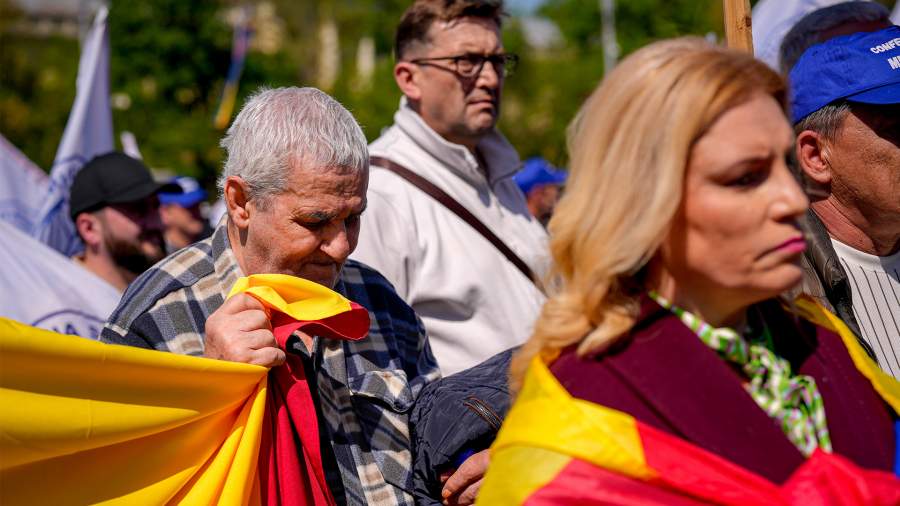
Romania's difficult financial situation has led to a protracted political crisis. The ruling coalition of Social Democrats and Liberals collapsed due to budget disputes and led to the resignation of Prime Minister Ilie Boloyan, who managed to work for just over ten months. Against this background, the right-wing eurosceptics, led by George Simion, who almost won the last presidential election, are gaining unprecedented popularity. What the current political situation in Romania leads to is in the Izvestia article.
The Doomed Coalition
• The foundation for the current political crisis in Romania was laid in December 2024 following the elections to the bicameral Parliament of the country. At that time, the Social Democratic Party of Romania (PSD) won, but its success was completely inconclusive - it received 22.3% of the vote in the Senate elections and 21.96% in the elections to the Chamber of Deputies. This became the worst indicator of the winning party in the modern history of the country, with a total loss of 35 seats.
• The National Liberal Party (PNL) lost even more seats, losing 19 seats in the Senate and 44 seats in the lower house of parliament. She dropped from second place to third, missing the main sensation of those elections — the far-right Alliance for the Unification of Romanians (AUR), led by George Simion. He scored almost twice as many seats as he had previously, and confirmed the growth of his popularity.

• Nevertheless, the AUR did not get into the government. The PSD and PNL agreed to form a pro-European coalition with two more parties in order to resist the possible election of Caelin Georgescu to the presidency with a pro-Russian position, while even then there were many contradictions between the Social Democrats and the liberals that prevented them from fully leading the government. Georgescu never got a chance to be elected, as he was eliminated after the first round, and the elections were rescheduled.
• A new turn in Romanian politics occurred as a result of the newly held presidential elections, in which Simion won the first round with a score of 40.96%, but was defeated in the second round by independent candidate Nicusor Dan. PSD leader Marcel Ciolaku resigned as prime minister, and PNL Chairman Ilie Boloyan, who previously served as president during the turmoil surrounding the presidential election, took his place. He reassembled the coalition with the Social Democrats, who got the most ministerial portfolios.
The collapse of the coalition
• Over the past ten months, the political crisis in Romania has not been resolved. During this time, Boloyan's government had to first solve the problem with the budget deficit, which until recently was the highest among the EU countries — in 2024 it amounted to 9% of GDP. At the same time, Romania needs to implement reforms by August at the request of Brussels in order to unlock access to €11 billion in financing from the EU reconstruction fund.
• The government has proposed austerity measures. These include a 10 percent reduction in the salary fund for civil servants, which led to protests from teachers, the taxation of pensions and an increase in value-added tax. These measures have reduced the budget deficit, but have not affected rising inflation and a record drop in the leu exchange rate, which threatens to increase debt service payments and lower the country's credit rating. The austerity measures angered the Social Democrats, and they decided to withdraw from the ruling coalition, blaming Boloyan for his harsh management style and refusal to compromise.
• As the largest parliamentary faction, the PSD put a vote of no confidence in Boloyan to the vote and joined forces with the AUR on this issue, despite significant differences between their agendas and protests from leftist parties in the European Parliament. The Social Democrats rejected further cooperation with the right, which gave Boloyan's supporters a chance that the vote would fail, but on May 5 he was nevertheless dismissed, for which 281 deputies voted with the necessary 233.
Romania's political future
• The appointment of a new Government and the holding of early elections are now on the agenda in Romania. There is a possibility that the Social Democrats and liberals, under pressure from President Dan, will unite again and elect a technocratic prime minister without political ambitions, who will solve the problem of bringing the country out of the budget and economic crises. At the same time, it will still be difficult for the two parties to find common ground after the numerous mutual reproaches that led to the current situation, so a new gap between them cannot be ruled out.

Nevertheless, both the head of state and the recent coalition partners will primarily try to prevent early elections, as the current crisis only adds political points to the right-wing eurosceptics. Back in February, the AUR began to lead in opinion polls and since then has consistently held the first place as the most popular party in the country, sometimes gaining support at the level of 40%.
• For Dan, who beat Simion in the presidential election, it would be essential to prevent him from becoming prime minister for as long as possible. However, now it is Simion who unites the protest electorate around him, who has not yet forgotten how Georgescu was removed from the presidential race, and now he is being tried on charges of preparing a coup d'etat. In early elections, AUR would have won a landslide victory, which would have allowed Romania to be added to the list of problematic countries for Brussels.
Переведено сервисом «Яндекс Переводчик»
