
Cognitively bogged down, the whole bird is lost: what are we just thinking about

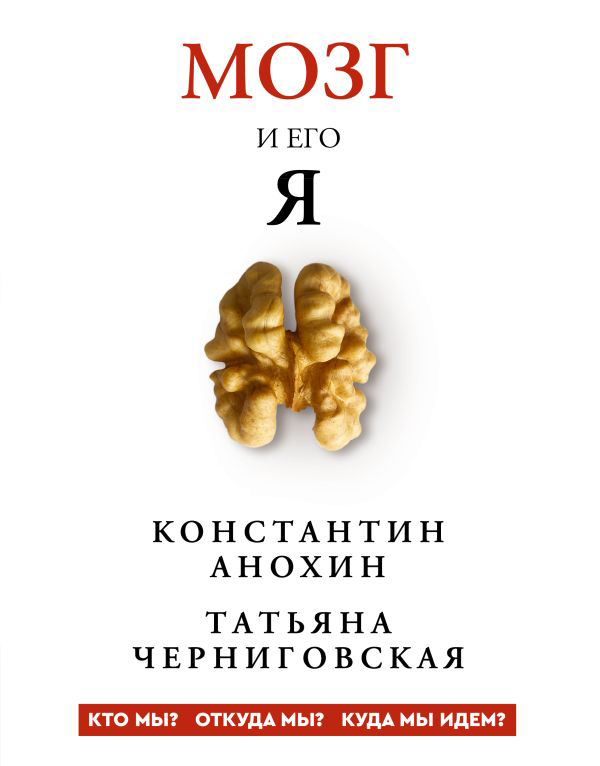
"The Brain and its Self" is a collection of diverse scientific materials belonging to two academicians, leading experts in cognitive research, neuroscientist Konstantin Anokhin and neurolinguist Tatiana Chernihiv. Critic Lidia Maslova presents the book of the week specifically for Izvestia.
Tatiana Chernihiv, Konstantin Anokhin
"The brain and its self. Who are we? Where are we from? Where are we going?"
Moscow: AST Publishing House, 2026. 496 p.
The title of the book, as the authors immediately point out, refers to a similar 1977 monograph "I and my Brain" by the philosopher Karl Popper and the neurophysiologist John Eccles, compiled from transcripts of dialogues about the structure of the human psyche that took place in a comfortable environment on Lake Como. In order to keep up with their predecessors and continue the conversation at the proper level, Russian scientists also retired to discuss pressing problems of brain science in some very pleasant place on the banks of the Katun River in Altai, judging by the cozy intonation of their conversations, which, however, occupy only one part of the book, about a fifth.
The Altai Dialogues are collected in the second chapter under the title "The main vector of Brain Science" and outline the paths that cognitive research will take in the near future, for which it is necessary first of all to correctly formulate the most important 20 issues that need to be addressed. These heuristic dialogues are preceded by a description of previous studies of the brain, primarily related to its anatomy and physiology: the first part of the book is Anokhin's article "The brain's Entry into the arena of History." Among other things, you can learn from it that the brain, the most complex material object known to man, has not always been appreciated as one of the most important human organs and the main highlight of the program that has been playing out in the arena of world history for several millennia. For example, in ancient Egypt, the heart was considered the center of the soul, and during the mummification of noble people, the brain was unnecessarily scraped with an iron hook through the nostrils and thrown away, and even the remains were thoroughly washed with chemical solutions so that they would not interfere in the afterlife.
"The Pharaohs went into eternity carefully prepared — with everything except the brain," says Anokhin ironically, for whom Descartes' reflections on the connection between the immortal soul and the specific anatomy of the brain are one of the defining milestones in the development of brain science. However, the materialist Anokhin does not use the term "soul" with a religious connotation and prefers a more scientifically correct formulation, highlighting the problem of the mind—brain problem as the main problem of cognitive research. It is one of the central ones in Altai Dialogues, the most recent part of the book, which also contains articles from, for example, 2007 or 2013. Based on them, you can get an approximate impression of how slowly the science of the brain is progressing in its philosophical and existential aspects.

"Our entire universe is enclosed in this amazing organ. We have yet to comprehend its true essence," the authors of the book warn before starting their dialogues about the brain, in which even experienced researchers often have to grope, stumble and repeat themselves in the dark, starting each new of the seven dialogues with a brief digest of the previous one. "In ancient times, travelers, depicting an unknown territory on maps, drew a dragon in its center — a symbol of mystery. For me today, this dragon in the dark is consciousness," Anokhin states the current situation, insisting on the need for a radically new approach to the relationship between mind and brain than all those that existed before.

As such a new key to understanding the nature of mental activity, Anokhin offers his theory of neural hypersets, or the theory of "cognitome" — this term, according to the scientist, will help overcome confusion and difficult to understand "polyphony" when translating the word mind into Russian, which can be understood as mind, mind, and consciousness. and the psyche. To stop the terminological confusion, Anokhin introduces the concept of a "cognitome" as a "complete system of experience of an entire organism."

A quick—witted reader quickly realizes that the cognitome is no longer just one of the neurons that make up the brain, but a kind of new entity formed by a group of neurons that form not just a neural network, but a hypernet. But if Anokhin considers the brain as a neural network, Chernihiv, in one of the articles included in the book, very poetically suggests considering the brain "like a baroque," which makes the situation more visual, and indeed more interesting: "A good brain, I think, is arranged by analogy with the Baroque. He, like Caravaggio, picks out faces and objects from the background <...>. The brain highlights unusual, non-trivial features of the world, struggles with darkness..."
However, Anokhin, who tries to think clearly and concretely, sometimes also has expressive metaphors that arise, perhaps not without the influence of Chernigov as a very charismatic interlocutor who helps convey some important things not with the help of terminology, but very clearly. It is precisely on the contrast between a neuroscientist and a neuro-linguist that the advantage of the figurative-metaphorical approach over the scientific-logical approach sometimes becomes especially obvious. Anokhin struggles a lot to explain the fundamental nuance that distinguishes just a neural network from a deep hypernet, which he considers our brain to be: "... a hypernet means a new level of organization appears, with new causal potentials; deep means that this hypernet is not just a superstructure from above: a neural network At the same time, it is being rebuilt and becomes different. In other words, in a brain with a cognitive mind, neurons no longer have the same properties as if they grew in a neural culture in a Petri dish."

Trying to explain as simply as possible that consciousness is not spread on the brain like butter on bread, but rather permeates it from bottom to top, Anokhin gratefully accepts the support of Chernigov, who very sensitively catches the interlocutor's thought, bringing it to completion: "Because this sandwich you're talking about is yours, in many ways"first of all, you know, there are complicated sandwiches, there are different things, and it's juicy, as they say... <...> all kinds of sauces there, everything flows to the bottom." This convincing image of the human brain as an ingenious multi-tiered sandwich soaked in various sauces constantly flowing back and forth, perhaps most accurately reflects the current state of cognitive research, which lacks complete clarity and certainty, but there is an undeniable appetite in anticipation of new discoveries.
Переведено сервисом «Яндекс Переводчик»
