- Статьи
- Culture
- The ringleader's Nest: detective "Rooks" will tell the truth about children's death camps

The ringleader's Nest: detective "Rooks" will tell the truth about children's death camps

Leningrad region, 1947. Hungry people, scorched by the war, honestly fulfill their professional duty and try to live every next day. In these stingy lines is the existence of millions of Soviet citizens. The action-packed historical detective story "Grachi" begins with the same atmosphere, which viewers of the REN TV channel will see on April 26. The format of the action—adventure film hides not only a serious drama, but also a historical foundation that is stunning in its cruelty - the work of children's concentration camps in the occupied territories. The creation of authenticity on the screen and the real death camps, witnessed on the pages of Izvestia during the Great Patriotic War, is in our material.
Childhood behind barbed wire
During the Second World War, Nazi Germany created more than 14,000 concentration camps. Many of them contained children. Specialized camps exclusively for minors often operated in the occupied territories of Russia, Ukraine, and Belarus, for example, in Salaspils, Latvia, or in the village of Vara, Leningrad region.
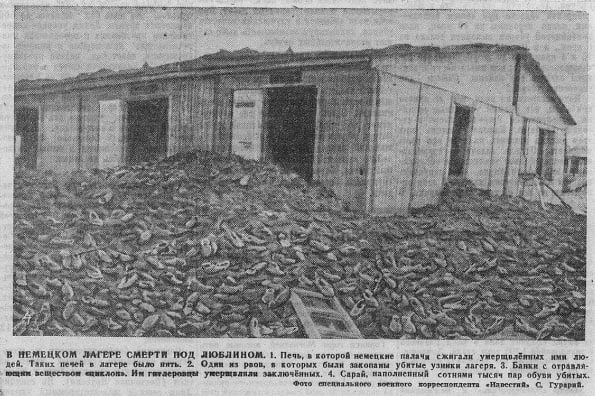
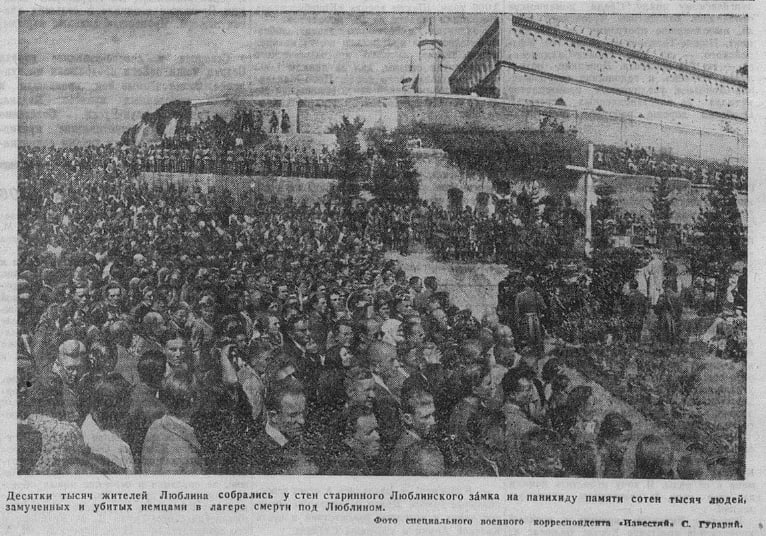
Throughout the war, Izvestia newspaper journalists traveled to the liberated territories and recorded the atrocities committed by the Nazis. So, on August 12, 1944, military commander Evgeny Krieger published the material "The Factory of Death near Lublin." He occupied the entire strip, half of which was made up of photographs by photographer Samaria Guraria. They show furnaces where the dead were burned, cans of the poisonous substance Cyclone, ditches with the bodies of prisoners and sheds filled with hundreds of thousands of pairs of shoes of the dead.
"I recalled witness accounts that the Germans placed children under the age of eight in women's barracks with their mothers, but all children over the age of eight were transferred to communal adult barracks as ordinary "political prisoners." But both of them suffered the same fate in Majdanek — death and burning in a block of electric furnaces," wrote Krieger.
There are hundreds of similar testimonies of the inhuman and bloody regime in the archives of Izvestia. Materials about the Nuremberg trials occupy a special place. On February 28, 1946, the testimony of a Polish citizen, Shmaglewska, a former prisoner of Auschwitz, was published, which detailed the massacre of defenseless children.
According to her, boys and girls were separated from their parents in front of the crematorium and sent to the gas chambers. Often they were simply thrown into furnaces or pits. Children from different countries came to the camp: Polish, Russian, Jewish, later Italian and French, as well as children from Warsaw after the uprising. Almost all of them were emaciated, sick, poorly dressed, and often barefoot. During the evacuation, the Nazis forced them to walk up to 30 km a day to Germany.

"Children were thrown into furnaces and pits alive. Their screams could be heard all over the camp. It is difficult to say how many more were destroyed in the gas chambers: they were often not even registered. We could only guess from the number of baby strollers arriving at the warehouses — sometimes up to a thousand per day," Izvestia quoted Shmaglevskaya as saying.
Today, when it is already necessary to fight for the preservation of historical memory, when the West is trying to forget about the feat of the Soviet people, these black pages of world and national history are reflected in the new series "Rooks". The main antagonist in the past is the deputy head of one of these children's death camps near Leningrad.

"We worked a lot with archives, and indeed there were concentration camps in the Leningrad Region, including children's camps," said Ilya Maksimov, director of the project. — The series combines several real stories: the fate of child prisoners who disappeared after their release, and the search for works of art stolen by the Nazis.
The creators chose an old manor house for filming the camp — historically, the Nazis often used similar buildings, avoiding the construction of new facilities.
— The former concentration camp in Gatchina is now located in the city center. This is the building of a former record factory, where offices and shops are now located. We abandoned this location and recreated the necessary atmosphere in another place," said Ilya Maximov.
The face of evil under the mask of virtue
The action takes place in 1947. Police captain Alexander Ratnikov (Artem Tkachenko) is investigating a series of murders in Leningrad. The trail leads to Pavel Vedernikov (Alexey Makarov), whose respectable image hides the former deputy head of the Nazi concentration camp for children "Grachi" Gunther Seiler.
— This is a very difficult project for me, it has been hatched for a long time. Its core is the confrontation between two extremely difficult people. This is not just a fight, but a real saga spanning a long time period. It is also important that the antagonist and the protagonist are mirrored in many ways: for some he is a saint, for others he is the devil," said general producer Olga Pogodina.

Initially, Artyom Tkachenko was offered to play a negative character, but the director deliberately changed the concept, building drama on contrast. The gloomy, harsh, introverted Ratnikov hides the ability to be compassionate behind his outward severity, while the charming and outwardly prosperous Vedernikov turns out to be a violent criminal. Alexey Makarov says this is the first time he's played such a scumbag in his life.
— My first film, thanks to which I made a big step into cinema, was "Voroshilovsky Shooter" by Stanislav Govorukhin. And there I also played that bastard," the actor recalls. — I will never forget how, after the release of the film, a woman with a stroller walked towards me on the street. She spat after me as she passed. Then I realized that the role had turned out well.

After a series of positive characters, he again had the opportunity to get out of his established role. Alexey Makarov admitted that he was ready to audition from time to time in order to eventually get the role of Zeiler.
— Among other things, this character hooked me with his passionate desire to own. If you think about it, nothing belongs to us in this world. Even my own body. Everything material that a person clings to is a great deception. And it doesn't occur to my hero that these valuable works of art he's after won't end up staying with him forever," the actor told Izvestia.

250 locations, 150 characters and a ship chase
At the same time, "Rooks" is not only a drama, but also a dynamic adventure movie. Shootouts, motorcycle and water chases, complex stunts — many of them were performed by the actors themselves. For the sake of the role, Alexey Makarov lost 7 kg, and Artem Tkachenko was even injured during filming.
— We didn't fully agree with one actor, and he abruptly slammed my back against the ground. I even had a crunch in my lower back and coccyx," he recalls. — I thought I tore some ligaments. After that, I suffered a lot for several months. And during the first shift, I slipped on the cobblestones at Mosfilm and hit my knee hard.

During the three months of filming, the team changed about 250 locations — from historical sites to nature sites in Novaya Ladoga, Vyborg and Lake Ladoga. More than 150 characters were involved in the project.
Special attention was paid to historical authenticity. The consultant was Sergey Rossinsky, Chief Researcher at the Institute of State and Law of the Russian Academy of Sciences. The actors also carefully prepared for their roles. So, actress Evgenia Dmitrieva studied the work of criminologists in 1947 and found out that due to the shortage of gloves, specialists often worked with their bare hands.

This is a story not only about the past, but also about how it continues to cast a shadow over the present. "Rooks" combines documentary truth, human drama and a tense plot, forcing us to take a fresh look at the value of what we've experienced, and sharpen our sense of justice, forcing us to look into the nature of human choice.
Переведено сервисом «Яндекс Переводчик»
