How to color eggs for Easter: unusual ideas that will surprise the guests


Orthodox Christians will celebrate Easter on April 12— the main holiday of the church year, symbolizing the Resurrection of Christ. One of the main attributes of this day remains painted eggs, which have long been considered a symbol of renewal, rebirth and new life. The custom of coloring them has been preserved for centuries, but every year new ways appear to make the symbol of the holiday more vivid and unusual. About how to color eggs for Easter in an original way, where this custom came from and what trends are popular in 2026, see the Izvestia article.
Where did the tradition of egg painting come from?
According to church tradition, the custom of coloring eggs is associated with equal-to-the-Apostles Mary Magdalene, who came to the Roman Emperor Tiberius with a sermon on the Resurrection of Christ and presented him with an egg. When the ruler heard about the miracle, he doubted her words and said that the egg would turn red sooner than the dead would rise. At the same moment, the egg changed color. Since then, the red egg has become a symbol of faith and one of the main attributes of the holiday.
Over time, the tradition has developed. In addition to red, other colors began to be used, each of which acquired its own symbolic meaning. Thus, yellow is associated with the sun and warmth, green — with the renewal of nature, blue, the color of the Virgin, — with heaven, purity and divine grace.
In the old days, egg painting was considered a separate craft, which was studied for years. Easter eggs, painted with traditional ornaments using wax and dyes, have become very popular in Russia. Unlike krashenok (boiled plain eggs), they were usually created on raw eggs and stored as amulets.
The tradition of egg coloring itself originated before the spread of Christianity. For example, in ancient Egypt, it was customary to give eggs during the flood of the Nile as a symbol of renewal and new life. Later, similar rituals appeared among the Persians, ancient Greeks and Romans, where the egg was also perceived as a sign of rebirth and the beginning of a new cycle.

Five ways to decorate Easter eggs
Traditionally, Easter eggs are dyed with onion husks and other natural dyes, but today housewives are increasingly choosing more creative solutions. Trends are set by social networks, where videos with unusual decoration methods gain millions of views. In 2026, Pinterest-style polka dot eggs, cosmic nebula, potala decoration (imitation gold leaf) and other methods became particularly popular.
Polka dot Easter eggs: a simple and stylish trend
Plain colored eggs with white polka dots have become one of the most popular trends. This effect can be achieved in two ways — using vegetable oil or wax.

In the first case, the boiled egg is dipped into a coloring solution to which a few drops of oil are added. It does not dissolve in water and repels the dye, so that light spots of different shapes form on the shell — the effect of an "oil pea" is obtained.
If you need a more accurate and clear drawing, use wax. Before coloring, dots are applied to the egg using a candle or a thin stick, after which they are immersed in the paint. In places covered with wax, the color does not fix, and after it is removed, contrasting white dots remain. This method allows you to create more thoughtful patterns and compositions.
"Cosmic Nebula": coloring with karkade tea
The effect of "space" on the shell is achieved with the help of karkade tea, which gives deep and layered shades. This method is appreciated for its naturalness and unique result. To prepare the solution, take a couple of handfuls of dried petals per liter of water, bring to a boil and leave for a few minutes. Then add a little vinegar — it helps to fix the pigment and make the staining more resistant.
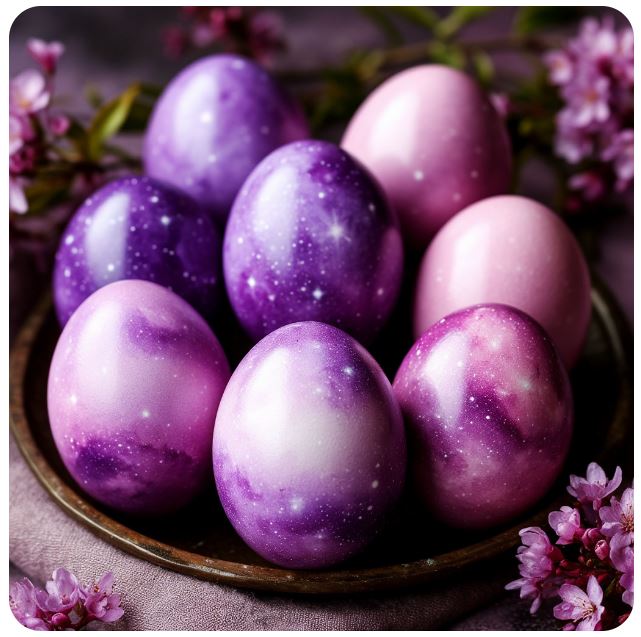
Pre-boiled eggs are carefully lowered into the prepared broth. After 10 minutes, the shell acquires a soft lilac or smoky pink hue. If you leave the eggs in the solution for 30-60 minutes, the color becomes much deeper — saturated blue, purple and even almost graphite tones appear. At the same time, it is important not to mix the solution too actively in order to preserve the natural stains.
The peculiarity of the method is that small tea particles settle on the surface of the shell. They create a "marbling" effect, reminiscent of stardust or nebulae in space. The longer the egg is in the broth, the more complex and expressive the drawing becomes. To keep the pattern clear, it is better not to wipe the eggs, but to let them dry naturally.
Potala decoration: the effect of gold leaf
Another popular way is to decorate eggs with a potala, which gives the surface a noble vintage look. This decor allows you to create different styles. For example, turmeric (yellow) with golden potala, purple or blue shades of karkade in combination with silver potala and white eggs with light golden accents give a good combination.

First, the eggs are boiled and completely cooled. They can be left white or pre—dyed with ready-made or natural dyes, such as turmeric, beetroot or karkade. Then the "glue" is prepared — lightly beaten egg white. It is applied to the surface of the egg with a brush or hands.
After that, the sheet is carefully applied horizontally to the shell or the egg is rolled over the sheet. With light pressing movements, the material is distributed over the surface, creating the effect of a gold or silver coating. After the protein dries, the potal is securely fixed, and the excess is removed with a dry brush.
Chameleon Eggs: how to get an "expensive" shade
Another method of coloring is the chameleon technique. It is based on the step-by-step use of two natural dyes: turmeric and karkade. As a result, the shell acquires an unusual, "expensive" appearance with natural color transitions. These eggs resemble natural stones or designer ceramics and look especially impressive on a festive table.
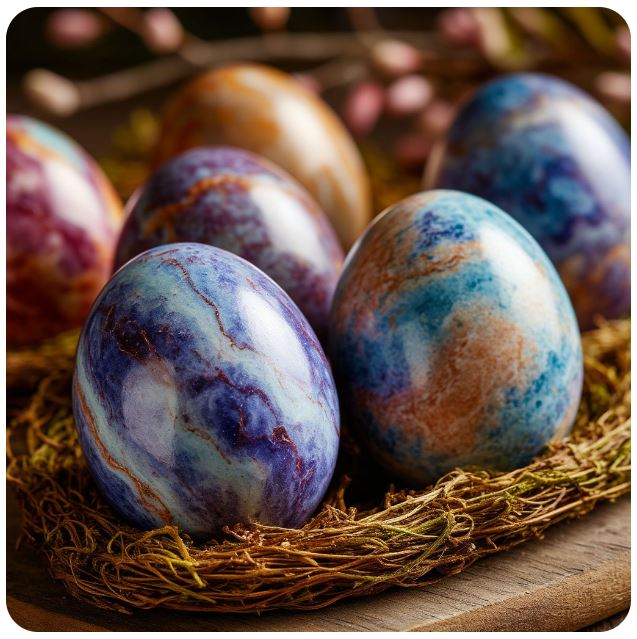
First, a decoction of turmeric is prepared: about three tablespoons of spices are added to a liter of water, brought to a boil and allowed to brew. Then pre-boiled eggs are lowered into the solution and kept until a rich yellow color is obtained, after which they are carefully removed and allowed to dry.
At the second stage, a strong decoction of karkade is used with the addition of a small amount of vinegar to fix the color. Yellow eggs are immersed in this solution, where the shades are mixed. The blue and purple pigments of karkade are superimposed on the yellow base, forming complex olive, marsh and gray-green tones. From the outside, it is difficult to understand how such a complex shade was achieved.
"Wine Crystal": a decor with a shimmering effect
Before Easter, the trend of dyeing eggs with wine is also popular on social media. The essence of the method is that the eggs are filled with wine (red, white or pink is suitable). When acids and sugars interact, an unusual effect is created — the shell is covered with tiny crystals resembling frost or small sparkles.
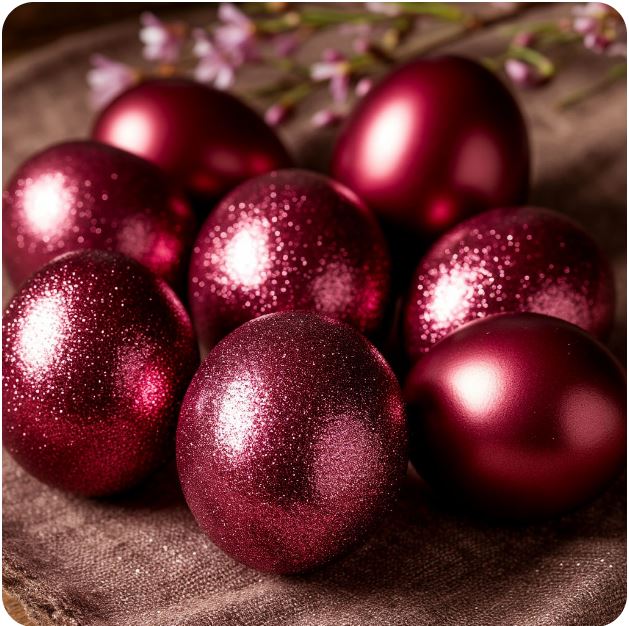
The process is quite simple. Eggs are poured with wine, brought to a boil and boiled for about 10 minutes. After that, they are not removed immediately, but left to cool directly in the liquid for several hours — usually from 8 to 12. It is a long stay in the solution that allows you to achieve a depth of color and a characteristic "velvety" coating.
The shade of the finished eggs depends on the chosen drink. Red wine gives deep burgundy and almost black colors, pink — softer and lighter, and white allows you to additionally experiment with dyes. As a result, the eggs shimmer and look as if they are covered with a thin layer of glitter.

How to choose eggs for coloring at Easter
Before you start decorating, it is important to choose the right eggs, because the final result directly depends on their quality. Experts recommend choosing white eggs of medium size — the color fits better on them, and the shades are more saturated.
The shell must be smooth, without cracks, chips or pronounced roughness, otherwise the paint will be distributed unevenly, and the pattern may be distorted. It is important to pay attention to the cleanliness of the surface (the product must be free of contamination) and freshness: a fresh egg sinks into the water and sinks to the bottom, while the old one rises up.
Before starting work, eggs should be thoroughly washed with baking soda or a mild detergent and gently wiped dry. They should be removed from the refrigerator in advance and allowed to heat up to room temperature — this will reduce the risk of cracking during cooking.
How to properly boil eggs and fix the decor
Put the eggs in cold water, add a little salt — it strengthens the shell and helps to avoid damage — and cook over moderate heat, without strong boiling. After boiling, 8-10 minutes is enough for them to be hard-boiled, while it is important to avoid sudden temperature changes.
When coloring, it is better to use natural or food coloring agents that are safe for health. The eggs are left in the solution for a few minutes until the color is fixed. To make the color more even, you can add a little vinegar to the solution. Then the eggs should be carefully removed and blotted with a soft cloth, taking care not to damage the painted surface.
The final stage is to add shine. The finished eggs are lightly rubbed with a drop of vegetable oil. This gives them a soft glow and a more festive look, and additionally protects the colored shells from moisture and fading.
When do they usually paint eggs before Easter
Traditionally, eggs are painted on Maundy Thursday, the last Thursday before Easter. In 2026, it falls on April 9th. According to the Gospel, it was on Thursday that the Last Supper took place — the last meal of Jesus Christ with the disciples, during which the Sacrament of the Eucharist, or Holy Communion, was established.
All household chores, including cleaning, baking cakes and coloring eggs, should be completed on this date, so that Good Friday and the following days are devoted to prayer and reflection. In addition, people believed that eggs cooked on Maundy Thursday were stored longer and brought well-being to the home.
The consecration of eggs and cakes takes place on Holy Saturday (April 11, 2026), starting in the morning and ending in the evening, as well as on the morning of the Resurrection of Christ after the solemn divine service.
Earlier, Izvestia reported on the traditional method of coloring eggs for Easter.
Переведено сервисом «Яндекс Переводчик»
