Wires have been installed: the transmission of energy in the form of light will reduce the risk of explosions in mines
- Статьи
- Science and technology
- Wires have been installed: the transmission of energy in the form of light will reduce the risk of explosions in mines


Russian scientists have increased the efficiency of energy transmission in the form of light through optical fiber by six to seven times. This makes its implementation economically feasible in various industries. In particular, the use of such technology can significantly reduce the risk of explosions in mines and chemical plants. In addition, replacing heavy metal cables with optical fiber will make it easier to design spacecraft, as well as simplify the infrastructure of smart cities. However, the technology needs to be "tested" in practice to test how the system will work in extreme conditions.
How to transfer energy in the form of light
Scientists at Perm National Research Polytechnic University (PNRPU) have proposed a technology that increases the efficiency of energy transmission in the form of light through optical fiber by six to seven times. The new development can replace traditional copper cables for powering devices in many areas. The Ministry of Education and Science of the Russian Federation told Izvestia about this.
— Optical fiber is usually connected to the Internet and data transmission infrastructure. These are glass filaments along which light signals run. By the same principle, it is possible to transmit not only information, but also energy," Alexey Garkushin, one of the developers and a researcher at the PNRPU Laboratory of Optoelectronic monitoring systems, told Izvestia.
In such systems, the expert explained, the laser converts electricity into light at the input, which is transmitted via optical fiber, and the photodetector (a special plate similar to a solar battery) at the output performs the reverse transformation. The technology is in demand where the use of metal cables is difficult or unsafe.
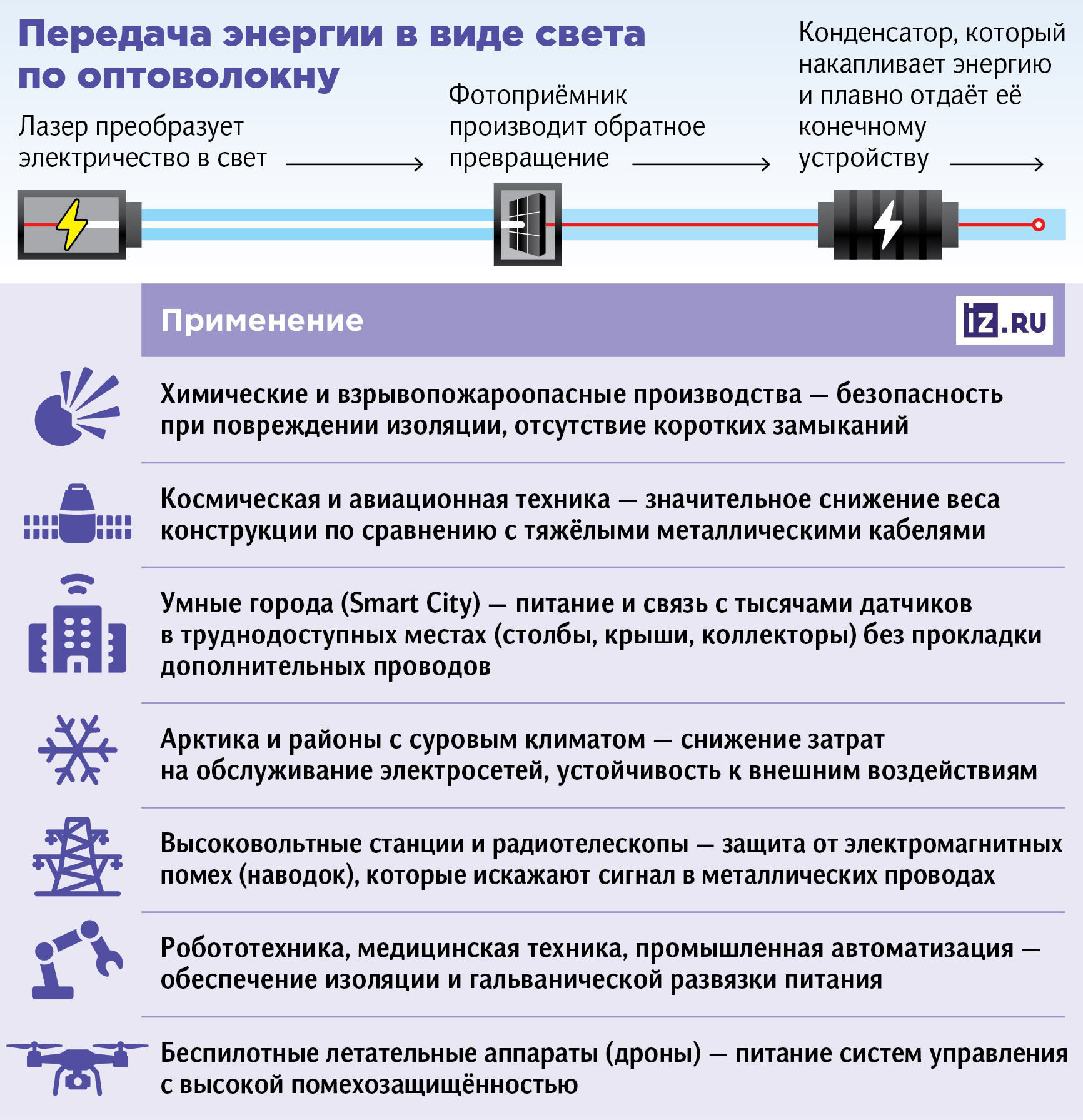
In particular, we are talking about mines and chemical plants, where damage to insulation can lead to a spark and explosion. In addition, in high—energy facilities such as radio telescopes or high—voltage power plants, light transmission of energy avoids interference caused by powerful electromagnetic fields. In the space and aviation industries, an additional advantage is the lower weight of optical fiber compared to copper wires, which makes it possible to reduce the weight of the structure.
— The problem is that now the efficiency of such systems remains low. Even in the best case, 10-15% of the energy from the source reaches the consumer device. Moreover, taking into account the losses in the cable itself, especially over long distances, this figure is reduced to 1-7%. Also, when the device needs little energy, the laser power at the input is simply reduced, which is why it works inefficiently, and a significant part of the energy is dissipated as heat and does not reach the photodetector," said Alexey Garkushin.
To increase the efficiency of the system, PNRPU proposed switching the laser light source to a pulsed mode. In this case, the amount of energy transferred is regulated by the duration of the inclusions: with low power consumption, the pulses are made short, and the pauses between them are longer, and vice versa, the scientist specified.

How technology will help build smart cities
Additionally, the researchers included an energy storage capacitor in the system, which accumulates it and then evenly transmits it to the end device, providing stable power.
— The effectiveness of the solution was tested using a digital twin. The simulation showed that at low power (less than 1 Watt), when continuous mode provided an efficiency of only about 2%, pulsed mode allowed it to be increased to 12-14%. In the power range from 0.75 to 15 watts, the efficiency increase was up to 6%," said Alexey Garkushin.
He stressed that even a slight increase in efficiency in such systems yields tangible results: a 3-5% increase in efficiency can mean up to 20% additional useful energy for the end device. According to him, the proposed solution expands the possibilities of the technology, making its use in various industries more economically feasible and safer compared to traditional methods of energy transmission.
In particular, as the scientist noted, the transmission of energy in the form of light via optical fiber is especially in demand in the Arctic and other regions where maintenance of traditional power grids is difficult and expensive due to climatic conditions. In the future, the technology may find applications in robotics, medical technology and industrial automation.
In addition, it may be in demand in smart city systems, where thousands of sensors and devices are combined. Many of them are placed in hard—to-reach places - on poles, roofs of buildings or in underground utilities. Using optical fiber will allow simultaneous data transmission and power supply to such devices, avoiding additional cables and simplifying the infrastructure.

How optical fiber will protect mines from accidents
— Optical power cables are protected from interference, short circuits and external influences, which is especially important for a number of industries. At the same time, the achieved efficiency of the system significantly exceeds current figures, which brings the technology closer to mass adoption in industry," said Anastasia Yuzhakova, Associate Professor of Glass Technology at Ural Federal University.
At the same time, in her opinion, the technology remains expensive, including due to the high cost of equipment. Therefore, it is necessary to continue research aimed at improving the efficiency of energy transmission.
— The transmission of high power using light is problematic, so it is not yet possible to launch heavy equipment in this way. In addition, the transmission of significant capacities requires fiber with an increased cross-section, the production of which is difficult due to the need to obtain high—purity material," commented Sergey Brostilov, Head of the Department of Electric Power Engineering and Electrical Engineering at Penza State University.
He added: currently, the efficiency of energy transmission via fiber is significantly inferior to power lines, so this approach is economically and technically impractical to power powerful equipment. At the same time, fiber-based measurement and communication systems are already demonstrating high efficiency. According to him, the development can be used, for example, to control drones or power control systems in mines.
— The noise immunity and safety of the technology make it relevant for underground mines, where problems with electrical wiring often cause accidents. It is also important that the proposed solution can be integrated into existing systems without major restructuring. The idea looks workable, but the technology needs to be "tested" in practice," said Nikolai Novikov, Deputy head of the business incubator at Ural State Mining University.
According to him, it is necessary to check how reliably the system will work in extreme temperatures, as well as compare the cost of the new technology with the cost of existing solutions. In particular, real-world testing is needed, for example in mines.
Переведено сервисом «Яндекс Переводчик»
