
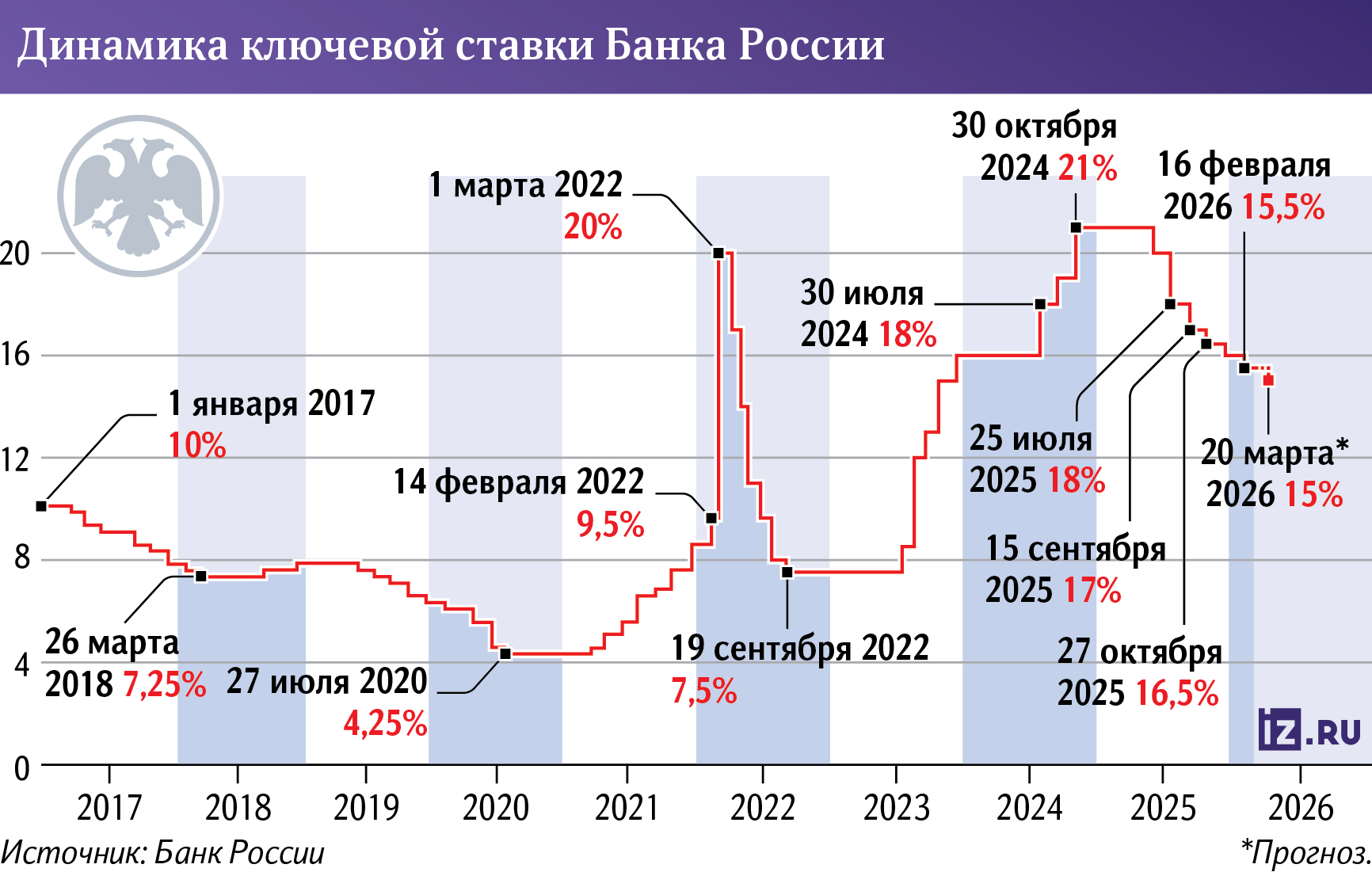
Again by 0.5%: the Central Bank may reduce the key rate to 15% in March

The key rate may drop to 15% as early as March 20, which is considered the most likely scenario by most analysts surveyed by Izvestia. The Bank of Russia is ready to respond to a steady slowdown in inflation, a cooling of lending and a decrease in inflation expectations of citizens. At the same time, the regulator is unlikely to give overly optimistic signals: questions about the budget rule and tensions in the Middle East continue to pose risks. How the rate will change before the end of the year and when inflation will reach the target level is in the Izvestia article.
The reasons for a possible reduction in the Central Bank rate
The main argument in favor of easing monetary policy in March is the return of inflation to target levels. As explained by Andrey Zolotov, portfolio manager of Alfa Capital Management Company, according to preliminary estimates, the price increase in February may be about 0.5-0.6% compared to the previous month, which corresponds to about 4% in annual terms (excluding seasonality). This is actually the target of the Bank of Russia.

Weekly inflation data looks favorable and confirms that the January surge in price growth was temporary, the expert stressed.
This thesis is shared by the majority of the experts interviewed. The Post Bank noted that inflation is within the forecast range of the Central Bank, and credit activity remains low. Among the main reasons for the key rate cut this month are the steady slowdown in inflation according to weekly data, the cooling of lending and the stabilization of inflation expectations of the population and businesses, the National Rating Agency (NRA) agreed.
Anton Pavlov, Deputy Chairman of the Board of Absolut Bank, confirmed: over the past few weeks, we have seen a slowdown in inflation, tax changes have had an effect, consumer and business activity remain at a low level. Dmitry Kulikov, Senior Director of the ACRA Group of Sovereign and Regional ratings, noted that due to low business activity indicators and the impact of tight monetary policy, the rate will continue to decrease.

Dmitry Golubkov, Director of Macroeconomic Analysis at OTP Bank, believes that the current key rate of 15.5% is overestimated, taking into account current indicators: inflation at 6% and M2 money supply growth of about 10%. The M2 indicator reflects the volume of rubles in the economy. If it grows faster than the production of goods, this provokes an increase in prices. February inflation is in line with the Central Bank's targets, and inflation expectations have adjusted after the January jump, Viktor Grigoriev, chief analyst at Bank Saint Petersburg, confirmed.
Why can't the Central Bank cut the rate quickly
In March, the Central Bank is likely to cautiously reduce the rate by 0.5 percentage points, to 15%, most of the experts surveyed are confident. As Pavel Biryukov, chief economist at Gazprombank, explained, an unusual situation had developed by the March meeting: on the one hand, inflation is returning to normal, on the other, the Ministry of Finance has suspended currency sales and is preparing changes to the budget rule, which creates inflationary risks.
The budget rule is a mechanism that determines which part of oil and gas revenues the state has the right to spend and which must be allocated to reserves. Currently, the cut-off price is set at $59 per barrel of Urals: if the actual price is higher, excess profits go to the National Welfare Fund (NWF). The Ministry of Finance is discussing lowering this threshold, which will automatically increase the volume of borrowings in the domestic market, creating additional demand for ruble liquidity and potentially accelerating inflation.
Sovcombank is also expecting a decrease of 0.5 percentage points, said Mikhail Vasiliev, the bank's chief analyst. If there were no changes in fiscal policy, the Central Bank would have more arguments to consider a step of 1 percentage point, he added.
Reducing the cut-off price may mean cutting costs, but if the government keeps them at the same level, this will create additional inflationary risks, warned Viktor Grigoriev from Bank Saint Petersburg.
Gazprombank clarified that the decision of the Ministry of Finance to suspend currency sales in March may create new pro-inflationary risks, which the Central Bank has already warned about. Pavel Biryukov does not rule out that the regulator will take this into account in the signal.

It is unlikely that the changes will dramatically complicate the Central Bank's task of lowering the rate, says Andrey Zolotov from Alfa Capital. Rather, we can expect a slightly more cautious and time-stretched mitigation trajectory.
Actual inflation has been 2 percentage points lower than the Central Bank's forecast for the fourth quarter in a row, Ilya Fedorov, chief economist at BCS World of Investments, added. Therefore, there is room for reduction, but external risks and budgetary uncertainty limit the step, agreed Natalia Pyrieva, head of the analytical department of Digital Broker.
Vladimir Evstifeev, Head of the Analytical Department of Zenit Bank, and Yuri Kravchenko, head of the Bank Analysis Department at Veles Capital IC, also forecast a reduction in the key rate to 15%. At the same time, the tone at the press conference will remain restrained, according to Pavel Verevkin, senior analyst at KIT Finance.

In the last two weeks, the situation in the Middle East has become an additional source of uncertainty. Sergey Grishunin, Managing Director of the NRA rating service, points to threats to imports and logistics, while Natalia Pyrieva points to rising energy prices and disruptions in global supply chains due to the escalation of the conflict.
Since the start of the military operation on February 28, Brent quotes have soared by more than 36%, from $72 to a peak of $119 per barrel on March 9, updating the highs since mid-2022. Prices then adjusted below $90 when countries started talking about the decision to release some of their reserves in order to calm the markets. However, on March 12, the quotes went back to triple digits.

The rise in oil prices has a twofold effect, Andrei Zolotov said. On the one hand, it supports the budget of the Russian Federation and provides the Ministry of Finance with the opportunity to temporarily postpone the adjustment of the revenue distribution mechanism, on the other hand, it increases the risk of cost inflation due to rising energy costs and disruptions in logistics.
How significant this factor will be will depend on the duration of the conflict and its impact on global supply chains. However, most experts agree that so far these risks will not have a significant impact on the March decision.

What will be the inflation rate by the end of the year
Analysts predict a further slowdown in inflation. Gazprombank expects it to decrease to 5.5% by the end of the half—year, while NRA expects it to drop to 5.3–5.5% by the end of the year. OTP bank calls the corridor 5-6%.
By the end of the first half of the year, inflation will be around 5.4% (compared to the same period last year). And in July, price growth may slow down, according to Viktor Grigoriev from Bank St. Petersburg. This will happen due to the so‑called base effect: current indicators will be compared with relatively high inflation values for the same period last year. Price growth will gradually fall from 6% in January to 5.4% in June and 5.3% by the end of the year, predicts Mikhail Vasiliev from Sovcombank.

In the summer, inflation will go below 4%, but a sharp increase will occur from October 1 due to the postponement of tariff indexation, Ilya Fedorov from BCS warned. According to his forecast, by the end of the year it will be 5.1%.
By the end of the year, the Central Bank may lower the key to 12%, experts expect. The NRA predicts steps of 0.5–1 percentage points with possible pauses in the third quarter. In Sovcombank — 0.5 percentage points at each meeting, up to 12%. The Central Bank will bring the rate to this level in the absence of force majeure, OTP bank clarified.
The Central Bank may be prompted to take more decisive action by the completion of its fiscal policy and a decrease in budget momentum, says Pavel Verevkin from KIT Finance. At the same time, according to Yuri Kravchenko of Veles Capital, it is possible that the double‑digit rate will remain for most of 2027 due to high inflation expectations of the population.
Переведено сервисом «Яндекс Переводчик»
