
Global flooding: severe flooding awaits at least 16 regions of Russia

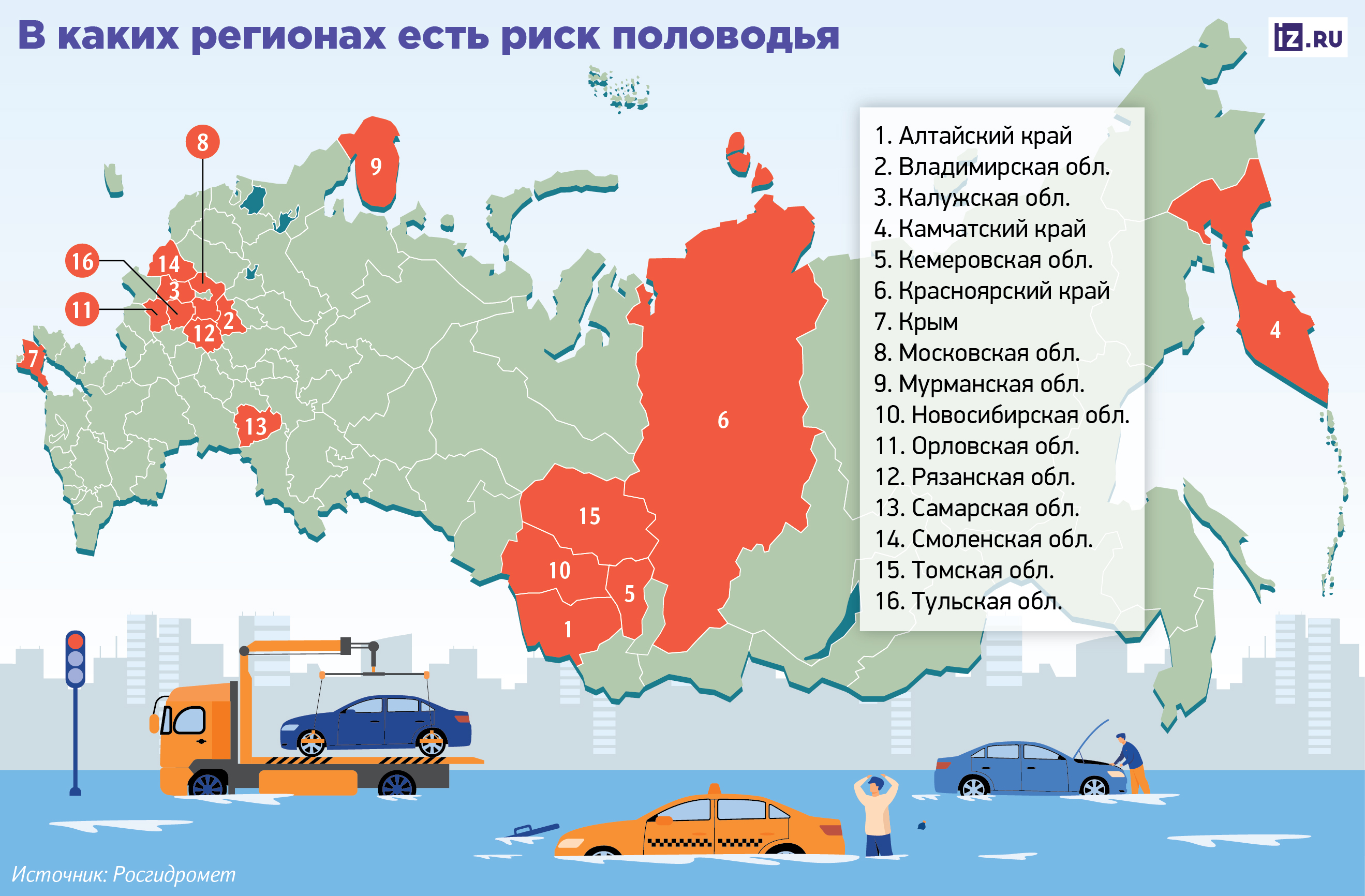
A significant excess of winter precipitation has led to the accumulation of snow cover in 16 regions of the country, which creates the risk of severe flooding. The situation may stabilize due to weather fluctuations: on March 8, a warming is expected in some regions, which will then be replaced by a cooling. This reduces the likelihood of large-scale flooding. In Central Russia, high water is expected in early April. For more information, see the Izvestia article.
Where the flood is coming
At least in 16 Russian regions, the level of spring flooding will be higher than normal due to significant snow cover, according to data from the Russian Hydrometeorological Service. At another 20, there is a possibility of exceeding the norm, but not so obvious. Significant flooding is possible in the Central, Volga, Siberian and Far Eastern Federal Districts.

There have been no serious floods in the Moscow region for the last 30 years, Mikhail Bolgov, head of the laboratory at the Institute of Water Problems of the Russian Academy of Sciences, and a hydrologist, told Izvestia.
"The weather in the region is difficult now, and the cold weather is expected to return," Mikhail Bolgov added. — There is a lot of snow — there is something to melt. But the melting itself can be prolonged due to frost, so there probably won't be any severe flooding. Catastrophic water rises on the Oka River, as in the 1970s, by 10-12 m, most likely, will not occur.
The exact date of the snowmelt cannot be named at the moment. Anatoly Tsygankov, head of the Department of Crisis Management at the Russian Hydrometeorological Center, suggested in an interview with Izvestia that this year the snow will melt in the capital region in the first 10 days of April.
— Forecasts are still vague. It is assumed that this year, with such a prolonged winter, the snow will melt for a long time," Mikhail Bolgov added. — And if ice jams form on the rivers, then the flood will be serious.

Alexander Shuvalov, a meteorologist and head of the Meteo forecasting center, doubts that there will be heavy flooding in the Moscow region.
— Yes, there is a lot of snow, but it all depends on the nature of the weather in the spring months, — he told Izvestia. — If there is a period with very high temperatures and rains, the flood may become extreme. There will be a prolonged spring period with the return of cold weather, then it will stretch over time and will not be so devastating.

At the same time, there are all the prerequisites for "high water" in Central Russia and the Volga region, said Alexander Shuvalov.
— In Moscow, the snow cover is noticeably lower than in the south-east — in the Ryazan region, Mordovia, Penza region, Tatarstan, where the snow cover is up to 90-95 cm, and in some places 1 m high. There is the greatest probability of high, close to extreme flooding," the expert noted.
Specialists from the Ministry of Energy of the Moscow region are preparing for a possible flood.
"To ensure guaranteed and reliable operation of electric grid facilities... The technical condition of electrical equipment in areas prone to flooding is being checked," the press service of the department reported.

The repair staff of Mosoblenergo is working out the procedure for actions in flood zones using equipment.
Which regions will warm up on March 8
The night of March 6-7 will be the frostiest in the calendar spring in Siberia, the Hydrometeorological Center reported. So, in Altai it will be up to -27 degrees, and in the Tomsk region — up to -36 degrees. At the same time, it will become warmer on March 8: in the Omsk and Novosibirsk regions, the thermometer will reach +1 degree, in the Altai Territory and Kemerovo Region — up to +5, and in the Altai Republic — up to +8.
According to the Hydrometeorological Center, moderate snowfalls will occur on March 7 in some parts of the Krasnoyarsk Territory, Khakassia and Tuva. On March 8, the air in the southern districts of the Krasnoyarsk Territory will warm up to +10 degrees, and in Khakassia to +7 degrees.
Frosty weather will remain in Tuva from March 7 to March 8. In the central regions, the air temperature will range from -5 to -8 degrees, while in the south of the region, temperatures are expected to rise to +3...+5 degrees.
It will get warmer on March 8 in the Irkutsk region: up to +8 is expected in the south of the region, meteorologists from the Hydrometeorological Center reported.

In Moscow, the average daily temperature is already approaching normal, although light precipitation may occur by the end of the week. On March 8, the specialists of the Hydrometeorological Center promise daytime temperatures in the capital from +3 to +5 degrees, and in the region from 0 to +5 degrees. However, the next day, on Monday, March 9, it will be slightly colder: -2... -7 degrees at night, and -2... +3 degrees in the afternoon.
— Kaliningrad will celebrate 12 degrees Celsius on March 8. It will be warmer there than in Sevastopol and Krasnodar," Alexander Shuvalov said. — There is a leapfrog in Krasnoyarsk. On a holiday, it will warm up to a positive temperature after 10-12 degrees of frost. In Barnaul, it is expected to reach +6 degrees.

There will be no early spring
In the capital region, spring usually begins on the 20th of March. In Russia, spring comes from the southwest, through the Black Sea, Krasnodar Territory, Stavropol, and smoothly approaches Moscow, Anatoly Tsygankov explained.

According to the norm, there should be about 38 cm of snow in Moscow, but in reality 52 cm is now one and a half times higher than normal. The situation is similar in Voronezh: 30 cm with a norm of 17 cm. There is more than 60 cm of snow in Tula.
— In the capital and around it, snow is one and a half to two times more than normal everywhere. The glacier is huge," the expert noted. — Winter did not leave Moscow. There was a two-day thaw in February, and now there is a three-day thaw. Frost is not visible yet — the March weather is normal.
Anatoly Tsygankov is sure that such a layer will not melt quickly, although 20 cm of snow was lost during the five days of the February thaw.
— He fell from 72 cm to 52 cm. On March 10, I think the snow will be around the norm — 35-38 cm. And then everything will depend on how warm it gets. If the snowdrifts are normally high without outbreaks of cold or heat, then they melt by about March 27 or April 5. Given that there is a lot of snow, it is likely to melt from April 1 to April 10," the expert added.
 In his opinion, there will be no early spring in Russia this year, as there is a lot of snow everywhere. At the same time, it is already spring in the southern part of the European territory of the country, but such weather is also the norm for the region. In Yakutia, the snow will probably melt only in May.
— Only in Siberia — Omsk, Tyumen — for the second time during the season there is an abnormal cold. We don't have to wait for early spring this year," said Alexander Shuvalov.
At the same time, snow will fall in St. Petersburg by March 15, as it fell there many times less than in the center of European Russia, the expert believes.
Переведено сервисом «Яндекс Переводчик»
