
The Orbit of Friendship: how the Mir station appeared in space

On February 19, 1986, the Mir scientific research complex entered orbit, which remained in the spotlight of millions of people for a decade and a half. Izvestia recalled how it was.
Space House
The world's first orbital station was Salyut, which entered Earth orbit on April 19, 1971. She was launched into space by a Proton-K launch vehicle. Soon, the designers came up with the idea of creating a station to which more and more spaceships could be attached. The project was adjusted several times, matching the tasks with the actual budget. In 1976, NPO Energia issued technical proposals for the creation of improved long-term orbital stations. Work on the base unit, on-board equipment, and scientific equipment for the future of orbital space began in 1979.

The Salyut-7 orbital station with the Soyuz-T-14 spacecraft during the flight
But at that time, the Soviet Union was carrying out two super—projects - it was building the Baikal-Amur Mainline and the Buran spacecraft. The project of a unique orbital station was much cheaper, but it was not considered a priority either. The usual "Fireworks" were working in orbit, and the need for new-generation stations was not acute. The creation of the "World" was postponed several times. Crucial was the support of the Secretary of the Central Committee of the CPSU, who oversaw the military industry, Grigory Romanov, who secured financing for the project and set the task of launching the station by the XXVII Congress of the CPSU, which was scheduled to open in February 1986. However, by the time the project was implemented, Romanov was already a personal pensioner. But the "World" was brought to mind.

Mir Orbital Scientific Station during ground training in the workshop of the Khrunichev Space Center
Mir was designed according to the modular principle. Other elements necessary to perform certain functions can be attached to the base unit, which was a modified Salyut station. Thus, the main problem for creating a full-fledged space laboratory was solved: it was possible to supplement the station's arsenal with an almost unlimited number of equipment. The service life of the multimodule complex is unlimited. The space prison could be repaired, upgraded, and supplemented for decades. It is not for nothing that Valentin Glushko coined the term "PIC" — a permanent orbital station. Mir is an echo of such a project.
The first in the "World"!
280 enterprises of the Union worked on the creation of the "World". The astronauts were thoroughly preparing for new tasks. The systems were tested on a test bench. The researchers examined hundreds of options for each aspect of the World's work. But working in orbit is always an advance into the unknown.

The launch of the Proton-K launch vehicle from the Baikonur cosmodrome with the base unit of the Mir space station. February 19th, 1986
On February 19, 1986, a week before the opening of the next party congress, a Proton-K launch vehicle was launched from the Baikonur cosmodrome, which launched the base unit of the orbital complex into orbit. The next day, hundreds of world media outlets reported on this event. Six people could work at the same time on the Mir. The operating orbit of the complex extended at an altitude of 300-400 km from the Earth. The base module worked almost flawlessly in automatic mode, waiting for the astronauts. At that time, the Soviet Union was the only country with successful experience in building manned space stations.

Crew members of the Soyuz-T-15 spacecraft Leonid Kizim (right) and Vladimir Solovyov at the Yuri Gagarin Cosmonaut Training Center preparing for flight
The first crew, consisting of Leonid Kizim and Vladimir Solovyov, arrived at the module on March 15, 1986. The astronauts worked on board for about two months, after which they made the first ever flight from one orbiter to another. On May 5, they left Mir on the Soyuz-T-15 spacecraft and the next day arrived aboard the Salyut-7 station, which had been hovering in orbit in automatic mode for a long time. This is a unique achievement. During the cosmonauts' absence, the Soyuz TM transport ship docked at the station. The lives of astronauts have changed a lot compared to the "Fireworks". The new orbital house was more comfortable and spacious.
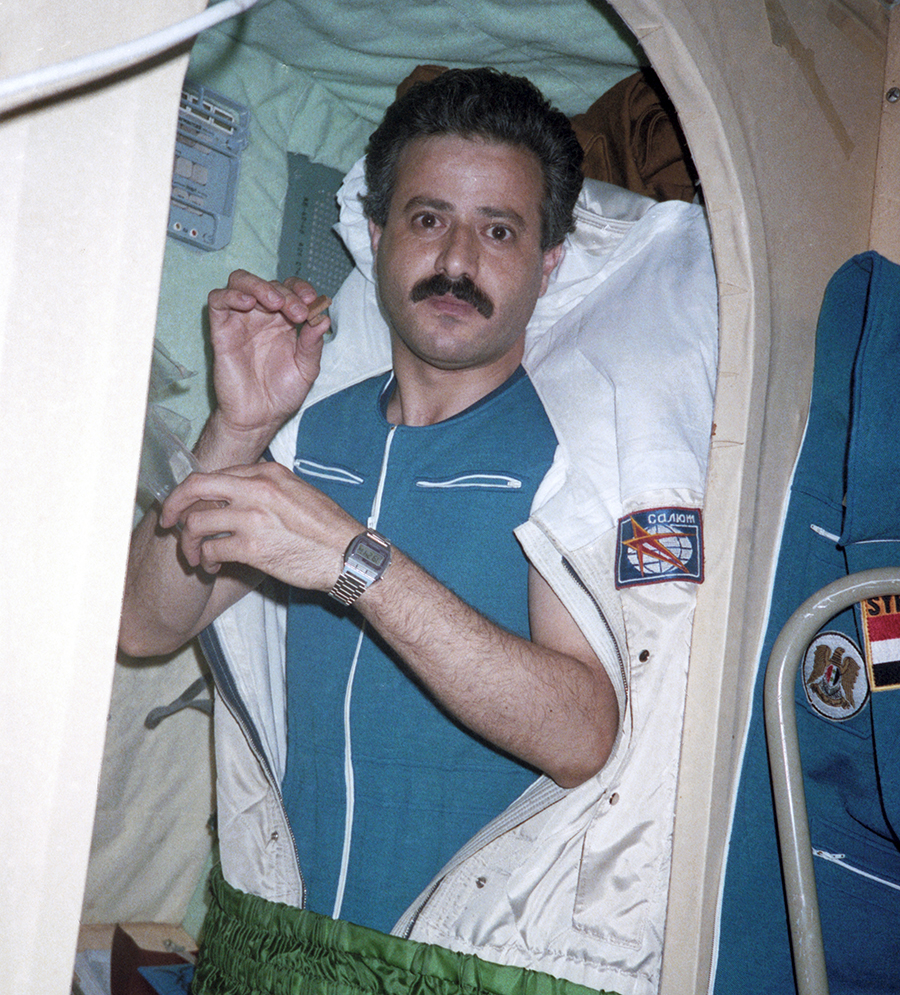
The first foreign guest at the station was Syrian Mohammed Faris. Later, representatives of Afghanistan, Bulgaria, France, Germany, Japan, Austria, Great Britain, Canada and Slovakia visited the "World" — and not as tourists, but as co—workers. And more than 30 US citizens.
Space Laboratory
The expansion of the orbital complex lasted ten years. In 1989, the Kvant-1 unit was successfully docked to the base station, which included a water regeneration system, an additional gateway for spacewalks and oxygen supplies. In addition, the Quantum housed the Treadmill –1 treadmill, the first device in the station's history for cardio exercises in microgravity. It was indispensable for long-term flights. The astronauts had the opportunity to recuperate in orbit.

A mock-up of the Mir orbital scientific station in the Cosmos pavilion at VDNH in Moscow
The Kristall module, which was launched in the Mira system in 1990, was intended for unique scientific experiments. Among other things, new medicines were being developed there. The Kvant-2 module had a Light bioreactor, which produced the second generation of wheat grown in space for the first time in history. Thousands of unprecedented experiments in biology, medicine, and physics have become the pride of the space laboratory. So, thanks to the equipment created at the Moscow State Engineering Physics Institute, it was possible to understand the nature of electronic radiation belts in space and establish their connection with phenomena such as earthquakes.

At the Mission Control Center during the docking of the Nature module with the Mir space station
One of the most spectacular experiments in the history of cosmonautics was Operation Banner 2.5. The researchers tried to get a reflection of sunlight on the earth's surface using mirrors. Dozens, if not hundreds, of such breakthrough experiments in various fields of knowledge have been conducted at the orbital complex. They were simply put on the assembly line at Mir. The Priroda module, which docked at the complex in April 1996, became the last Mir unit. There they studied the effect of radiation on the human body, received information about the Earth's atmosphere. High-precision instruments for observing our planet were working there.
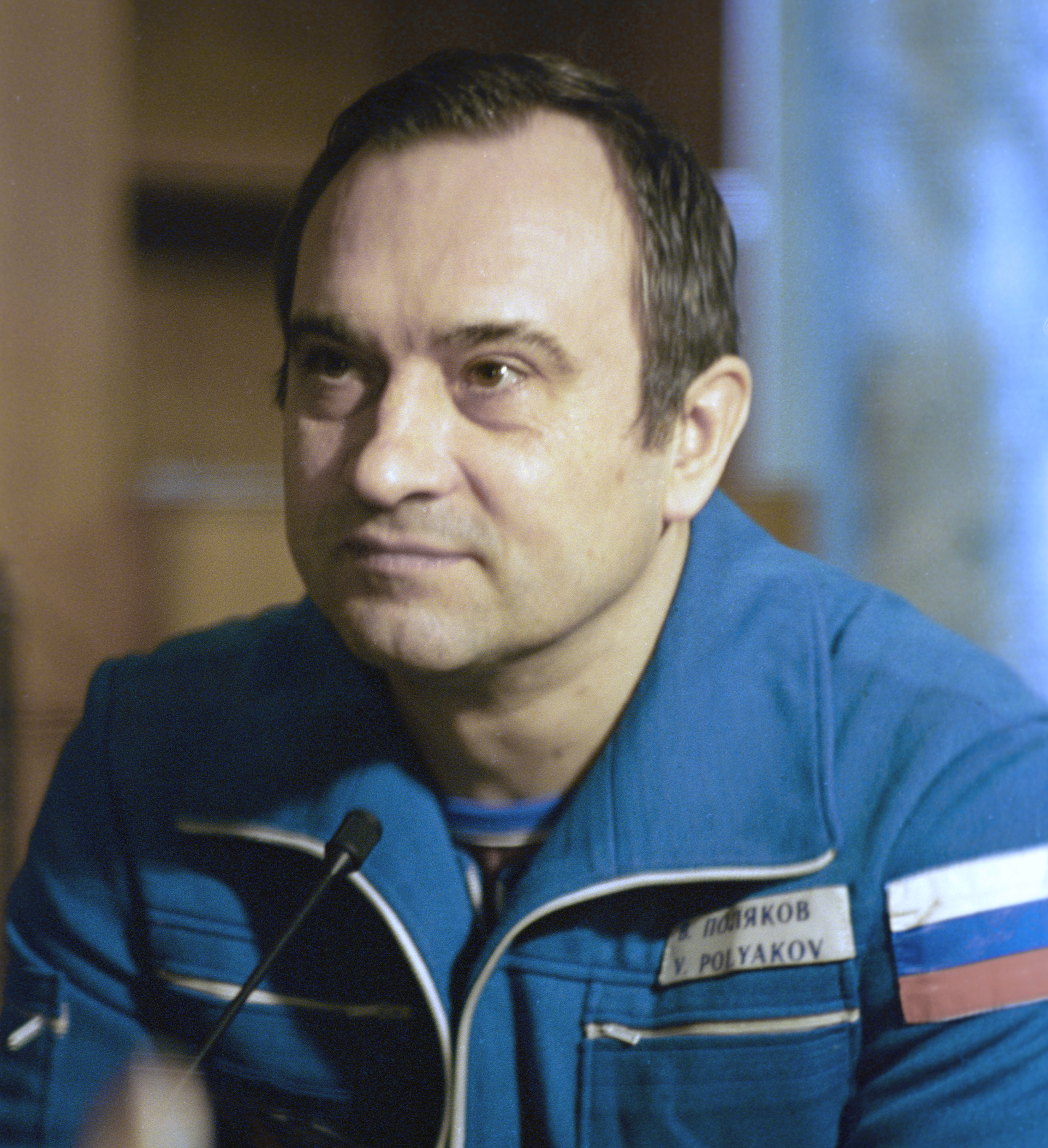
Several historical achievements have been established on Mir. Perhaps the loudest of them was the absolute record for the duration of a person's continuous stay in space flight. Its owner is doctor Valery Polyakov, Hero of the Soviet Union and Hero of Russia. He worked at the station twice, and his second mission (from January 1994 to March 1995) lasted 437 days, 17 hours, 59 minutes. Anatoly Solovyov went into outer space 16 times, having worked there in free flight for a total of 77 hours and 46 minutes. Of course, they didn't go the marathon distance in orbit for the sake of reporting records. It was necessary to check whether the human body was physically and psychologically ready for long—term work in conditions of weightlessness and cosmic radiation. The experience of the "World" will help in the creation of alien bases, and during flights to the Moon and Mars, which await us in the future.

A footprint in the Universe
The country was changing, and this was reflected in the work of the station. In December 1990, Japanese journalist Toyohiro Akiyama became the first space tourist on Mir. He not only photographed and recorded his impressions, but also followed the experiment with tree frogs from his country. In May 1991, flight engineer Sergey Krikalev arrived at Mir. According to the plan, he was supposed to return in six months, but he stayed to work with the next crew. His separation from Earth lasted until May 25, 1992. The cosmonaut started from the USSR, and returned when the Union ceased to exist, becoming one of the first Heroes of Russia and the last Soviet cosmonaut.

The docking of the Russian orbital station Mir with the American spacecraft Atlantis. Shooting from the Mir station
In the 1990s, Mir became a symbol of cooperation between Russia and the United States. The Mir—Shuttle program operated, according to which three American space shuttles — Atlantis, Endeavour and Discovery — made nine flights to the station, delivering Soviet cosmonauts and their American colleagues to it. Mir had to go through one of the most difficult trials on June 18, 1997, when the Progress M-34 cargo ship's remote control system collided with the Spectrum module. The orientation of the station was disrupted, and the module needed immediate and serious repairs. The disaster was contained, the station survived, but since then Spektr has been used only as a space warehouse. Ten years after launch, the complex performed brilliantly in research tasks, although the number of breakdowns on the Mir was approaching 2 thousand. The station needed modernization, which required a lot of capital. And by the end of the 1990s, Russia's budget consisted of holes. In the early spring of 2001, the Mir modules made their last orbit around the Earth.

The Mir Space Station. From left to right: Kvant module, Soyuz transport ship, Nature module, Spectrum module, Kristall module
The Progress spacecraft gave the station a final boost, allowing it to be removed from orbit in order to be disposed of. The wreckage of the "World" fell into the Pacific Ocean. It happened in a specially designated non-navigable area. At that time, all the hopes of cosmonautics were connected with the International Space Station, the ISS. Mir has remained a unique orbital space created by the Soviet Union. A similar International Space Station was the result of cooperation between several countries and, above all, two great space powers — Russia and the United States. The modern Chinese Tiangong orbital station is still inferior to Mir in terms of both technical characteristics and scientific impact. Will we see similar bright achievements in the field of space research in the future? The generations that created the Mir space station knew how to work, believe and hope — and left their mark on the universe. We have someone to learn from.
The author is the deputy editor—in-chief of the magazine "Historian"
Переведено сервисом «Яндекс Переводчик»
