"The duet of Fiennes and Bychkov will lead us to triumph"


The soloist of the Mikhailovsky Theater will perform the main role in "Eugene Onegin" on the stage of the Grand Opéra — the Paris National Opera. British actor and director Ralph Fiennes chose a composition by Pyotr Tchaikovsky for his debut on the stage, not being afraid of anti-Russian rhetoric in Europe. On the eve of the premiere, which will take place on January 26, Boris Pinkhasovich spoke with Izvestia and told why the repertoire of no self-respecting theater can do without our classics, what Turgenev prompted Fiennes to do and what the appointment of Russian conductor Semyon Bychkov as its musical director would give the Paris National Opera.
"For me, the Grand Opéra is the greatest shock"
— When did you first get to the Grand Opéra? What were your impressions of this magnificent theater, which is visited not only for performances, but also for excursions?
— You won't believe it, I got to the Grand Opéra for the first time just two weeks ago. Although my debut in Paris took place back in 2018, but then it was a different theater — Opéra Bastille. Now I have the opportunity to work in the Grand Opéra, in a sacred and great space for any musician. For me, this theater is the greatest shock. The acoustics in it, by the way, are very difficult.
— It is clearly no coincidence that Ralph Fiennes chose the material for his debut as a theater director: in 1999, he played the main role in the film Onegin. Russian Russian culture has long been his interest, and he even speaks a little Russian. Did you find a common language right away?
— It was planned that we would see Fiennes a year before the production. We thought maybe in Zurich, Paris or New York. But they couldn't catch each other. When Rafe was in Paris, I was in America. When he was in America, I was in Europe.
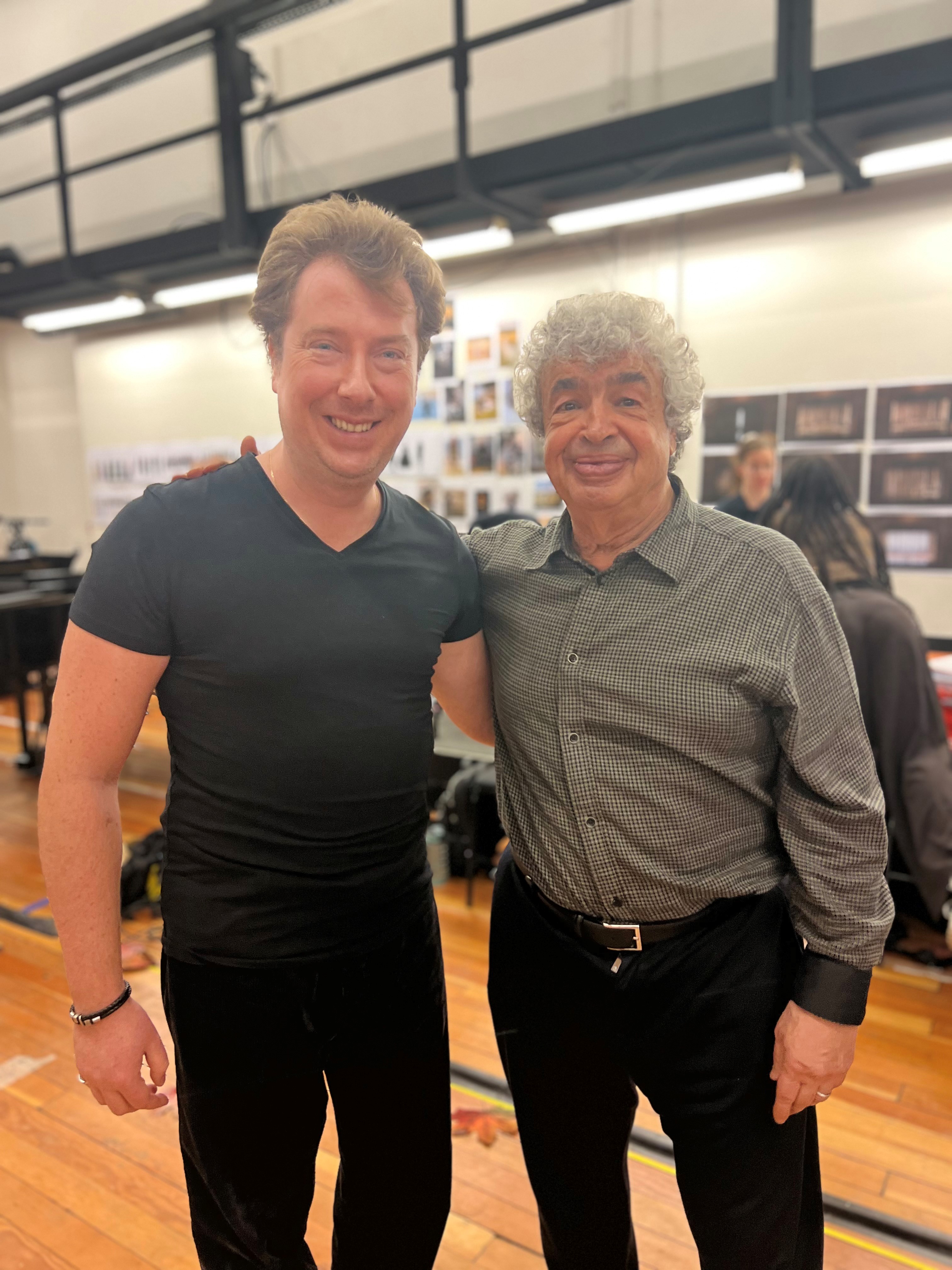
Our first communication took place via video link. At that time, I was in the House of Creativity of the Composers of Repino near St. Petersburg. You rest your heart and soul there. And then such a long-awaited conversation with Fiennes! We became despoiled on the first day of winter. There was a reunion of souls — we are somewhat similar to each other.
— What do you have in common?
— Attitude to the profession, total perfectionism in life and in creativity, which is why it is sometimes difficult to exist. I can't even call it a job. We have a collaboration with Fiennes, so to speak. I am infinitely happy about this opportunity. Rafe is a great actor, a profound philosopher, and a thinker. I am in great awe of working with him. I'm looking forward to the premiere!
— How did the director explain the choice of a Russian opera to debut on stage?
"He didn't explain. The wind blew from the side of the brilliant maestro Semyon Bychkov. The conductor suggested that Fiennes stage "Eugene Onegin." And that was about five years ago. They have a long and strong friendship. The maestro's offer was an opportunity for Rafe to try his luck on stage and prove himself as an opera director.
— At the beginning of the year, it was reported that Bychkov would take up the position of musical director of the Grand Opéra. He also became the musical director of the upcoming premiere.
- yes. Semyon Bychkov was recently announced as the new musical director of the Paris National Opera. I congratulate the whole of Paris and us musicians immensely. This is a great happiness!
I came out of the conducting environment myself, I got a conductor's diploma in parallel with vocals, and I've been doing this all my adult life. That's why I know very clearly what I'm talking about. I think the Fiennes–Bychkov duet, God willing, will lead us to triumph.

"The main thing is that Tchaikovsky and Pushkin are needed by us"
— Why do you think Ralph Fiennes is interested in Russian culture?
— Rafe is an immensely sensitive person. I think our culture is that layer of the greatest world heritage that is very important to him. Not being a Russian by birth, he reads our unique cultural code.
And it is precisely with this that his appeal to Tchaikovsky and Pushkin is connected. Russian Russians can even speak in part about some kind of worship of the Russian land, respect for it, and a special concept of the sanctity of Russian culture.
— In your opinion, do Europeans need Tchaikovsky and Pushkin today?
— Where without them! The main thing is that we need Tchaikovsky and Pushkin. And for us, there is no doubt that these are the two greatest pillars on which the entire world culture stands. Therefore, especially nowadays, it sounds very modern and fresh. It is impossible to ban Pushkin and Tchaikovsky, and it simply will not work. These are those who are timeless, beyond problematic.
— Are European viewers ready to go to Onegin in conditions when politicians from all sides cancel everything Russian?
— Nothing is canceled. Tchaikovsky is heard in every self-respecting European and world theater. This is confirmed by the premiere of "Eugene Onegin" at the Grand Opéra on January 26. This is a colossal and lasting happiness that befell me at this stage of my life — a partnership with two great ones — Fiennes and Bychkov.
— An international team has been assembled for the production. What does this mean to you?
— It's part of our profession. We work in an international team where artists, singers, and musicians of different nationalities gather, and that's great. It's part of our culture.
— Does Fiennes remember his trips to Russia?
— Of course, he often visited Russia, even starred with Vera Glagoleva in Turgenev's film "Two Women". Filming took place in the countryside near Smolensk.
When I arrived in Paris, we had a private dinner with Rafe—just the two of us. I sent him greetings from people who appreciate and love him very much. They told me that the last time Rafe was in St. Petersburg, he went to the Hermitage and even danced there out of happiness. I reminded him of this moment, which made him laugh and make him happy.
— You studied with the great opera singer Irina Bogacheva. Despite her talent, she, a People's Artist of the USSR, failed to achieve the fame of Elena Obraztsova. Perhaps the reason is that Bogacheva made her career in Leningrad, and Obraztsova in Moscow. What are the differences between the St. Petersburg and Moscow opera schools?
— That's a good question. But I do not know the answer to it. Both St. Petersburg and Moscow vocal schools were represented by great masters. Unfortunately, they have already passed away. For me, there is no fundamental difference in schools. As a native of St. Petersburg, a graduate of the St. Petersburg Conservatory in the vocal class of the great Irina Bogacheva, of course, I profess everything Petersburg. But that doesn't mean I don't like Moscow. I love being there and performing. I recently had a solo concert in the capital.
Here, most likely, we need to talk about the vocal school in general, in its global sense. I am deeply convinced that there is one school — Italian bel canto. Those great masters, from whom I had to study, nevertheless acquired the mastery of vocal technique from the Italians. That's why we have one school.
Переведено сервисом «Яндекс Переводчик»
