
Marriage at the gates: why brides continue to be stolen in Kazakhstan

At the beginning of this year, Kazakhstan was rocked by two high-profile crimes related to bride abductions. In the city of Shymkent, a man tried to steal a 21-year-old girl, but in the process stabbed her with a knife, in another case, the "groom" abducted and raped a 17-year-old college student. Izvestia investigated the situation.
I didn't understand the word "no"
Nurai Serikbai, 21, studied design in Alma Ata, and came to her parents in Shymkent during the January holidays. On the 11th, she went to the flour store to bake her favorite pies. Near her house, she met a man who has been stalking her for a long time. According to the CCTV footage, the self-styled groom first shouted something at the girl, then attacked and stabbed her several times.
Nurai died on the spot, and later investigators counted more than 10 stab wounds on her body. "According to our traditions, we had to wash our bodies in order to conduct it properly. But they couldn't fully do it due to severe injuries. Terrible cuts on his face, seven deep knife wounds on his back. The mother didn't even show her daughter's body," said one of the relatives.

The killer tried to escape, and two days later, security forces detained him in an open steppe in the vicinity of Shymkent. The attacker turned out to be 29-year-old Sherkhan Aimakhan, who had been stalking Nurai for a long time. It is known that the young people met at a wedding last summer. Since then, the man did not give the girl a pass — he called on the phone, wrote on social networks, stood guard at the entrance, came to Alma Ata, where he came to an educational institution.
A relative named Ayana says that in October, the boyfriend tried to kidnap the girl, but then family members were able to prevent the disaster. "He did not calm down, wrote from different accounts, followed every step, threatened, did not understand the word "no". At some point, Nurai collected evidence and contacted the police, but they did not respond in any way. As a result, a tragedy occurred," she says.
From social media to the President
The incident caused a strong reaction on social networks. Teenage girls began recording numerous videos in which they asked not to kill them if they refused to communicate with someone. Others demanded punishment for police officers who are sluggish in responding to complaints.
Some MPs have spoken out about the situation. Majilis deputy Yerlan Sairov said that marriage should be a free choice of a man and a woman, and bride kidnappers should be strictly responsible. His colleague Murat Abenov also called for the punishment of police officers, "who, apparently, internally support incomprehensible traditions."

President of Kazakhstan Kassym-Jomart Tokayev
Finally, President Kassym-Jomart Tokayev drew attention to the tragedy, noting that he had received about 130 complaints in connection with Nuray's murder. "It has been established that the suspect pursued the girl and threatened her. In the end, it all ended in death. Bride kidnapping is a blatant and barbaric crime that undermines the authority of our nation," he stressed at a meeting of the National Kurultai.

The Head of state also demanded a legal assessment of the actions of the Shymkent security forces. After his speech, it became known about the dismissal of the head of the city police, Nurlan Almasbekov, and his first deputy. At the same time, an investigation was launched against the staff of the district department, where they ignored the appeal of the deceased.
A place for the bride
Another episode was played a little less loudly. In mid-January, four men abducted a 17-year-old college student in Shymkent. The girl later said that she had never known any of the intruders before. "They pushed me into a car and took me away. When we arrived at the place, adult relatives were already waiting there. Fireworks were being fired in the courtyard, and many were filming what was happening," she said.
According to the girl, her phone was taken away from her at home, they demanded to write a receipt stating no complaints, then one of the men raped her, explaining everything that happened with "traditions". "I was told that I would no longer study and would never leave this house. They threatened that if I didn't comply, I would be locked up indefinitely," she said. Later, she managed to escape home.

At the same time, a video of this incident appeared on social networks. The footage shows how a screaming and resisting girl is dragged out of the car, many men and women gathered around, one of the grandmothers is holding a white handkerchief, some are filming everything on mobile phones, music is blaring against the background, festive illumination is flickering. Later, a criminal case was opened on this fact.
The handkerchief and the grandmother
According to estimates by organizations for the protection of women's rights, up to 5,000 cases of theft of girls occur annually in Kazakhstan, most of these episodes are recorded in the southern regions of the country. Researchers, speaking about the causes of this phenomenon, note that very specific ideas about women's rights are common among young people.
In addition, many men do not have the money to court and establish relationships with the parents of a potential bride. Finally, young people are often just afraid of being rejected. "Girls are stolen without their consent, literally on the first "date", like a sack of potatoes, without giving a damn about causing psychological trauma, and after that, possibly, physical violence," says one of the publications on this subject.

In the classic abduction scenario, the groom and his friends ambush the girl in a deserted place, shove her into a car and take her home. On the spot, a white handkerchief is put on the girl, which symbolizes marriage, numerous relatives praise the groom, one of the grandmothers can lie down on the threshold so that it is more difficult for the victim to leave. Eventually, the abducted woman may be raped so that she has no way back.

It's hard for girls raised in patriarchal families to go against this scenario. In addition, many people know that they will not receive support at home. The fact is that parents are often not ready to take back a daughter who has spent at least one night in someone else's house. Besides, after such a thing, there is hardly a man who will agree to marry her. As a result, many are forced to accept the situation.
The door to the wedding
Opinion polls show that a significant part of society tolerates such practices. In 2023, the Kazakhstan Institute of Social Development published the results of a study, according to which almost a quarter of respondents (23.6%) have a neutral or positive opinion of the abduction of women. Only half (54%) advised victims to flee and contact law enforcement agencies.
Abductions and some media resources are normalizing. In a neutral or even positive way, bride theft is described in a number of films and talk shows. The most scandalous was the advertising integration of one of the door manufacturers. In the popular TV series, a girl is stolen and beaten, she sobs, wants to escape, but then remains, admiring the doors in the groom's house.
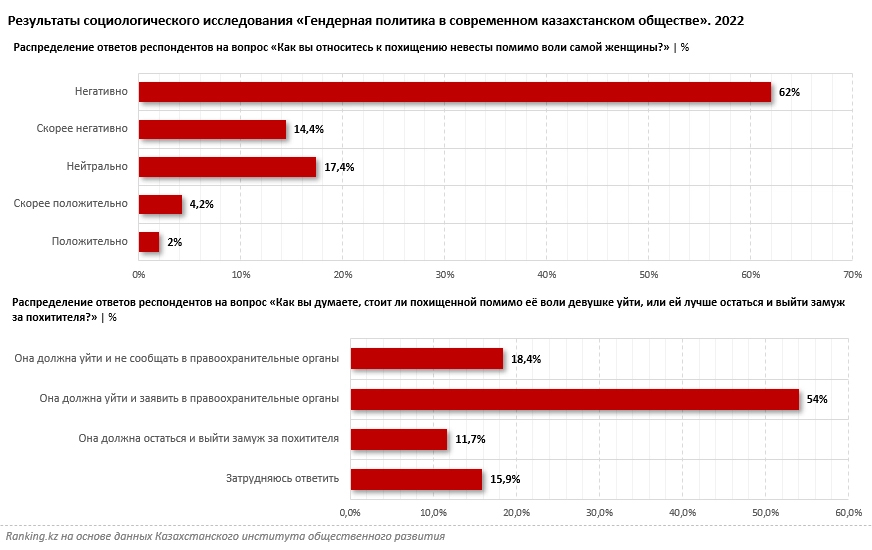
It is noted that many police officers are reluctant to respond to relevant complaints. According to published statistics, in 2019-2024, 214 criminal cases were initiated in connection with abductions of women. Most of them were terminated due to the lack of evidence of a crime. Only 10 cases were sent to the courts, and 27 people were brought to justice as a result.
The Kazakh authorities have been trying to change the situation in recent years. MP Murat Abenov calls for active explanatory work in schools and universities. According to him, it is necessary to train police officers so that they understand that this is not about tradition, but about an offense. In addition, it is necessary to inform the girls that "you can take off your headscarf when you put it on, and tell your grandmother about the crime being committed on the threshold."
President Kassym-Jomart Tokayev has also spoken out on the topic more than once, stressing that "obscurantism defies any justification." As a result, in September last year, a new article on forced marriage was added to the country's Criminal Code. She faces up to two years in prison. Penalties for obsessive harassment (stalking) have also been introduced, and standards for kidnapping have been tightened.
What the experts say
Alexander Kobrinsky, a political scientist and director of the Agency for Ethnonational Strategies, notes that mores are noticeably tightening.
— In Central Asia, in the post-Soviet period, the level of education is declining, experienced specialists are leaving schools and universities, and new personnel are now working with young people without the same humanistic values. Besides, people just don't have a clear ideology or a foothold in life right now. In such circumstances, many become religious, nationalistic, or return to some medieval practices, as in these abduction cases. I think we will see the development of these processes in the future," he said.
Kazakh political analyst Rustam Burnashev says that abductions of girls in their current form have nothing to do with traditions.

— Among the nomadic peoples, the groom could indeed steal the bride, but this was done solely by prior agreement. The goal was not to pay the kalym (ransom. — Ed.), both the girl's parents and herself knew about the man's intentions. If this happened without collusion, then the mechanisms of blood feud were immediately activated and total hostility between the clans began," he explains.
The expert adds that a distorted understanding of traditions leads to tragedies.
— We are actually talking about kidnapping, that is, a criminal offense. But because of the peculiar gender stereotypes, the girls' families and law enforcement agencies react rather sluggishly. At the same time, the authorities are actively working, the punishment has been tightened, and all such cases are widely discussed. I think there will be fewer and fewer such incidents in the near future," he says.
Переведено сервисом «Яндекс Переводчик»
