- Статьи
- Economy
- Thirst for a place: unemployment in the North Caucasus is many times higher than the average level in the Russian Federation

Thirst for a place: unemployment in the North Caucasus is many times higher than the average level in the Russian Federation

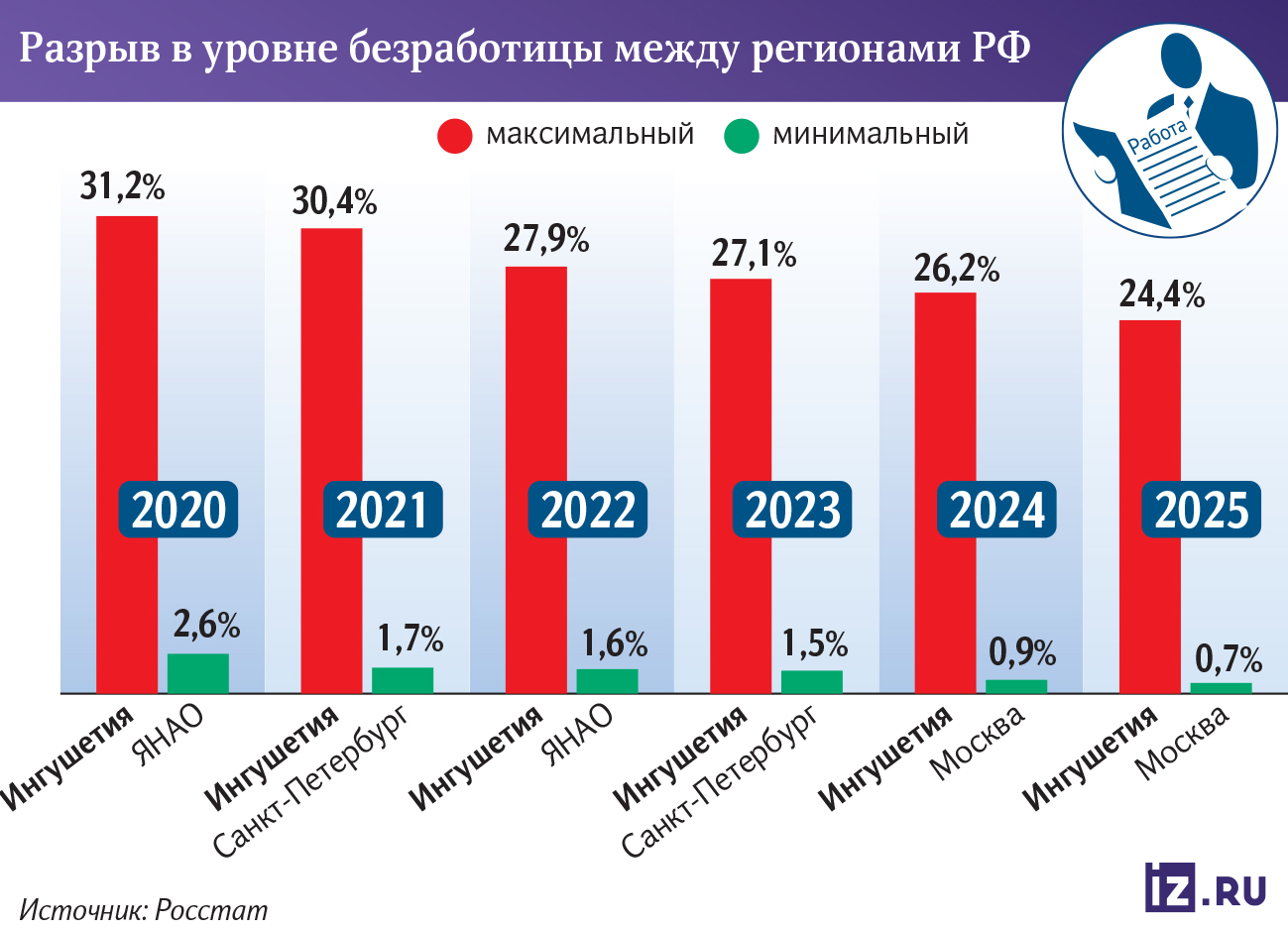
Unemployment in the North Caucasus is three times higher than the average in Russia — 7.1% versus 2.1%. This is indicated by Rosstat data, which was studied by Izvestia. In September 2025, unemployment in Ingushetia reached 24.4%, and now it is the highest level in the country. The minimum unemployment rate was recorded in Moscow (0.7%): the difference in the share of the unemployed population between these regions reached a record 35 times. Experts explain the unemployment rate in the south of the country by the prevalence of shadow employment, a small number of large employers, a high birth rate, a significant proportion of rural residents and a large number of housewives. The current situation, according to experts, may carry a number of risks for the regional economy, from tax shortfalls and rising social support costs to an increased outflow of young people. How and whether this problem can be solved is described in the Izvestia article.
Regions with the lowest and highest unemployment in the Russian Federation
The average unemployment rate in Russia in September, according to Rosstat, was 2.1%. Despite the historically low figure, the proportion of unemployed is still noticeably higher in some regions. In most federal districts, it ranges from 1.4% (in Central) to 2.7% (in Siberian). At the same time, in the republics of the North Caucasus, it reaches 7.1%, that is, three times the national average.

The editorial board sent a request to the Ministry of Labor with a request to comment on the current situation.
The highest unemployment rate in September 2025 was recorded in Ingushetia — 24.4%. This is the only region where the share of unemployed has a double-digit value. Dagestan is followed by a significant margin — 9.9%, North Ossetia–Alania — 7.2%, Chechnya — 6.7% and Karachay-Cherkessia — 5.9%. The only region outside the North Caucasus Region with a comparable indicator is Altai with 6.4%.
At the same time, the lowest unemployment rate was in Moscow — 0.7%, as well as in the Yamalo-Nenets Autonomous Okrug, Kaluga and Murmansk Regions — 0.9% each. The Khanty-Mansiysk Autonomous Okrug and Nizhny Novgorod Region complete the rating with 1%, according to Rosstat data.

Thus, the gap between the regions with maximum (Ingushetia) and minimum (Moscow) unemployment has reached 35 times. This is a record for the entire period of observations, calculated by Izvestia.
Why is there high unemployment in the North Caucasus
The republics of the North Caucasus exhibit high unemployment due to the limited number of large employers and the dominance of the public sector. Against this background, an increased share of informal employment is forming in the regions, explained Viktor Lyashok, senior researcher at the INSAP Center of the IPEI Presidential Academy.

— There are few large private companies in the region, and the economy is mainly based on budget organizations and small businesses. Few jobs are being created, while there are many people, especially young people. Private investors are entering cautiously due to weak infrastructure and a limited set of industries, so the demand for workers here is lower than the national average," said Roman Yerkhov, CEO of TuBi recruitment company.
The region has historically remained oversupplied due to its high birth rate and longer life expectancy, said Yulia Dolzhenkova, professor at the Financial University under the Government of the Russian Federation. Another factor is the significant share of the rural population, which is about 49% compared to about 25% of the national average. And finding a job in rural areas is noticeably more difficult, the expert explained.

The situation was also affected by the mass closure of enterprises in the 1990s. Then, for various reasons, organizations in the agro-industrial complex, mining and metallurgy stopped working here, and a significant part of the local residents lost their jobs, the professor recalled.
In addition, shadow employment is still widespread in the North Caucasus. Quite often, a person is officially registered as unemployed and receives benefits, but actually works in the informal sector, Yulia Dolzhenkova added.

The gap between the regions continues to grow as they develop along different trajectories, Roman Yerkhov believes. According to him, in Moscow and other major centers, the economy relies on modern services, IT and the financial sector, where new jobs appear much faster. In regions with a simpler economic structure, this process is slower, so the differences are increasing.
What can high unemployment lead to?
For the economy and the population, high unemployment means weak business growth, limited tax base and the region's dependence on the federal budget, said Yaroslav Kabakov, Director of Strategy at Finam IC.

High unemployment leads to the fact that people earn less and buy less, which reduces consumer demand, and businesses reduce the production of goods and services, Roman Yerkhov agrees. At the same time, he added, the outflow of young people to more developed regions is increasing, which also affects the local economy and reduces the attractiveness of the territory for investors.
— In addition, with high unemployment, the standard and quality of life decrease, the number of poor increases and social tension increases. The burden on regional budgets is increasing, as it is necessary to pay social benefits, including unemployment benefits," added Professor Yulia Dolzhenkova.
According to the Ministry of Economic Development, unemployment will rise to 2.6% in 2026. Currently, Russia has a record low of 2.1%, which experts attribute to a shortage of personnel, especially in the manufacturing industry and the IT sector, as well as the "demographic pit" of the 90s.
It is possible to fight this, says Natalia Milchakova, a leading analyst at Freedom Finance Global. She noted that one of the ways is to develop new industries. For example, in the republics of the North Caucasus, with the exception of the traditionally resort Krasnodar and Stavropol territories, tourism is beginning to develop — from sightseeing to skiing and gastronomy. This can stimulate job creation, as the hotel business, catering, financial services, and the production of souvenirs, clothing, and footwear are expanding along with tourism.

High technologies can also become a promising area: if not a local Silicon Valley, then at least a regional Skolkovo could be formed in one or several republics, Natalia Milchakova believes.
In general, Roman Yerkhov believes that in the coming years, we can expect increased competition for personnel and a further widening of the gap between regions if modern jobs are not created faster in problem regions.
Переведено сервисом «Яндекс Переводчик»
