Torments without conscience: "Resurrection" has arrived at the Gogol Theater


Pavel Parkhomenko's play "Resurrection" was performed for the first time on the Main Stage at the Gogol Theater. The one that ran on the Small Stage for two years, but the authors gave the production a new dimension, and at the same time solved the problem with the lack of available seats in the hall. One of the most complex novels by Leo Tolstoy is presented here as an encyclopedia of Russian life of the 19th century in all its diversity. The scenery has become even more voluminous, and the complex, sometimes dangerous choreography and brilliant acting have remained. Izvestia visited the performance and appreciated the transfer of the idea to a large scale.
A new level
The play "Resurrection" directed by Pavel Parkhomenko based on the novel of the same name by Leo Tolstoy was first performed on the Small Stage two years ago. Then it was lucky, because no theater accepted the Resurrection for staging. The director was refused, considering this work too complicated and gloomy. The Gogol Theater adopted Pavel Parkhomenko's bold vision, and the play gained an army of fans.
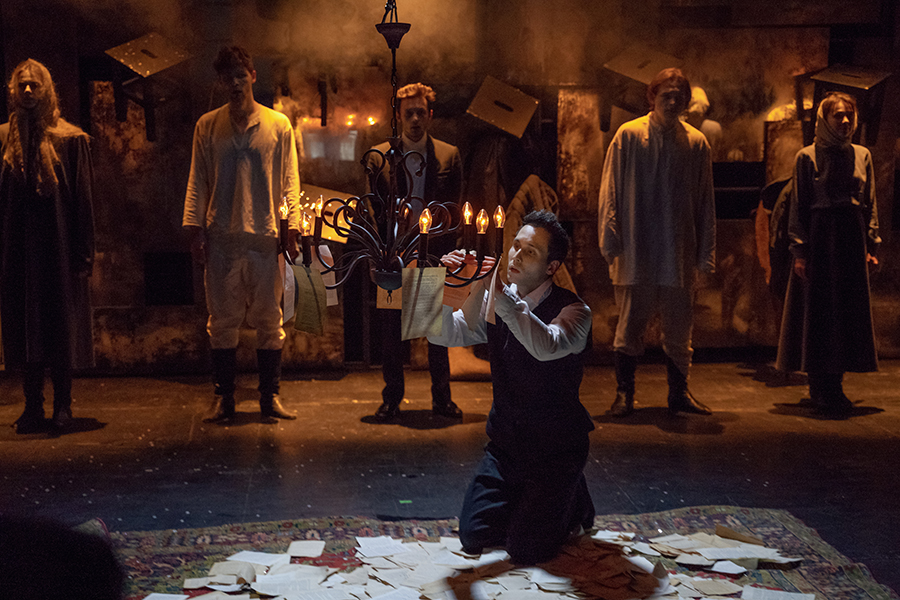
It turned out that the Small Stage stage did not match the scope of the team of creators. But the main thing is that there were so many people who wanted to see the classics, which were not experimented on or "exhausted", that they had to be put on the waiting list. The sold—out premiere on the Main Stage is a confirmation that Anton Yakovlev, artistic director of the Gogol Theater, made the right decision by giving creative space to the production team.

On the stage, the main decoration is a huge mirror, divided into fragments. From the audience, it seems that the surface has gone craquelure from time to time, somewhere a layer of mica has worn off. But it still seems that this has not been a single canvas for a long time and is still able to reflect what is happening. In different scenes, a portrait of Alexander II, an iconographic face, or just an entourage of a manor house appear on the mirror surface. Pavel Parkhomenko and artist Polina Fadeeva worked on the set design, the latter dressed the characters in accordance with the era.
To help the directors, there is a light. Artist Stanislav Teuvazhukov creates a world of heroes playing with different facets under the spotlight. It's life-affirming, and offensively unfair, and scary, and hopeful. The background music sometimes helps the viewer to smile and catch the smoldering hope of happiness. Although the main character does not believe that it exists.
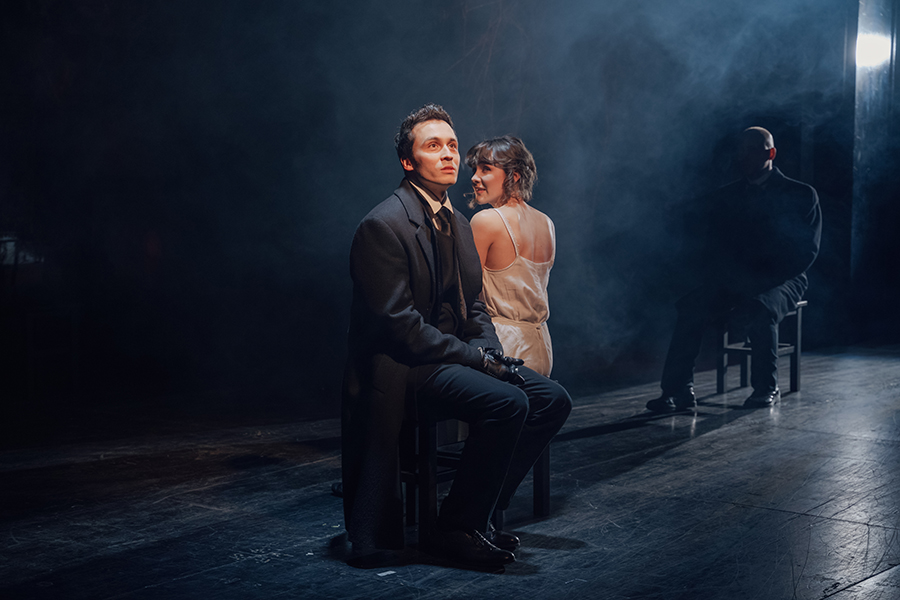
It is based, of course, on the story of Katyusha Maslova, whom Prince Dmitry Nekhludoff seduced and abandoned. And when I met her a few years later, I was shocked by the circumstances. It turned out that with his appearance in the girl's life, all the good things were over. Katyusha became a prostitute, who is now accused of robbing and murdering merchant Smelkov. The prince suffers from pangs of conscience and the inability to change anything. Katyusha goes to hard labor, Nekhludoff follows her, getting to know his country and himself from a new perspective.
The plot was suggested to Tolstoy by the famous Russian lawyer Anatoly Koni. He was a judge in a trial where a juror recognized a prostitute accused of theft as his beloved. Only now she was not so good: the disease had disfigured her face and weakened her health. The man was ready to turn a blind eye to this and even marry her, took incredible steps to free her, but the girl died without waiting for a happy ending. Tolstoy turned this plot into one of the greatest novels in history.
What is amazing about the play "Resurrection"
Yanina Tretyakova plays the role of Katyusha Maslova. From the first appearance on stage, the viewer is interested in following the development and transformation of the heroine: from a young beauty living in a landowner's house in service, to a beaten fate, but still a loving victim of Nekhludoff. The prince is played by Alexander Khotenov. His prince also lives his way from a frivolous and bon vivant to resigned to the role of a fatalist, but suffering and seeking help from the Almighty.
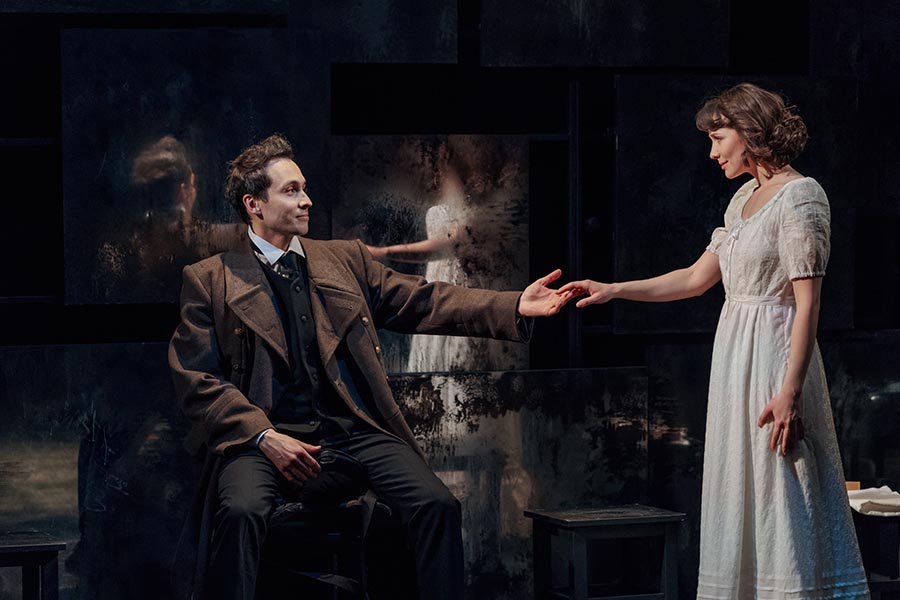
In front of the audience, one scene from Nekhludoff's life is replaced by another. The director finds all kinds of techniques to convey suffering. The most spectacular scene is in which Nekhludoff lies on a table in the house of his fiancee Missy (Sofya Kovaleva) and, in a fit of rage, cuts a block of ice with a knife, which he shouldered on his chest. I immediately think of the film "Basic Instinct" by Paul Verhoeven. If in it Sharon Stone famously wields an ice pick, killing lovers like ancient queens, then Alexander Khotenov puts himself in danger with a gun.

As the director admits, for him, resurrection is also a person's ability to recognize the monster in himself. To face your fears, to realize and, perhaps, to free yourself.
The tempo is so dynamic that the viewer does not have time to get tired of the classical texts spoken by the artists for the author, but he also considers with interest what techniques the director offers them to keep their attention. Sometimes the audience watches the characters balancing on stools, sometimes they watch the spectacular tricks of Petrusha's servant (Evgeny Putsylo) with a saucepan, and then Katyusha Maslova runs into the limelight with a huge ladder. She puts it on her shoulders like a yoke. But at some point, when she bends down under the weight, strong male hands pick up the ladder. And now they are already twisting the girl as they want. And Katyusha, like an acrobat, then soars up, then falls to the ground, clinging to the crossbar with her hands. And this is not just a staircase, but a train carrying away her beloved prince.
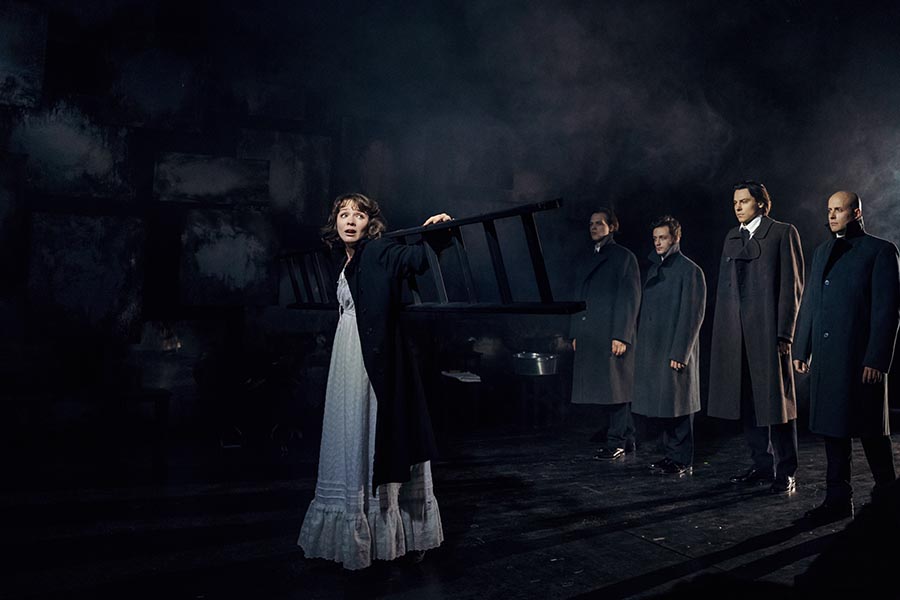
There were different ways to show the fall, but it was done very delicately in the play. The viewer does not have to wince and close his eyes, looking at Katyusha Maslova and Nekhludoff. Outerwear is provided to help the actors. She hides her underwear and gives only a hint of intimacy. Maybe because the love of the heroes was pure. The same cannot be said about Missy Korchagina, Nekhludoff's wealthy fiancee. She is ready to give herself "for a ruble for twenty" right at a family dinner.
In addition to the main characters, the actors play several other characters. Irina Rudnitskaya can be both the habalka Bochkova, and the affectionate maid Agrafena, and the youthful brunette at the reception Sofya Vasilyevna. Kirill Malov plays for three people in Resurrection: he is the grotesque chairman of the court, the goofy Prince Korchagin and a strange Old Man. Anatoly Prosalov — for the Prosecutor, for the former provincial leader Kolosov and for the General.
Anton Pavlovich Chekhov considered Tolstoy's novel remarkable. One thing left him perplexed: that there is no end to the composition, and what there is cannot be called the end. Today we know that Tolstoy thought for a long time about the continuation of the novel, but in the end could not write it. Pavel Parkhomenko's production has logic, but there is also room for the audience's imagination. The next screening of "Resurrection" is on November 12 on the Main Stage of the Gogol Theater.
Переведено сервисом «Яндекс Переводчик»
