They got into "Bondage": Moscow Art Theater named after Chekhov opened the season with the premiere of Bulgakov
- Статьи
- Culture
- They got into "Bondage": Moscow Art Theater named after Chekhov opened the season with the premiere of Bulgakov


Konstantin Khabensky as Moliere, Nikolai Tsiskaridze as King Louis XIV of France. At the Moscow Art Theater named after Chekhov's "Cabal of Saints" returned. The play, written by Mikhail Bulgakov specifically for this stage, is being staged here for the fourth time. Now directed by Yuri Kvyatkovsky. The auditorium is sold out, and the tickets are sold out for two months. How the premiere went and where the hype came from is in the Izvestia article.
Outplay Tabakov
Interest in the new performance of the Moscow Art Theater named after Chekhov's "Cabal of Saints" is a grandiose one. Tickets for the premiere screenings are sold out. Moreover, the prices for the best seats were comparable to the cost of a Large one — 35 thousand rubles. The speculators also made a fuss. A ticket to the tenth row of the stalls on September 5 is being resold for 115 thousand. The last row of the balcony on October 17th costs about 12.8 thousand.
The play based on Bulgakov's play was staged at the Art Theater several times. Mikhail Afanasievich first introduced the troupe of the Art Theater to his new work about Jean-Baptiste Moliere in 1930, but it took her a while to find an audience. Just as Tartuffe by the great Frenchman was once banned, Bulgakov's work, of which he became the hero, immediately came under the close attention of censors.
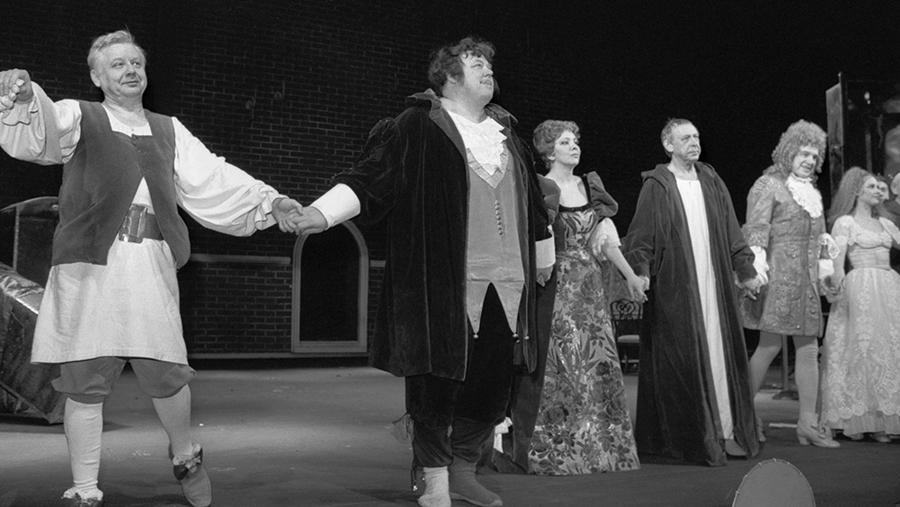
It was directed by Nikolai Gorchakov for the first time. After a couple of months of rehearsals, she was banned. It was only Gorky's intervention and Bulgakov's appeal to Stalin that brought the "Cabal of Saints" back to the stage. But still, the play was played only seven times. In 1988, Adolf Shapiro took over the "Cabal of Saints." He made a play for Oleg Yefremov, Innokenty Smoktunovsky and Natalia Tenyakova. And in 2001, he presented it in an updated version with Oleg Tabakov as Moliere, who appeared in the 1988 play as Jean-Jacques Bouton.

Yuri Kvyatkovsky's version is the fourth. Now Moliere is played by the artistic director of the Moscow Art Theater. Chekhov's Konstantin Khabensky. Nikolai Tsiskaridze made his dramatic stage debut as King Louis XIV of France.
"Louis XIV invented my profession, he created ballet, and what exists now is his invention," says Nikolai Tsiskaridze. — And suddenly Khabensky offered me this role in the play of the Moscow Art Theater. I feel a little uneasy because I have seen Innokenty Smoktunovsky in these walls and in this role. I could never have imagined that one day I would step on this stage.
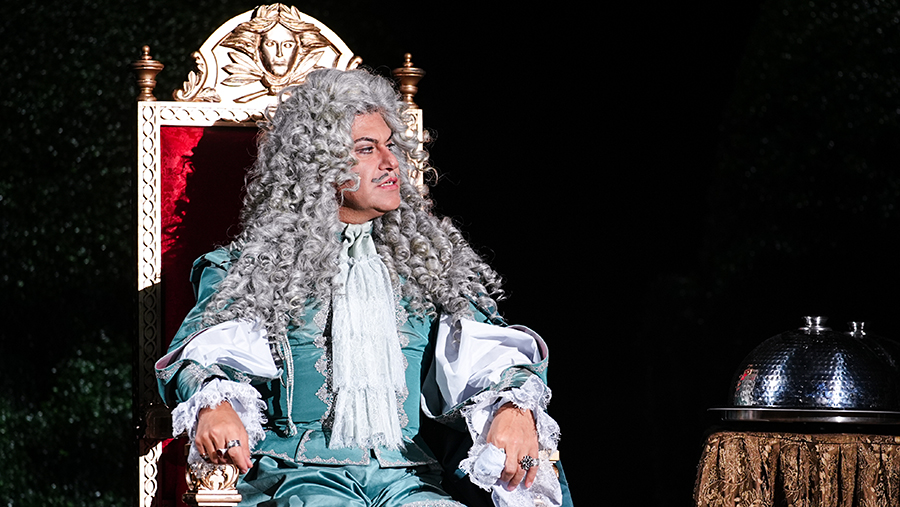
The name of the People's Artist does not appear on the poster. In the program, the role of Ludovic is played not by Nikolai Maximovich, but by Maxim Nikolaev. This is how he came up with a pseudonym for himself.
Alexandra Detek (Madeleine Bejar), Sergey Volkov (Muarron), Ivan Volkov (Archbishop Charron), Igor Khripunov (Bud), Pavel Vashchilin (Anna of Austria), Valery Troshin (Descartes), Alexey Agapov (Poklen), Ivan Dergachev (Du Croisy) are also involved.
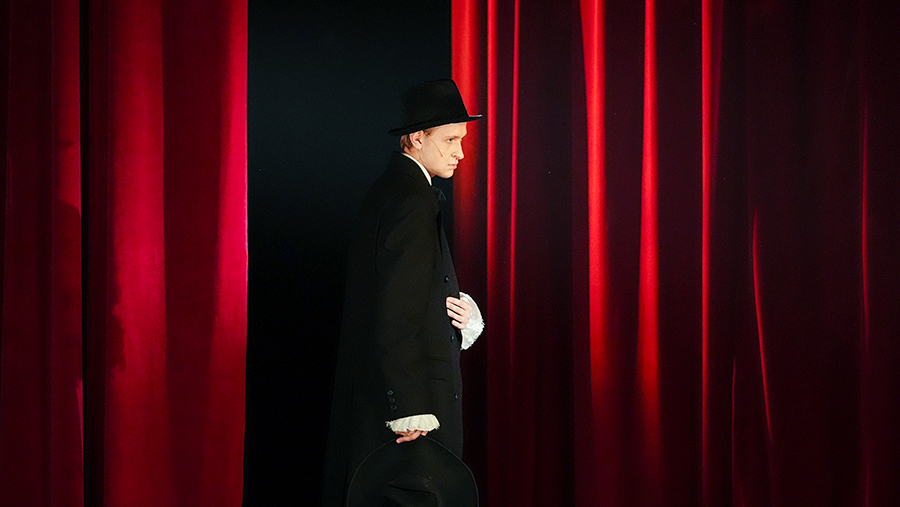
A new character also appears. Playwright Mikhail Degtyarev supplemented the production with fragments of Bulgakov's novel "The Life of Monsieur de Moliere." This is how the author appeared in the "Cabal of Saints" performed by the young artist Ilya Kozyrev. The actor has been dead for two years, and no premiere is complete without him. The young man has 14 titles from his repertoire. Even the artistic director doesn't have that much: Konstantin Khabensky appears in a dozen productions.
The Kunstkamera or the King's chambers
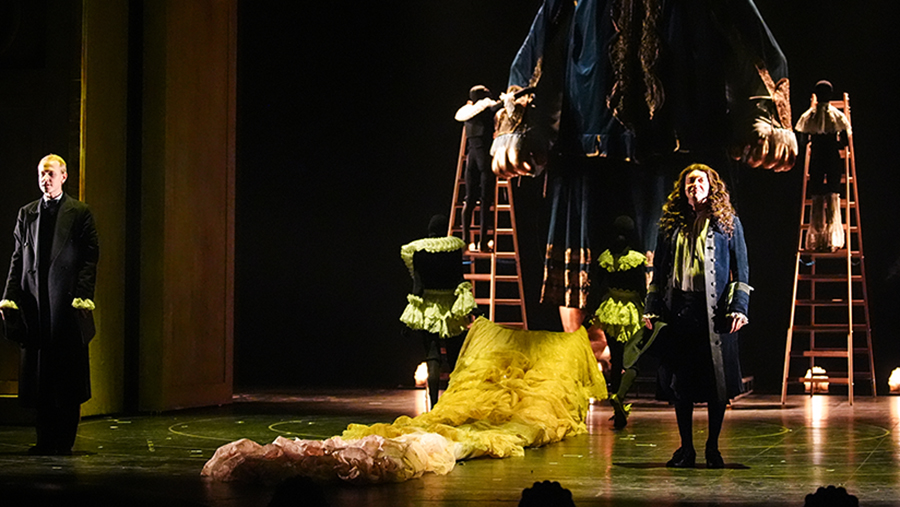
The expectations of the audience, who were ready for Bulgakov's textbook play, were not fully justified. There is a swing on the stage. There are two giant heads in the center. Behind is a shelf with creepy dolls on the shelves, resembling freaks in jars from the anatomical collection of the Kunstkamera. The same big-headed kids were busy on the stage. One of the simple ones is the future playwright Jean-Baptiste Moliere. And the second is the golden boy, the future Sun King Louis XIV.
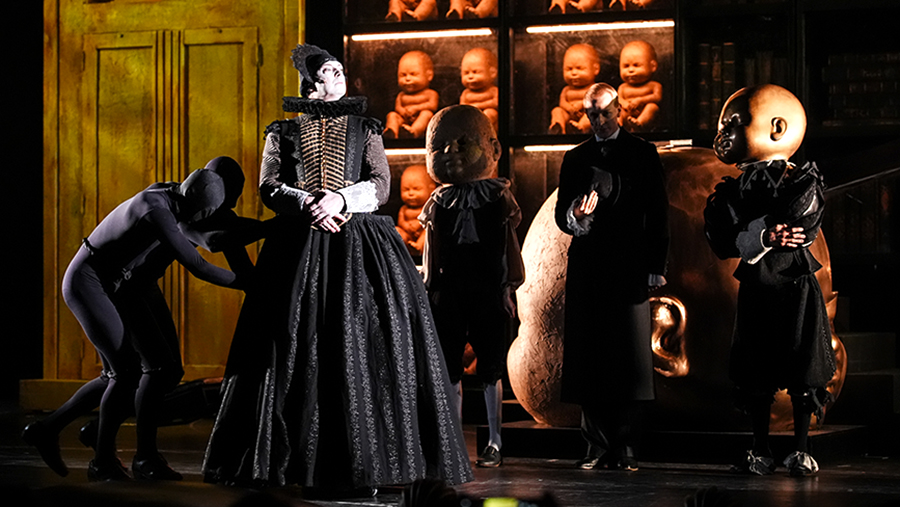
The artist of the play, Nikolai Simonov, used the image of a scary doll in the design of the entire action. This one appears in the play on the bas-reliefs of the Moliere Theater. In the second act, Louis strolls through the garden along the bushes, trimmed in the form of children's heads, reminiscent of the rubber sculptures of Samuel Salcedo in the park Les Jardins d'Étretat in the city of Etretat. A lot of work has been done to create the atmosphere of 17th century France. The interiors of the cathedral have been created, where the archbishop confesses, as well as the tools with which the holy Inquisition tortures infidels: a wheel with spikes, a "witches' chair" with pins.
Costumes play a special role in the performance. They were created by Russian fashion designer Igor Chapurin. Louis XIV alone changes his image six times. One is more luxurious than the other. The king is in gold, in blue, in white, in turquoise. There is also a special detail. Konstantin Khabensky handed Nikolai Tsiskaridze a ring that Oleg Pavlovich Tabakov had once worn in the "Cabal of Saints." Today's Louis appears to the viewer majestic, imperious, and unflappable.
"France is in front of you in an armchair," says the king, receiving Moliere in his palace. "She eats chicken and doesn't worry.
"You're the only one in the world who can say that,— Moliere replies.
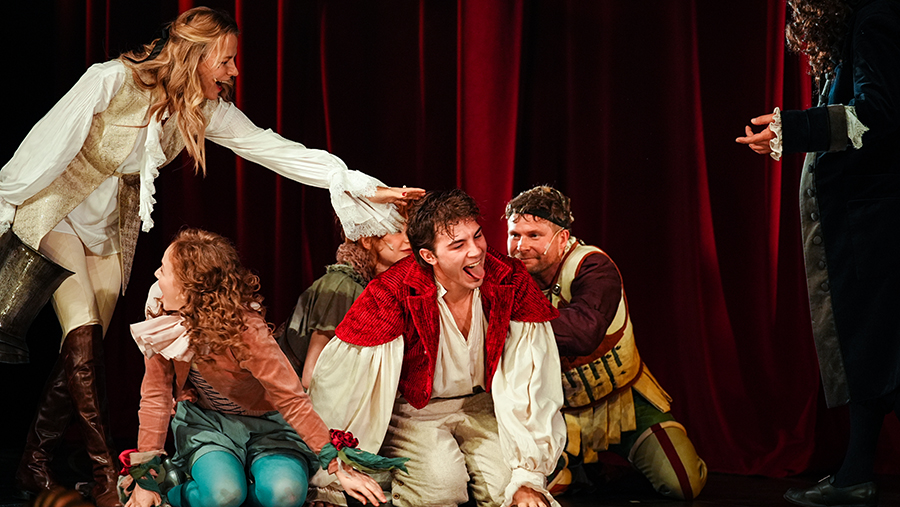
Despite the sycophancy, the punishment overtakes the playwright. Louis overthrows his beloved writer, comedian, without hesitation, after learning about Moliere's crime against the church. Jean-Baptiste married a young actress, Armande, who turned out to be his daughter. The girl's mother, Madeleine Bejar, the prima ballerina of his troupe, did not know who the real father was and passed the heiress off as her sister. Two children of Moliere and Armande did not live to be a year old due to incest. The atheist was destined for a terrible end. Madeleine is dead. His young wife became entangled with Moliere's named son Moiron. The lover was caught off guard and handed over the main secret of the "father" to the archbishop. But despite the monarch's sanctions, Moliere eventually forgives the informer Moiron.

The director decided that it was not only Moirron who deserved forgiveness in this performance. In the final scene, Moliere's first act of apology is to a young, rake-like snitch. And then the actors of the Chekhov Theater admit that everyone has moments in life when repentance is necessary. "My tongue is my enemy," the actors reasoned.
— I urge everyone not to repeat my mistakes, and to think with your own head, if there is one, — Anna of Austria repented.
"I am Ilya Kozyrev, the actor who plays the author in this play, and I apologize for the playwright who corrected and rewrote the text of The Cabal of Saints," the actor said. — I sincerely apologize for the manipulation of historical facts in favor of fiction. I don't understand how this could happen. Apparently, his mind was clouded. I'm sorry, for God's sake.
— I, Konstantin Yurievich de Moliere, the artistic director of this theater, sincerely apologize for all this. In the pursuit of achievements, ambitions, success, the line of what is allowed has been erased. I understand that a people's artist should choose his words more carefully. I still have to analyze it. But I am truly ashamed in front of everyone who watched this performance. Perhaps they believed in him. I'm sorry for what I did. Once again, I apologize to the victims and those who left during the intermission.
And the audience forgave. They thanked the artists with an ovation.
Переведено сервисом «Яндекс Переводчик»
