Needle on departure: rapid test will protect athletes from sudden death
- Статьи
- Science and technology
- Needle on departure: rapid test will protect athletes from sudden death


Russian scientists have experimentally confirmed that the level of troponin protein in saliva is consistent with its content in the blood. This compound is traditionally used as a marker for detecting heart damage after heavy training in athletes. However, the need to take material from a vein limits such studies. As a result, sudden deaths among professional athletes at competitions occur regularly. The discovery of domestic specialists makes it possible to create a simple method for monitoring cardiac disorders, which athletes can use independently, without the help of doctors. According to experts, the entire sports world is now trying to abandon blood tests, and the development will be an important step in this direction. However, for practical application, studies on larger samples are needed.
Assessment of the state of the heart by saliva
Scientists from Lobachevsky Nizhny Novgorod State University have experimentally confirmed that the level of troponin protein, involved in the contraction of cardiac muscle cells, in saliva is consistent with its content in the blood. Therefore, it can serve as a marker of damage to the heart muscle (myocardium), which is possible during heavy physical exertion. The discovery showed the possibility of creating rapid tests for athletes who will be able to monitor their condition even without the help of doctors. Now such a study requires blood and its analysis by a specialist.
— The obtained results open up new possibilities in cardiac monitoring of athletes. An express saliva test will allow you to quickly receive information about heart damage caused by physical exertion, which can help save lives, given the growing interest in extreme sports both in Russia and around the world. Imagine a glucose meter for diabetics, but instead of blood, it uses saliva, and it does not measure sugar, but damage to your heart after a marathon. We are now starting research related to the verification of the developed approach in clinical practice. We are talking about a new project that was supported by the Russian Science Foundation and the ultimate goal of which is to create a predictive model for the early diagnosis of myocardial infarction in people involved in sports," said the project leader, head of the research Laboratory of Noninvasive Diagnostics in Sports, associate professor of the Department of Sports Medicine and Psychology at Nizhny Novgorod State University named after N.I. Lobachevsky. Alexander Ovchinnikov.
According to the developers, cardiovascular complications are one of the main causes of death among athletes. According to statistics, in 56% of cases sudden death during exercise occurs due to heart disorders. At the same time, most of the victims did not experience obvious symptoms before the tragedy. Heart attacks also occur regularly in competitions. For example, one of the most high-profile incidents occurred at the 2020 European Football Championship. Then the midfielder of the Danish national team Christian Eriksen lost consciousness right on the field during the first half of the match with Finland. Doctors diagnosed him with cardiac arrest, but their competent actions saved the football player from death.

Traditionally, the level of troponin in the blood is measured for the diagnosis of myocardial infarction. Troponin is a protein that is involved in muscle contraction and serves as the gold standard marker of damage to heart muscle cells. This approach makes it possible to identify myocardial damage caused by high-intensity prolonged physical exertion, including extreme ones.
The study of the level of cardiac troponin-I in saliva demonstrated accuracy comparable to its analysis in the blood. This makes it possible to create non-invasive biosensors to identify athletes at risk of acute or chronic myocardial damage, as well as to monitor recovery after competition.
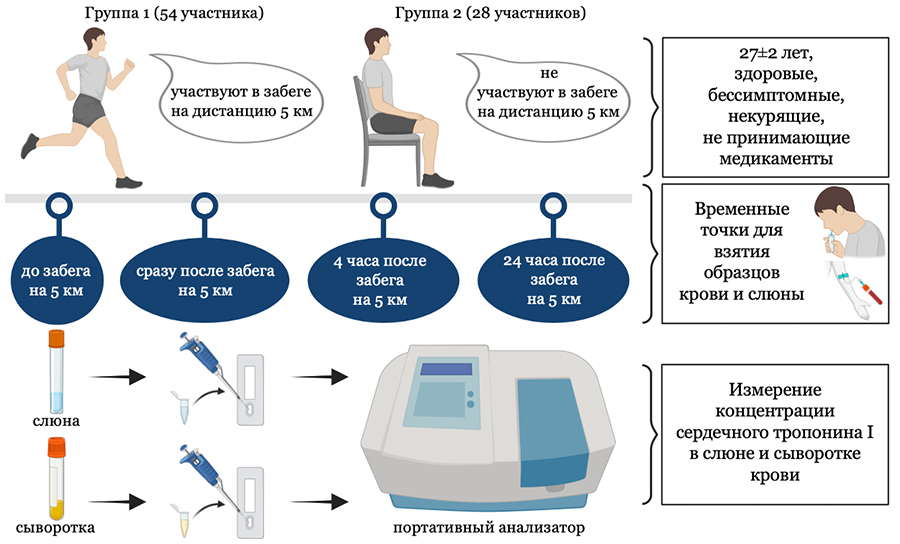
82 male athletes participated in the experiment of Russian scientists. They were divided into the main group (54 people), which ran 5 km at the maximum possible speed, and the control group (28 people), which did not perform such a task. Blood and saliva were taken from the subjects before the race, immediately after, after four and 24 hours for subsequent analysis. The results showed that the runners' levels of cardiac troponin-I in saliva and blood increased significantly after exercise and peaked after four hours — the protein concentration increased almost four times compared with the control group. After 24 hours, the indicators returned to their original values. There were no changes in the control group.

Large sample
According to Alexander Miroshnikov, Associate Professor of the Department of Sports Medicine at RSUFKSMiT, the creation of a non-invasive technique for monitoring heart damage would be an important step for sports medicine. However, for practical application, it is necessary to confirm the results obtained on a larger sample.
— Many more studies on large samples are needed to prove the results obtained. Troponin in the blood has been controlled for many decades, and if it can be done by saliva, it will be an important achievement. The whole sports world and WADA (World Anti-Doping Agency. — Izvestia) they want to avoid blood tests because it is an expensive, painful and inconvenient procedure. This is a trend. Now the agency is even trying to replace all the samples with dry blood and "get away" from the vein, — said Alexander Miroshnikov.
In addition to sports, the analysis of saliva for troponin can find application in the emergency room and other medical fields, says Albert Rizvanov, head of the Center of Excellence "Personalized Medicine" at Kazan (Volga Region) Federal University.
— The study showed that frequent, non-invasive saliva monitoring is possible directly "on the field" without medical staff. Outside of sports medicine, this is applicable in emergency care, telemedicine home monitoring in patients at risk of heart disease (ischemia, myocarditis), as well as in occupational medicine for groups with high physical activity (firefighters, military, miners, construction workers, etc.). The key to implementation is the clinical validation of test thresholds and comparability with highly sensitive blood tests. When these criteria are confirmed, the market for a "glucose meter for the heart" seems realistic," said the specialist.
The results of the study, supported by a grant from the Russian Science Foundation, are published in the scientific journal Scientific Reports.
Переведено сервисом «Яндекс Переводчик»
