- Статьи
- Science and technology
- Mouse training: Bion-M No. 2 will help create medicines and find the source of life

Mouse training: Bion-M No. 2 will help create medicines and find the source of life

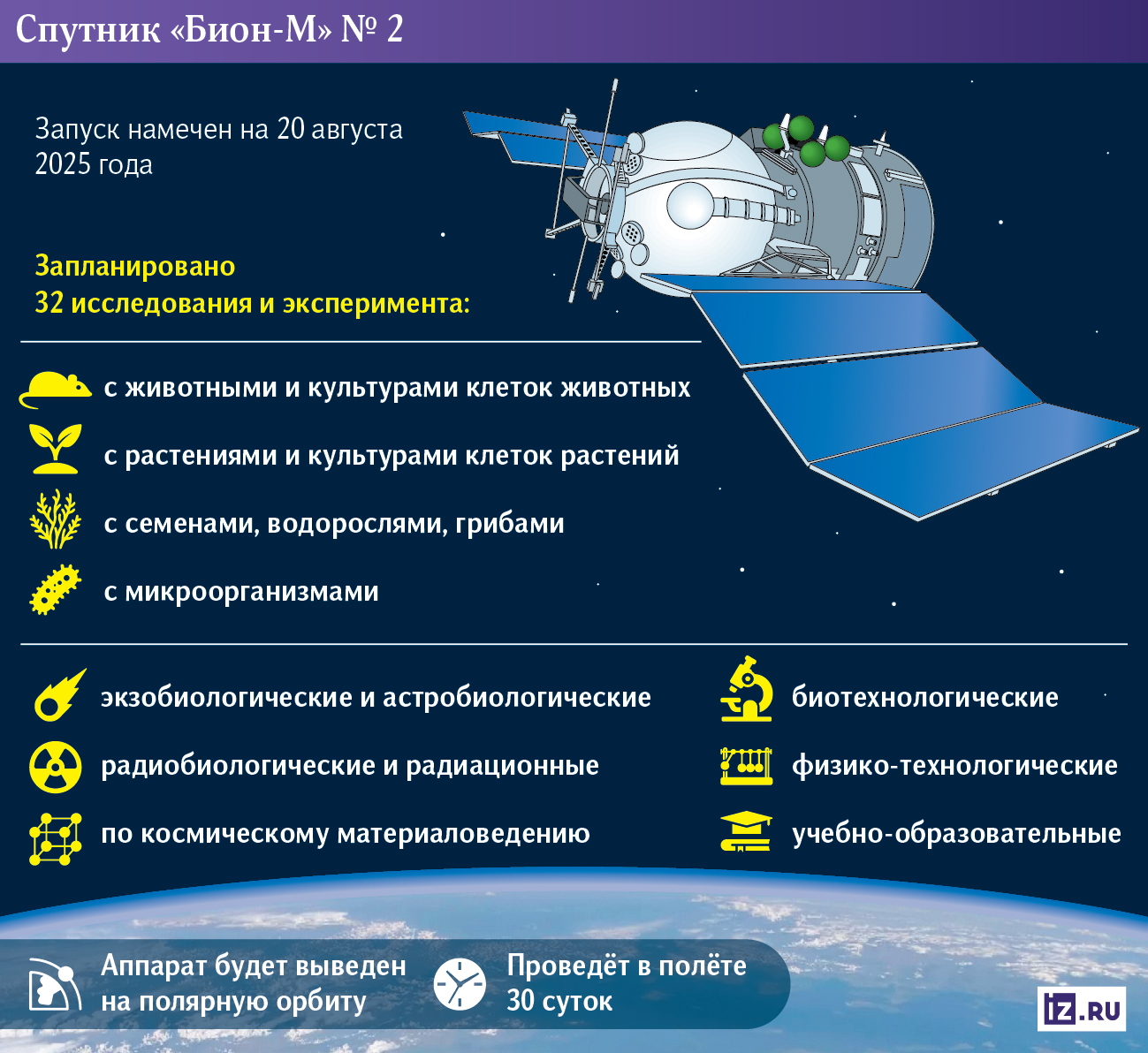
The flight of the Bion-M spacecraft No. 2, which is scheduled for launch on August 20, will last 30 days. During this time, several generations of drosophila flies will change on board. This will help to better understand the impact of space conditions on the offspring of living beings. Also, for the first time in the world, Russian scientists will give mice water in the form of a gel and check whether microbes could get to Earth from space. In total, more than 30 scientific experiments will be conducted on the biosatellite during the orbital mission. Read more about the most interesting of them in the Izvestia article.
How a biosatellite will bring the exploration of deep space closer
Scientists will conduct unique research on the Bion-M satellite No. 2, which is scheduled to be launched on Wednesday, August 20. They will become the basis for new discoveries in medicine, biology and technology and will bring humanity closer to interplanetary travel. This was told to Izvestia by Russian scientists.

Biological and technical tests of scientific equipment BIOS MLZH-02
— The launch of a biosatellite is a strategically important project for our country, which holds a leading position in biological space research. Many foreign scientific organizations use Russian developments in this field," Gennady Krasnikov, President of the Russian Academy of Sciences, commented in an interview with Izvestia.
He specified that more than 30 experimental studies will be carried out during the mission. More than 50 Russian scientific organizations participated in their preparation and implementation.
— The upcoming mission is distinguished from the previous ones by the orbit that passes over the poles of the Earth. Compared to the usual conditions of space flights (at low latitudes), it has 30% higher radiation levels, as well as much more high-energy galactic particles and a different geomagnetic environment. The influence of these factors is of great interest, as it can be extrapolated to flight beyond the Earth's magnetosphere. This brings us closer to the exploration of deep space and other bodies of the Solar System," said Vladislav Sedletsky, Executive Officer of the Bion—M project No. 2, head of the laboratory of the IMBP RAS.

Scientific equipment TRITEL-B. It is designed to study the dynamics of absorbed and equivalent dose, flux and spectrum of linear energy transfer from various sources of ionizing radiation during space flight.
He recalled that 75 mice, 1.5 thousand fruit flies of drosophila, several species of plants, their seeds, as well as cultures of fungi and microorganisms will go into space on board the spacecraft. Unlike previous flights, this time scientists will have the opportunity, in addition to standard telemetry information, to receive video images from the satellite.

This in itself, the scientist noted, will allow us to obtain important results about the behavior of animals in flight. On the other hand, the new technology will make it possible to adjust the tactics of work in the research process.
How space flight affects offspring
According to Vladimir Sedletsky, the scientific program of the project includes 10 areas. In particular, with the help of small laboratory animals (mice), scientists will explore the possibilities of adapting the cardiovascular, bone, muscle and other physiological systems of mammals to the conditions of space flight.
Scientists will also solve technological problems during the experiments. In particular, they will study in what form it is better to give animals water, which behaves unpredictably in zero gravity. For these purposes, some of the mice will receive a pasty feed with a liquid content, and one group will receive water in the form of a gel. This technology has been used for the first time in the world.

Mice of the C57black/6 line in the scientific equipment of BIOS MLZH-02-02 during biological and technical tests
— At the same time, scientists will study the long-term consequences that may occur in the next generations of descendants of the flight participants on the fruit fly drosophila. The similarity of many genes and molecular mechanisms with similar ones in humans makes it possible to use these insects to study human diseases," explained Vladimir Sedletsky.
At the same time, he stressed, due to a short period of development (10-14 days) and good fertility, mutations and changes in DNA caused by cosmic factors can be traced in one month of space flight, using at least two or three generations of flies.
Another large group of experiments, the project manager said, is focused on studying the impact of space conditions on plant biology. In particular, as part of these programs, calendula and Rhodiola rosea will be sent into orbit.
In the course of these studies, scientists intend to study whether the rate of cell growth and production of nutrients used in medicine and the production of dietary supplements will change in space. Of particular interest are possible beneficial mutations that can be fixed genetically in order to create more effective strains in the future.

In one of the experiments, experts are examining the seeds of rare plants that have previously traveled to space on the Photon-M and Bion-M satellites No. 1. These studies will show how space conditions will affect the ability of seeds to produce more stable and productive offspring.

Work on the Bion-M1 biosatellite landing site. An IMBP RAS specialist examines the appearance and condition of scientific equipment immediately after opening the hatches
— We will study both new plant species that have not previously participated in space experiments, and the "great-grandchildren" of plants that have already been in orbit. Our goal is to understand whether the genetic and phenotypic changes caused by space conditions are fixed after repeated flight. This time, thanks to new technologies, for the first time in real time — throughout the entire 30 days of the mission — we will be able to obtain accurate data on environmental parameters: radiation, microgravity, temperature fluctuations, etc., and their effect on plants," one of the directors of the experiment, an agronomist of the flora department of the Botanical Garden, told Izvestia. the garden of Samara National Research University named after Korolev Elena Kayurova.
Could microbes have come to Earth from space
In general, according to Vladimir Sedletsky, the Bion-M mission No. 2 will expand understanding of the laws of life in the universe. In this sense, an experiment in which researchers simulate the arrival of a meteorite on Earth is of particular interest. Its role will be performed by basalt disks fixed on the outside of the satellite, inhabited by microorganisms.
During the mission, scientists will observe how the bacteria on the meteorite will withstand the cold of space, radiation in orbit, and extreme heat when it is enveloped in a plasma cloud on its way back to Earth during entry into the dense layers of the atmosphere.

Scientific equipment SPD-M. Designed to study the distribution of integral (for the entire flight) absorbed and equivalent doses of radiation from various ionizing radiation sources inside the Bion-M lander No. 2 and on the surface of its inner skin
In this way, scientists will be able to test the theory of panspermia, which involves the introduction of life to our planet from outer space.

According to the project manager, according to the plan, after 30 days of flight, the satellite will return to Earth, where scientists will conduct a detailed analysis of all biological samples.
— We expect that it will be possible to quickly fix the biomaterial at the landing site, which will make it possible to assess the almost "pure" influence of space flight factors. Such capabilities are an advantage of biosatellites compared to other types of research in real space flights," the scientist explained.
According to him, experts have already started designing the next mission involving a biological satellite. Its scientific program will be based on the results of the current flight.
Переведено сервисом «Яндекс Переводчик»
