The US and the EU have concluded an unequal tariff deal. What you need to know

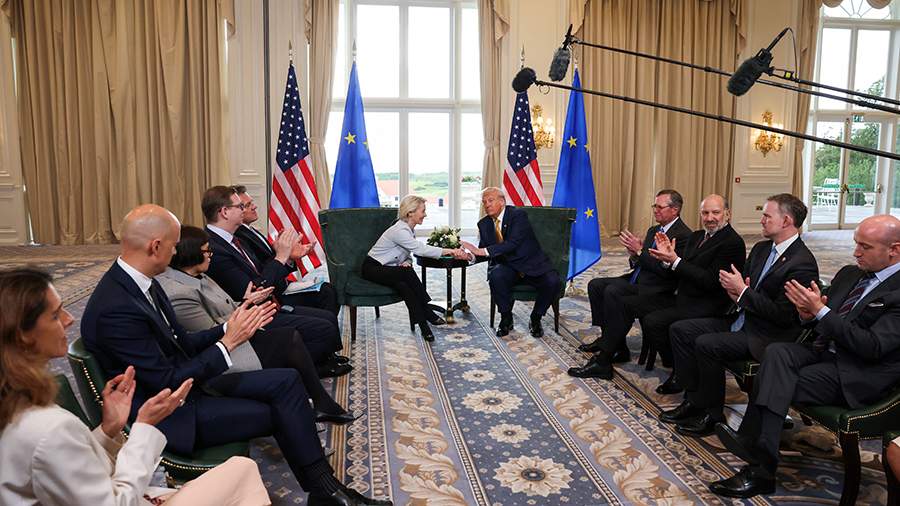
The agreement between Washington and Brussels, according to which exports from the European Union to America will be subject to a 15% rate, could hit the European economy hard. In addition, such strong concessions demonstrated the disunity within the EU. Why Brussels agreed to unfavorable conditions for itself is in the Izvestia article.
The split in the union
• The European Union had to agree to a trade agreement with the United States, including 15 percent tariffs on EU supplies, due to the inability of the bloc's countries to develop a common strategy for countermeasures. The choice was between accepting the conditions proposed by Washington and developing a coordinated response. However, a collective reaction would require unity of opinion, action, and a willingness to face possible negative consequences. European countries did not dare to do this.
• As a result, the deal turned out to be extremely beneficial for Washington: the United States plans to occupy about 70% of the European energy market if the EU countries increase the volume of purchases of American resources to $250 billion annually. In turn, possible losses are already being calculated in Europe. In particular, Poland may lose about $2.2 billion from trade duties. At the same time, with the continued devaluation of the dollar, which has already exceeded 10%, European companies focused on exporting to the United States will be forced to look for new markets. In particular, Italian supplies may decrease by about €23 billion. After all, it will be unprofitable for businesses to pay duties and earn income in a currency that depreciates faster than the euro.
• However, there are doubts that the terms of the deal are even feasible. In order to achieve the expected volume of trade supplies, the European Union will need to triple purchases of American energy resources compared to previously recorded volumes. To achieve this scale, US energy companies will not only have to concentrate all existing export flows in the European direction, but also exceed current supply levels by using additional resources. An additional complication for the European Union is the fact that energy purchases are handled exclusively by private corporations, not government agencies, which is why Brussels lacks direct leverage over import processes and the distribution of energy supplies.

• The weakness of the European Union manifested itself in the inability to behave as an integral strategic force, which is required by the global context. Although the European Commission is officially responsible for trade issues, the key parameters of the deal were determined at the intergovernmental level within the union. Within the EU, this agreement is perceived as a forced measure and the least painful option under the circumstances. In particular, France and Germany opposed actions that could provoke retaliatory steps on the part of the United States and damage their economies.
• During the discussions, the EU countries focused not on common European interests, but on protecting their own economies. Each state sought to minimize risks and costs for itself, which prevented the formation of a unified position. The proposal to create a list of American goods for potential retaliatory duties faced resistance from those countries that feared increased pressure from Washington.
Why is the deal unprofitable
• The EU-US agreement restricts the economic interests of European countries, especially in the context of unstable global trade and the internal vulnerability of European industry. The introduction of duties means an automatic reduction in the competitiveness of European products in the American market, one of the key areas of the EU's foreign economic activity. This applies primarily to high-tech industries, mechanical engineering, agriculture and the chemical industry, where European companies traditionally occupy strong positions. An increase in the cost of products due to duties can lead to a loss of market share, a reduction in exports, a decrease in production volumes and, as a result, job cuts in a number of EU member states.
• An additional burdensome factor is the structure of the deal itself, which provides for large purchases of energy and weapons from the United States. These costs are borne by the budgets of European states and create long-term obligations to the American side. Fixed-volume purchases limit the flexibility of the European Union in finding more profitable or sustainable suppliers. As a result, dependence on the United States in key economic sectors is increasing. In the long term, this may negatively affect the energy and defense independence of European countries.

• The formation of the terms of the deal without the general agreement of all EU participants reflects the limited ability of the bloc to act as a whole in a crisis situation. The countries pursued primarily short-term economic goals, seeking to avoid immediate consequences such as potential sanctions or economic pressure from Washington. As a result, the agreement was concluded due to concessions from the EU.
• In addition, the lack of retaliatory measures or readiness for them on the part of the European Union demonstrates strategic vulnerability: without a mechanism for collective economic defense, the EU becomes dependent on the decisions of more powerful trading partners. This undermines his negotiating position in the future. This creates a precedent in which other states may perceive the European Union as a weak union that is not ready to protect its own interests.
• As a result, the deal carries complex risks for the EU, from loss of export revenues and pressure on domestic markets to restrictions on freedom in strategic planning. The damage may not appear immediately. However, in the long term, it can significantly weaken the economic and political positions of the European Union in the international arena.
When writing the material, Izvestia took into account the opinions of:
- Associate Professor of the Faculty of Economics of RUDN University Sergey Zainullin;
- the economist Vasily Koltashov.
Переведено сервисом «Яндекс Переводчик»
