Zelensky is conducting a large-scale reshuffle in the government. Analysis

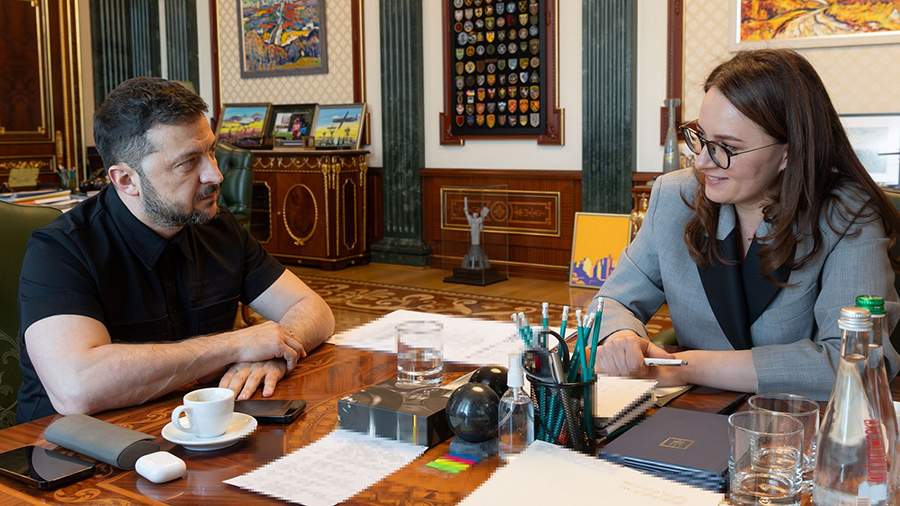
President of Ukraine Volodymyr Zelensky is carrying out large-scale personnel changes in the composition of the Ukrainian government. In particular, we are talking about the change of the Prime Minister and the head of the Ministry of Defense. What these changes are aimed at and whether they will be able to increase the efficiency of officials' work is discussed in Izvestia.
Government reshuffle
• Yulia Sviridenko, who holds the position of Deputy Prime Minister and oversees the economic sector, has received an offer from President of Ukraine Volodymyr Zelensky to head the Cabinet. According to preliminary information, Prime Minister Denis Shmygal, leaving his current post, will take over the post of Minister of Defense, replacing Rustem Umerov in this position. The latter, in turn, is scheduled to be sent to Washington as Ukraine's new ambassador to the United States. There has not been such a large-scale reshuffle since the beginning of its history. Such drastic changes are related to the need to get out of the crisis situation that Ukraine is currently in.
• Sviridenko led the Ukrainian delegation during a visit to the United States, where she held talks with American Treasury Secretary Scott Bessant about the investment fund (we wrote more about the natural resources deal that led to the creation of the fund here). This trip was a kind of test. Overseas, she was assessed as a potential candidate for the post of head of government. Sviridenko is also considered close to Andrei Ermak, the head of the president's office, who actively lobbied for her candidacy. There has been talk in the Ukrainian media space that Sviridenko should head the Cabinet of Ministers for at least three months. This appointment is primarily due to Kiev's desire to please European and American politicians who are investing large sums to continue the military conflict.
• In turn, the appointment of Shmygal to the post of Minister of Defense of Ukraine is not related to the desire to strengthen the military bloc or modernize the armed forces. He will probably only manage the financial flows coming to the country from Western partners. Over the years of his work in the government, he has established himself as an executive bureaucrat who is not inclined to take independent political steps and does not demonstrate a desire to expand his own influence.

It is difficult to predict how Umerov will perform in the role of ambassador, but his work as Minister of Defense was clearly unsuccessful. It has long been said in Ukrainian expert and political circles that he should have been relieved of his post as minister much earlier. However, Umerov has long since moved his family to the United States. In recent months, he has actively interacted with American representatives within the framework of the Ramstein format, participating in meetings with senior US officials. In addition, Umerov personally arrived in the United States shortly before the Russian-Ukrainian talks scheduled for June 2-3. His appointment as ambassador was a matter of time.
The consequences of the permutations
• Every conflict of interest between the Ukrainian elites or a change in the foreign policy context entails a reformatting of the executive branch. Now the reshuffle is primarily related to the creation of an investment fund for the United States and Ukraine.
• The creation of this fund, despite its outwardly positive presentation, has a number of potentially adverse consequences for Kiev. First of all, in the long term, this structure may limit the sovereign management of the country's economy and increase external dependence. The fund's mechanism itself presupposes the active participation of foreign structures in the selection and implementation of investment projects in Ukraine. This means that strategic decisions on financing and resource allocation are likely to be made taking into account the interests of external investors. At the same time, the internal needs of Ukrainian society are unlikely to be taken seriously.
• There is no reason to expect fundamental changes in the effectiveness of the new Ukrainian government, because the main causes of managerial instability remain unchanged. The systemic weaknesses of public administration took root long before the current political crisis. In Ukraine, the government often depends on the immediate political decisions of the president, who is influenced by various local oligarchs. At the same time, for many years Ukraine has been de facto governed by international financial organizations and foreign political partners such as The Vanguard Group. Also, until recently, the American corporation BlackRock had a great influence. As a result, each new Government finds itself within pre-defined constraints, where opportunities for independent development and implementation of strategic initiatives are minimal.

• The formation of a new cabinet of Ministers now will not be accompanied by deep personnel rotation. In fact, this is just the movement of already agreed-upon politicians within an already well-known bureaucratic scheme. Government officials move from one position to another without offering fresh approaches or alternative solutions. This creates a vicious circle effect. As a result, the new cabinet will continue to act according to the logic of the previous one. Even with loud reformist rhetoric, concrete actions will be hampered by bureaucratic resistance and inconsistencies between the various branches of government.
When writing the material, Izvestia talked and took into account the opinions of:
- Vasyl Vakarov, a member of the Council of the Other Ukraine movement;
- political scientist, Professor of the Higher School of Economics Andrey Bystritsky;
- military political scientist, expert of the Association of Military Political Scientists, Head of the Department of Political Analysis and Socio-Psychological Processes of the Russian University of Economics. Plekhanov by Andrey Koshkin.
Переведено сервисом «Яндекс Переводчик»
