
Satan's Buttons and Witch buns: what the ancestors mistook fossils for

Anton Nelikhov, a specialist in mythical and other paleontology, has collected in his new book many examples of human attitudes towards the fossils of ancient fauna — both respectful, reverent and superstitious, as well as purely utilitarian. Critic Lidia Maslova presents the book of the week, especially for Izvestia.
Anton Nelikhov
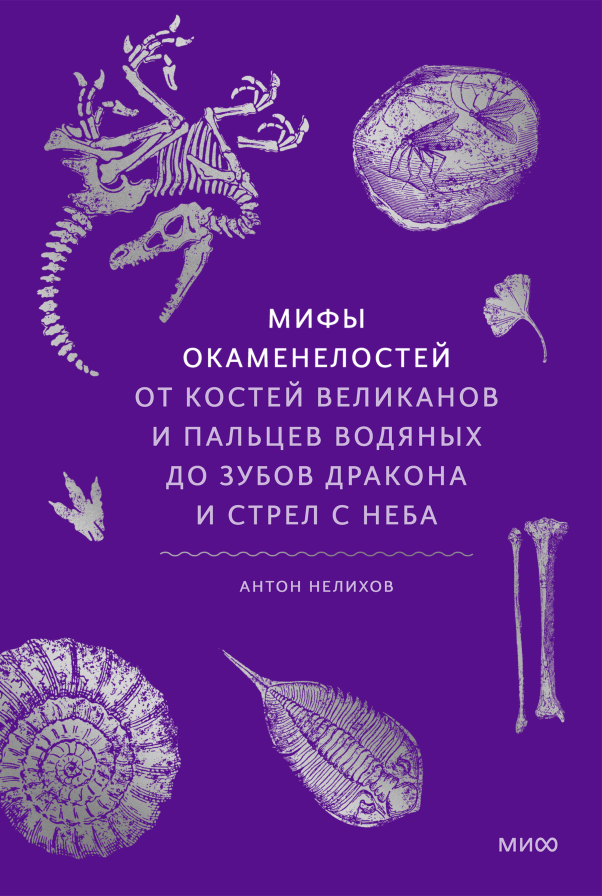
"Myths of fossils"
Moscow: MIF, 2025. 320 p.
The utilitarian, however, occupies a much smaller place in the history of research due to the cognitive distortion known as the "survivor's error" and associated with the use of fragmented data. This is discussed in the conclusion with the subtitle "Dice Games", where the author hints that there could be whole mountains of evidence about the mythological and folklore interpretation of fossils, much more than those two hundred or more of the most interesting stories, which he decided to limit himself to, leaving many overboard because of their monotony..
"The reconstruction of folklore representations based on such extensive material looks plausible," writes Nelikhov, "but there is a problem: fossiliferous finds were not always accompanied by superstitions, rituals, and rituals." However, up to this point, the gullible reader has already had a strong impression that not a single bone, shell, tooth or claw mark found on earth was perceived by ancient (and relatively modern) people as rationally explicable and not at all supernatural natural phenomenon, but immediately overgrown with fabulous, magical meanings and properties. This is explained by the fact that "most of the fossilized remains do not look like anything familiar," and therefore the answers to the question of where they came from could have the most original character.

Nelikhov begins his acquaintance with fossils, which have been present in people's lives at all times, since the Stone Age, and have constantly found use in everyday life since 814 and suggests moving to the capital of the Frankish Empire, Aachen, where the first emperor of the West, the "father of Europe" Charlemagne, is buried. In the gorgeous two-kilogram crown decorated with emeralds, amethysts and pearls adorning his gilded bust, Nelikhov especially highlights two nondescript "translucent brown pebbles the size of a fingernail" inserted into the occipital part. These are bufonites, named from the Latin word bufo (toad), known in Russia as zhaboviki, or toad stones, and have long been shrouded in legends and superstitions, like the toad itself: "They were said to grow in the heads of old toads between the skull and skin. They allegedly warned the owner about the proximity of the poison: if there was poison nearby, the buffonites sweated and burned the skin. They could also suck the poison out of a poisoned person, while seemingly changing color, becoming dark and cloudy."

Nelikhov dispels the "toad" misunderstanding, explaining that the bufonites are actually not stones at all, but the teeth of the Jurassic ray-finned fish Scheenstia maximus, which swam on the territory of modern western Europe and outwardly resembled two-meter bream. Their round teeth were arranged in several rows, so "the mouth looked like a cobblestone pavement." However, the ancient people, who did not have scientific information, stubbornly continued to search for magical minerals in the heads of snakes, turtles, birds and other creatures — in the Russian Empire, for example, in the heads of sturgeons and belugas.

The second chapter of the first part, "Symbols: masks, graves, sanctuaries," talks about the fact that Paleolithic man was already endowed with symbolic thinking, which allowed him to make fetishes out of fossils, worship them, and sometimes even animate them for ritual purposes: "Archaeologists have a joke: consider everything incomprehensible as ritual. The opposite is also true: everything that is considered ritual is unclear." One of the most popular ritual objects were the rostrums of the belemnite fossil mollusk and round ammonites, which are still popular with jewelers: "Ammonite shells are pleasing to the eye, they look like the sun, which gives life to people, pigs, and gardens, and therefore the superstitions associated with them are very monotonous."

A separate chapter is devoted to Ancient Greece, which, like many other cultures, had its own mythical paleontology, which tried to imagine with the help of huge fossil bones where the world came from and what it was like in the deep past. At the same time, the Greeks, including the wise "father of history" Herodotus, could sincerely mistake dinosaurs for hydra and dragons, mammoths for huge cows, comet impacts for divine punishments, and extinct animals for mythological heroes: "A hundred years after Tiberius, bones fell out of a cliff on the seashore near Troy, which the oracle recognized as the remains of the hero of the Trojan War, Ajax. Emperor Adrian himself came to see them. He kissed them, and then ordered them to be laid out in the shape of a man. It also turned out to be almost a five-meter skeleton, that is, the bones were probably from an elephant. At the behest of the emperor, a beautiful tomb was built for them in Troy." Ancient Egyptians and Romans also repeatedly buried fossil bones under the guise of the remains of gods, heroes and demigods.

In the chapter "Europe: giants, saints, Lindwurms," Nelikhov talks about the medieval tradition of mistaking fossilized bones for the remains of fallen angels or for the relics of saints, but the logic of perception of fossils remains the same even after Antiquity: "Even a cursory review of the mythical paleontology of medieval Europe shows that it was filled with the same typical characters as antique". Moving across countries and continents, the author of the book captures recurring, typical patterns of mythological thinking in different cultures, including its ambivalence, when the same subject, depending on circumstances, becomes sacred or, conversely, demonized. How, for example, were the same rostra widely distributed Belemnites demonized?: "In addition to nails and teeth, evil spirits all over the world massively lost petrified objects. Various remnants of invertebrates were called Satan's buttons, witch's plates, goblin hats. In the Pyrenees, Cretaceous corals became witch buns. The rostra of the Belemnites in Dagestan is called Shaitan's garlic press."

Studying all these stories, one is amazed at the ability of the human mind to mythologize anything, probably so that life would not be so boring. "The Myths of Fossils" once again confirm that the main "factory setting" built into our brain is the ability to willingly and sincerely accept one thing for another. "A person is always trying to understand what he has seen..." explains Nelikhov this feature of perception, which is in too much of a hurry to "understand" and therefore rushes to explain on the basis of incomplete surface information. Since everything incomprehensible is frightening, the first explanation often turns out to be intimidating, menacingly mystical, or, at best, too romantic, as, for example, in this case: "About twenty years ago, paleontologist M. A. Rogov examined a cliff with sandstone layers in the Crimea. As expected, the layers were laid horizontally. Due to groundwater and precipitation, they were broken by vertical cracks and resembled an ancient wall of large stones. A passing tourist said it was the ruins of an old fortress. What can we say about the traveler of the XIV century!"
People's imagination is endless, as Nelikhov rightly notes in the finale of the book, where he comes to the conclusion that fossils remain unchanged from century to century, and only the changeable human consciousness constantly strives to see in them something more interesting and strange than brittle brittle bones, strong teeth, shiny shells, sticks and circles. These reflections eventually lead the reader out of the narrow sphere of paleontology into a wider space: thanks to the bizarre structure of the human psyche, it is interesting to observe not only illiterate medieval travelers, but also people of the 21st century, armed with seemingly advanced scientific achievements and rational knowledge, but not at all deprived of the ability to come up with the most incredible conspiracy explanations of subjects and phenomena of the surrounding world.
Переведено сервисом «Яндекс Переводчик»
