
Judge for yourself: every eighth bank has left the mortgage market

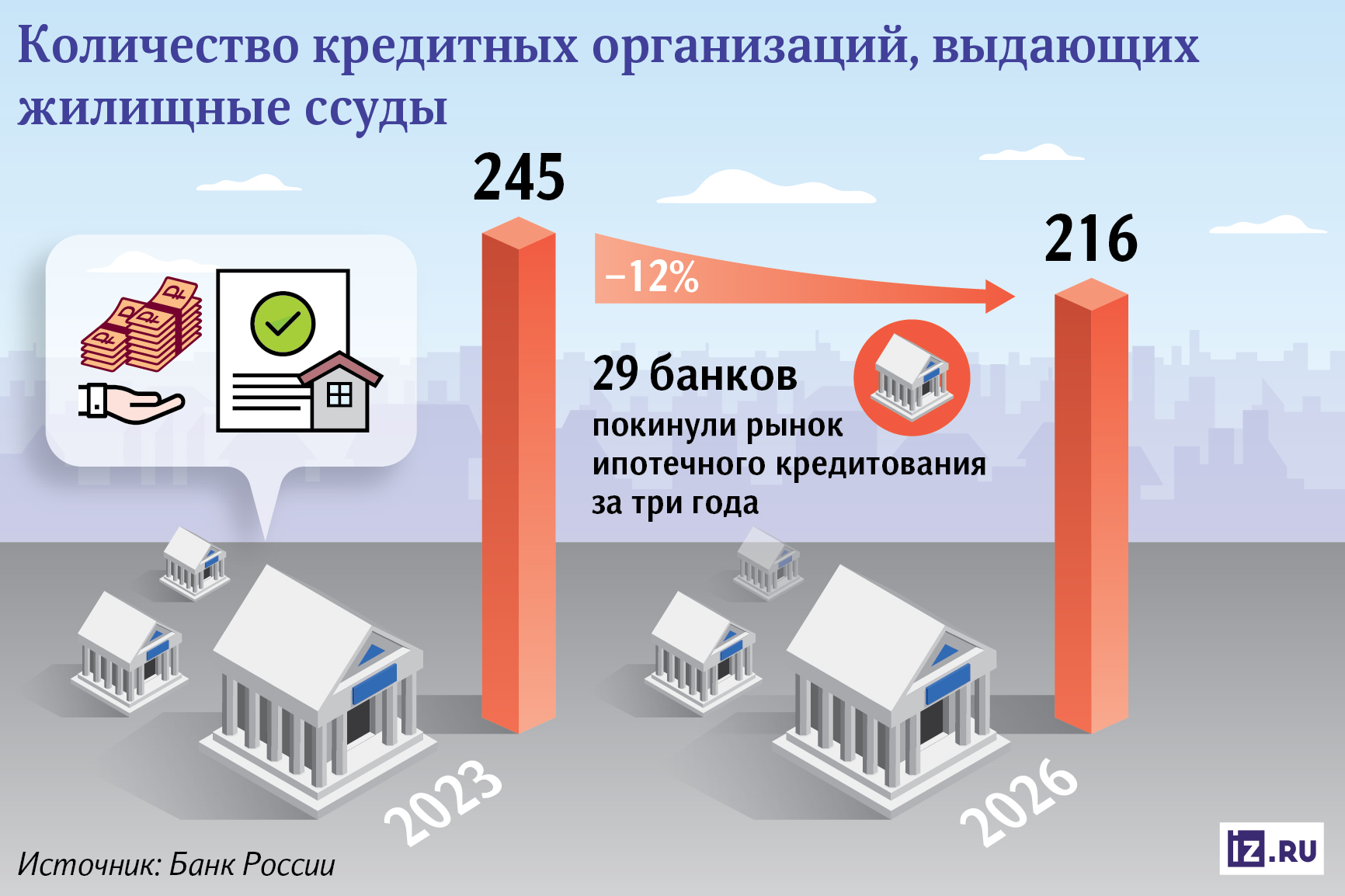
The number of banks issuing mortgages has decreased by more than 13% in three years, from 249 to 216, according to data from the Central Bank, which was studied by Izvestia. 33 medium and small banks have left the market, which face several problems at once: preferential programs do not always provide them with sufficient returns, and market mortgages remain expensive for borrowers, and demand for them has fallen critically. It is becoming increasingly difficult to compete with major players who can raise money cheaper and negotiate with developers. As a result, home buyers have fewer options, and the largest banks have more opportunities to influence lending conditions. Why the mortgage market is becoming less competitive and what it will mean for consumers is in the Izvestia article.
Why banks refuse mortgages
The mortgage market has lost 33 participants over the past three years. From the second quarter of 2023 to the second quarter of 2026, the number of banks that provide housing loans decreased from 249 to 216— which is 13.2% of all players, according to information from the Central Bank, which was analyzed by Izvestia. At the same time, we are not talking about closing credit institutions, but about their abandonment of mortgages — this banking product often does not pay off the costs of it and the risks associated with it.
For many banks, housing loans are becoming unprofitable due to reduced demand for market mortgages, strict requirements of the Central Bank and expensive deposits that small and medium-sized banks are forced to offer in order to attract customers, experts say.
The demand for market mortgages has fallen critically in recent years amid high interest rates. According to the assessment of "Dom.Russian Federation", they are on average at the level of almost 19% per annum, and sometimes exceed 20%. This seriously reduces the number of borrowers who can service the loan.
Only 7% of potential buyers can afford a classic mortgage, said Evgeny Shavnev, CEO of the Flip Group of Companies, an investment company in the real estate market. As a result, spending on servicing and developing mortgage programs turns out to be incomparable with the profits received, and banks simply abandon such a business, the expert emphasized.
Because of this, preferential mortgages remain the main engine of the market. In August 2026, it accounted for 56% of all disbursements, according to the Central Bank. A year ago, banks were even more dependent on government programs — they provided more than 80% of new housing loans.

Currently, family mortgages are issued at 2-12% per annum, depending on the number of children, but market rates on housing loans are significantly higher than this level. The authorities reimburse banks for lost income on such loans. The amount of this compensation for most loans since October, when the terms of the subsidy were changed, is calculated according to the formula "key +2%". Now it is about 16%; the percentage that the borrower pays is deducted from them.
Until recent changes, the formula "key +3%" was used, but even under such conditions, the potential profit of banks was much less than under market programs. Now that this direction has become even less profitable for banks, the withdrawal of players may continue or accelerate.
Ultimately, the main problem lies in the insufficient profitability of mortgages for the banks themselves, explained Ekaterina Shchurikhina, Director of Ratings at Expert RA credit institutions. Housing loans are issued for decades, while banks need to raise funds to finance them, check borrowers and evaluate collateral. With high deposit rates and the risk of non-repayment of loans, it becomes unprofitable for some banks to continue operating in this market.

It is easier for large banks to stay in the mortgage market
Small banks are finding it increasingly difficult to compete with large players, said Finam analyst Igor Dodonov. In order to attract depositors, they often have to offer higher deposit rates, which are essentially included in the cost of loans issued. This reduces the possibility of favorable market mortgage terms for borrowers.

Large banks have a more advantageous position: they have a wide customer base and can attract money from various sources. In addition, many of them cooperate with developers. This partnership helps to attract buyers of new buildings and offer them special credit conditions.
As a result, the mortgage market is increasingly concentrated in the hands of the largest banks. Igor Dodonov estimates that the top 10 players account for about 90-95% of new issues.
An additional risk remains the growth of overdue debt. By September 1, 2026, Russians had delayed mortgage payments by 267 billion rubles. The delay was about 1.2% of the total debt — this share does not yet indicate a critical situation, but it already creates additional risks for creditors, said Evgeny Shavnev from Flip Group of Companies.

In case of non—repayment of problem loans, banks are required to create reserves - to set aside funds to cover possible losses, the expert explained. The higher the probability of non-payments, the more money may be required for such protection. It is more difficult for small banks to allocate additional funds, so some of them may have refused to issue mortgages.

How will the withdrawal of banks from the mortgage market affect home buyers
The main consequence of the withdrawal of banks is the reduction of choice for borrowers. Lenders remaining on the market may tighten the requirements for down payment, proof of income and a package of documents. At the same time, small banks often offer more flexible terms and an individual approach, so their departure may complicate obtaining a mortgage for clients who find it difficult to meet the standard requirements of large players, said Vasily Kutyin, Director of Analytics at Ingo Bank.
The withdrawal of regional banks may be felt most strongly in small towns and remote areas, where initially there are fewer offers. Local lenders are often more aware of the specifics of residents' incomes and can adapt to individual borrowers, explained Maria Ermilova, Associate Professor of Finance for Sustainable Development at Plekhanov Russian University of Economics.

At the same time, the reduction in the number of creditors does not mean an automatic increase in mortgage rates: their level primarily depends on the key, the cost of deposits and the terms of preferential programs, said Natalia Milchakova, a leading analyst at Freedom Global. But with less competition, it is easier for large players to maintain strict requirements for borrowers. In some cases, additional customer costs may increase, for example, if a favorable rate involves the purchase of additional banking products.
The basic scenario remains the gradual withdrawal of banks, for which mortgages have stopped paying off costs and risks. According to independent economist Viktor Mangazeev, the number of market participants may decrease to 200 by the end of 2027.
Reducing the key interest rate, which will make market loans more affordable for borrowers, will slow down the withdrawal of banks from the mortgage market, says Valeria Popova, senior analyst at Rikom-Trust. At the same time, it is important to maintain the current conditions of state support: a further reduction in compensation may make participation in preferential programs unprofitable for medium and small banks. As a result, the number of market participants will continue to decrease, and Russians will have fewer opportunities to choose between mortgage offers from different banks.
Переведено сервисом «Яндекс Переводчик»
