
Import substitution: medical glove suppliers could steal 2.5 billion from the budget

Law enforcement officers have uncovered a large-scale scheme of embezzlement from the budget during government purchases of medical gloves, Izvestia found out. The damage could reach 2.5 billion rubles, as the Grundlage company at the center of the investigation and its affiliated legal entities won so many government contracts. They supplied cheap Chinese products with a high zinc content to hospitals and clinics, and passed them off as high-quality domestic products. And at the same time, they gained an advantage as a Russian manufacturer at auctions. The Basmanny Court of Moscow recently arrested two defendants in this criminal case. There are about 100 episodes of government purchases of gloves in more than 50 regions, a source told Izvestia. How fraudsters could deceive the state by posing as domestic manufacturers is in our investigation.
How did the glove scheme work?
Investigators of the Main Investigative Department of the Investigative Committee of the Russian Federation have arrested several defendants in a large-scale criminal case on fraud in the supply of medical gloves, a source close to law enforcement agencies told Izvestia. At the end of June, the Basmanny Court of Moscow sent Alexey Ustinov, the head of production at Grundlage LLC, and Vladimir Vyatkin, the actual beneficiary of the company, to jail. They were charged under articles of the Criminal Code on the handling of falsified, substandard and unregistered medical devices and fraud as part of an organized group on an especially large scale.
According to investigators, the company bought medical gloves from China and Uzbekistan for a song, repackaged them under its own trademarks, passing them off as manufactured in Russia, and supplied them to hospitals and clinics in the country.

The Ministry of Industry and Trade has included Grundlage gloves in the official Register of Russian Industrial Products (RRPP). This allowed the defendants for several years to receive preferences under the national regime at auctions as a Russian supplier and bypass competitors offering gloves of foreign manufacture.
As part of the investigation, hundreds of facts of Grundlage's conclusion of state contracts with various healthcare institutions in more than 50 regions of the Russian Federation have already been established and documented.

However, the scope of its activities can be much broader. On the Izvestia public procurement website, they found about two thousand auctions, the winner of which was Grundlage and its associated legal entities. From November 2023 to May 2026, they supplied medical gloves worth about 2.5 billion rubles to medical institutions in various regions, the publication estimates.
Since February 2026 alone, during the investigation of the criminal case, substandard, falsified medical gloves worth over 50 million rubles have been withdrawn from illegal circulation.

Izvestia sent a request to the Investigative Committee about the progress of the investigation, but they preferred not to disclose its details.

In pursuit of preferences
The main company on whose behalf the businessmen participated in public procurement is NPO Rusmedperchatka LLC. His co-founders with equal shares are the Grundlage company and the SZMI Trading House, according to the Rusprofile database. At the time of the initiation of the criminal case in February 2026, the SZMI Trading House was also one of the founders of Grundlage, but soon after that it resigned from its membership.
The SZMI Trading House itself is affiliated (through common founders) with Samara Medical Device Factory LLC.

In response to a request from Izvestia, the Samara Medical Device Factory reported that the company had indeed concluded a "contract with Grundlage for the development of a technological process and production at a medical glove manufacturing plant." "However, the plant does not disclose the details of this agreement," the response says.
It also states that the plant is aware of the criminal case against Grundlage and "provides assistance to the authorized bodies within their powers."

It was the contractual relationship with the plant that allowed Grundlage to enter the Register of the Russian Chamber of Commerce and Industry and receive preferences at auctions, the Izvestia source believes. Only in July of this year, the Ministry of Industry and Trade excluded all Grundlage products from the specified register, Izvestia found out. The publication asked the Ministry of Industry and Trade for information about the situation.
According to investigators, Vyatkin and Ustinov did not act alone. They were assisted by a number of people and, in particular, Ekaterina Blinova, CEO of Grundlage LLC. The Basmanny Court of Moscow arrested her back in February of this year on the same charge. Blinova is currently in jail. According to the source, other defendants may appear in the case in the near future.

What happened in the regions
After the criminal case was initiated, employees of the territorial divisions of the Economic Security and Anti-Corruption Department of the Ministry of Internal Affairs began to send notifications about the possible threat of their use to regional medical institutions that had purchased Grundlage gloves.
"Substandard medical gloves are supplied to Russian medical institutions for blood collection, abdominal operations and patient care, which can lead to massive cases of harm to the health of patients and medical personnel, both moderate and severe," according, for example, in a notification sent by the Ministry of Internal Affairs of Russia in the Tyumen region to the head of the territorial Roszdravnadzor. (Izvestia has it).
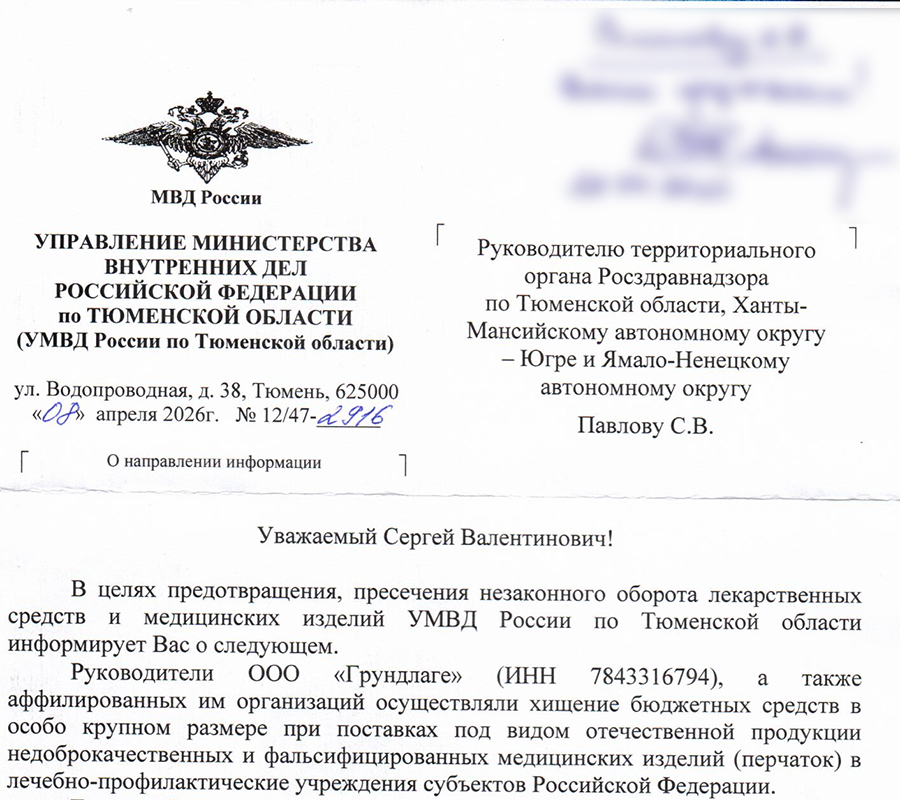
The same letter says that the heads of Grundlage and its affiliated organizations "embezzled budget funds on an especially large scale" when supplying the mentioned gloves, and mentions the possible scale of fraud: "the analysis showed that over the period 2024-2025, organizations and individual entrepreneurs controlled by the defendants in the criminal case concluded more than 1,800 state contracts for the amount of more than 1.5 billion rubles."
In response to police warnings, the regional Ministries of Health also began to sound the alarm. So, in April 2026, the Ministry of Health of the Voronezh Region sent a special notification to the heads of local medical organizations (Izvestia has it). It contained a warning about the "high risk" of supplying substandard and counterfeit gloves, and provided specific supply numbers for government contracts.
And back in 2025, the federal Roszdravnadzor began sending messages to regional divisions and medical organizations about the withdrawal of Grundlage medical gloves from circulation "due to their poor quality," it follows from the letters (Izvestia has). The agency's experts found an increased zinc content in them.
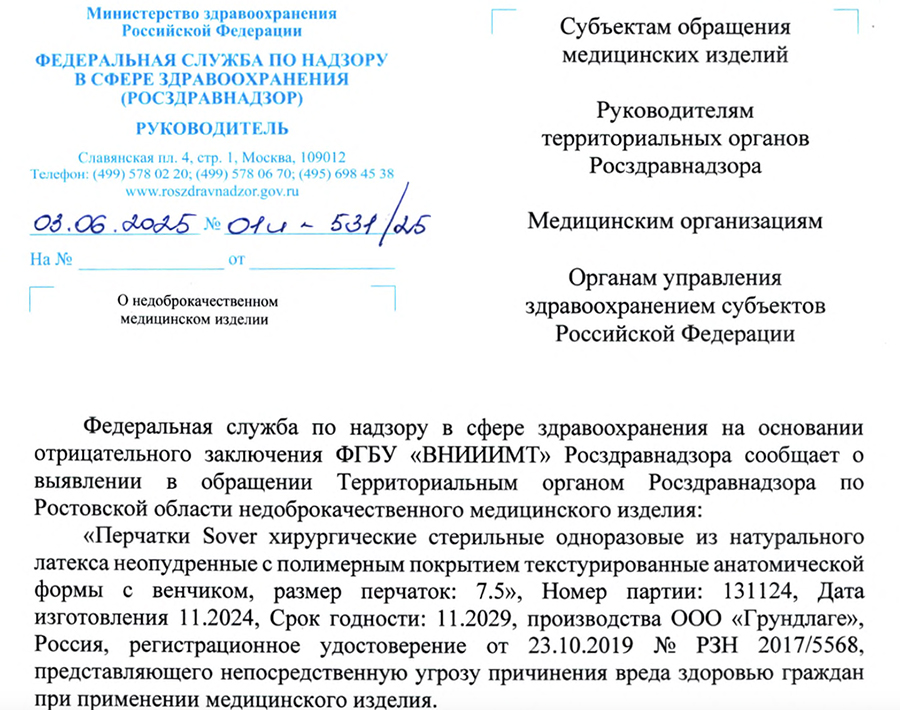
Izvestia asked Roszdravnadzor about any other violations on the part of Grundlage and whether the supervisory authority is currently conducting any verification measures against this supplier.
Grundlage's financial performance has grown significantly in recent years. In 2025, revenue reached 876.6 million rubles, which is 2.8 times more than in 2024 (311.4 million), and net profit increased sixfold — from 9.1 million to 56.8 million. However, according to the government procurement website, this is just the tip of the iceberg. The multi-stage business structure of Grundlage allowed dozens of related companies to participate in auctions and use registration certificates and preferences of the main player.

What is the danger of counterfeiting
Fake gloves, including those with a high zinc content, can cause a severe allergic reaction not only in the doctor who performs the operation, but also in the patient, medical workers interviewed by Izvestia said.
"Low—quality medical gloves can be dangerous if a person has allergies," said Elvira Sinyakova, a dermatovenerologist at the Medsi clinic. — Previously, it was believed that latex gloves are more likely to cause allergies. If it contains talcum powder and the hand sweats when interacting with the glove, this can cause contact dermatitis.

Such gloves can be especially dangerous for patients with eczema or other skin diseases, the doctor emphasized. In addition, low-quality medical gloves tear faster, which increases the risk of infection during surgery. Both the doctor and the patient can become infected.
Yulia Goryacheva, a nurse at the Valgo clinic in Moscow, added that if sterility is disrupted during invasive procedures, such as injections or blood collection, there is always a risk of secondary infections.

Repackaged medical gloves of unknown origin pose a direct biological and chemical threat, the Public Consumer Initiative (OPI) told Izvestia.
—If sterility is violated or non—certified raw materials are used, the risk of nosocomial infections and cross-infection of patients and medical staff increases dramatically," explained Oleg Pavlov, head of the OPI. — There is also a risk of developing severe allergic reactions, for example, to low-quality latex or residual chemicals. Micro—punctures and non-compliance with counterfeit strength standards deprive gloves of their main function - barrier protection.

Not the first case
This is not the first scheme of frauds with medical gloves in Russia that has been identified by law enforcement officers. Izvestia wrote earlier about a similar case, only on a smaller scale.
Back then, businessmen from Buryatia also supplied low-grade Chinese products under state contracts under the guise of high-quality domestic products. But Grundlage's activities turned out to be much broader.

The presence of counterfeit goods on the market destroys fair competition, Oleg Pavlov noted. Unscrupulous players who buy cheap technical or rejected gloves and repackage them under the guise of high-quality medical brands are dumping prices. This deprives legitimate domestic producers and importers of income, who invest in sterilization, multi-stage quality control and obtaining Roszdravnadzor registration certificates.
"Before the introduction of strict controls, the repackaging scheme remained one of the most widespread on the medical supplies market," said the head of the OPI. — Cheaper protective or low-end examination gloves were often sold under the guise of medical products. It is also common to substitute imported products of Asian origin, purchased through gray channels, under the guise of well-known Russian brands. This led to a distortion of market statistics and a decrease in confidence in the entire industry.

After the introduction of mandatory labeling, which has moved to the stage of case-by-case accounting, each package receives a unique DataMatrix code. It cannot be copied or reused — the system immediately blocks duplicates. Now the path of gloves is fixed from the factory or the border to the hospital. Goods "out of nowhere" or without documents can no longer be physically put into circulation. In addition, the system blocks the issuance of codes if the manufacturer does not have a valid medical device registration certificate. Buyers and purchasers now have the opportunity to check the legality of gloves through the application, and any violation immediately goes to the supervisory authorities, the OPI summarized.
Переведено сервисом «Яндекс Переводчик»
