- Статьи
- Science and technology
- Getting into listeria: the genome of a weakened bacterium will help defeat a dangerous food infection

Getting into listeria: the genome of a weakened bacterium will help defeat a dangerous food infection

For the first time, Russian researchers have deciphered and analyzed the genomes of two weakened strains of listeria, the causative agent of severe food infection, which are used to vaccinate farm animals. The authors have identified genetic changes that turn a dangerous bacterium into a basis for protection against listeriosis. The data obtained will help create new-generation vaccines and drugs that enhance animal immunity. According to experts, in the future, this technology may form the basis of infection prevention tools for people at risk.
What is the danger of listeriosis and how to deal with it
Scientists from the Saratov State University of Genetics, Biotechnology and Engineering named after N.I. Vavilov and the All-Russian Scientific Research and Technological Institute of Biological Industry for the first time compared the genetic features of listeria strains used in Russia as vaccines with the genomes of dangerous variants of the causative agent of listeriosis.

The researchers paid special attention to the search for mutations that could be associated with a weakening of the pathogenic properties of the microorganism. It turned out that the AUF-2 and AUF-3 vaccine strains lack a number of genes responsible for virulence (the ability to cause infection), resistance to the acidic environment of the gastrointestinal tract, and some "aggressive" interactions with host cells. There were also no genes involved in the formation of toxins, antibiotic resistance, and bacterial adaptation to adverse environmental conditions.

At the same time, the studied strains retained a number of important genes necessary for the formation of an immune response. This means that weakened bacteria are able to induce protective immunity without developing a serious illness.
The results obtained help to better understand the mechanisms by which pathogenic bacteria become "protectors" and create the basis for further improvement of veterinary vaccines against listeriosis.

— In the future, we plan to find out exactly which substances of weakened bacteria are involved in the development of immunity in vaccinated animals and how this happens. If successful, we will be able to use our knowledge to develop a new generation of vaccines that are effective, safe and convenient for use in the livestock sector. It is possible that in the future it will be possible to "teach" the immunity of animals to protect themselves from this dangerous pathogen," said Valentina Fedorova, MD, Honorary Worker of Science and High Technologies, Professor of the Department of Microbiology and Biotechnology at the Saratov State University of Genetics, Biotechnology and Engineering named after N.I. Vavilov.
The results obtained are important for improving the control of the incidence of listeriosis and, ultimately, strengthening the country's food security, the authors of the study emphasized.
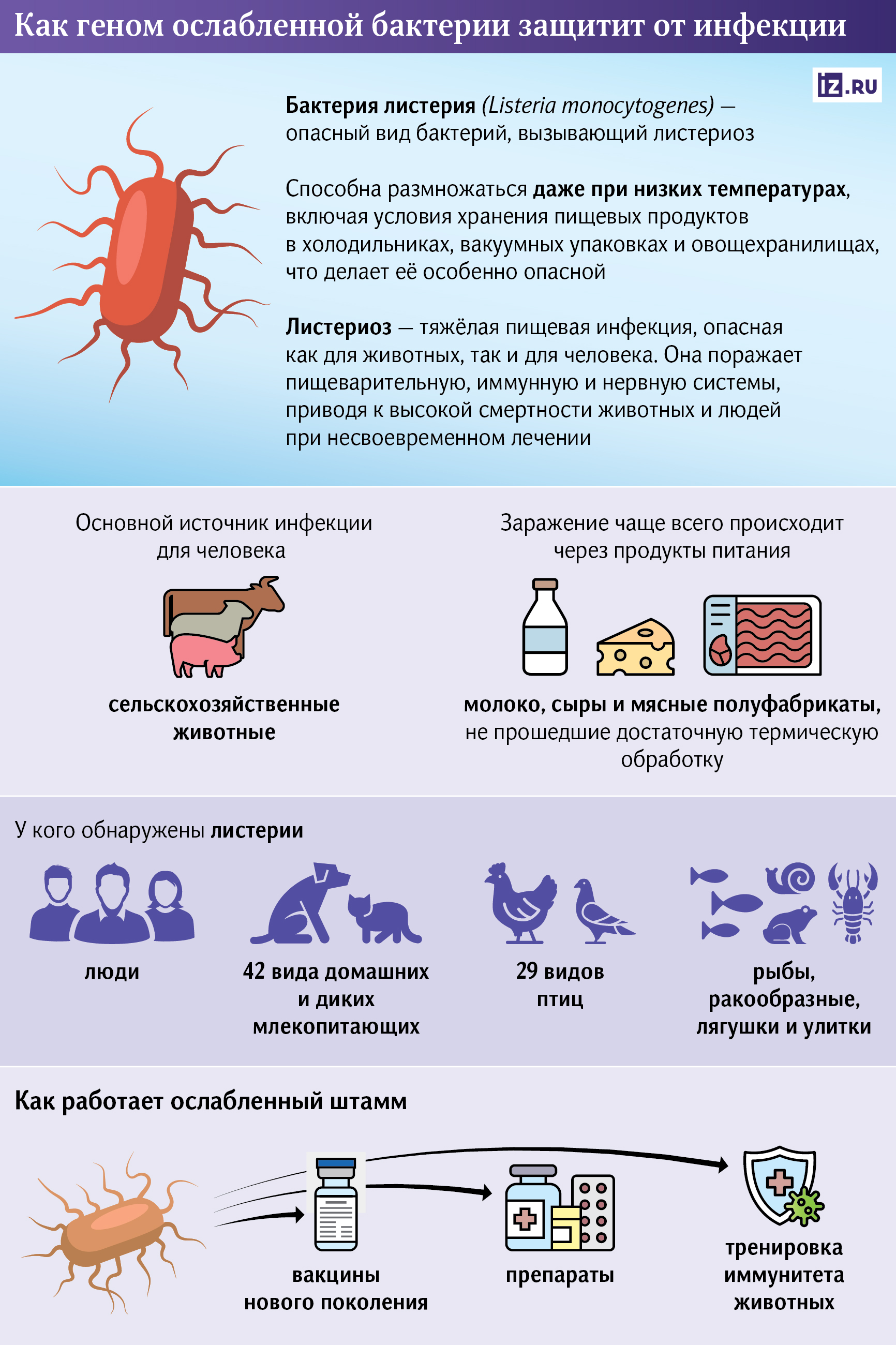
Listeriosis is a severe foodborne infection that poses a threat to both animals and humans. The disease affects the digestive, immune and nervous systems and, in the absence of timely treatment, can lead to high mortality. Farm animals remain the main source of infection for humans, and the infection is most often transmitted through food products: milk, cheeses and semi-finished meat products that have not undergone sufficient heat treatment. The causative agent of the disease, the bacterium Listeria monocytogenes, is able to multiply even at low temperatures, including when food is stored in refrigerators, vacuum packaging and vegetable storages. That is why the prevention and control of listeriosis directly at livestock enterprises is of particular importance.
Protection against listeriosis and its prevalence
Listeriosis is inferior to salmonellosis and campylobacteriosis in prevalence, but surpasses them in lethality and severity of the clinical course, said the head of the Smart Supply Chain segment of the FoodNet working group NTI Sergey Kosogor. The pathogen is detected in meat, milk, fish and fish products, the disease has a seasonal character in the spring and autumn periods.
— To date, Listeria monocytogenes has been found in humans, 42 species of domestic and wild mammals, 29 species of birds, as well as fish, crustaceans, frogs, and snails. Every case of listeriosis in cattle and small animals leads to losses, and the ability to survive at low temperatures is a serious problem for the food industry. From this point of view, the opportunity to curb the bacterium makes important economic sense for the Russian agro—industrial complex," he said.
Decoding the genome of weakened strains is of great practical importance. Multiplying in the host's body, such strains stimulate a protective immune response without causing disease. In fact, this allows you to get a kind of vaccination that prepares the immune system in advance to face a deadly pathogen. This will save the number of animals and reduce the damage, the expert believes.

Listeriosis is not just a "disease from the refrigerator," as the pathogen multiplies even at low temperatures, said molecular biologist Arina Kholkina.
— The value of the work lies in the fact that for the first time scientists have "read" the genomes of the live veterinary vaccines AUF-2 and AUF-3, which have been vaccinated in cattle in Russia for many years. It turned out that these strains had lost their aggression and toxin genes, but retained recognizable "tags" of the dangerous pathogen on the surface. The immune system sees them, learns to defend itself, but the disease does not arise — an ideal risk—free workout, which is how vaccines work," she noted.

According to her, knowing the exact genetic changes opens up opportunities for targeted improvement of vaccines, making them more stable, safe and effective. In the future, drugs can be created on this basis to protect people at risk.
The results of the study, supported by a grant from the Russian Science Foundation (RSF), are published in the journal Scientific Data.
Переведено сервисом «Яндекс Переводчик»
