
Atomic appeal: Six nuclear-free countries seek to join NATO nuclear missions

Norway has switched to supporting the North Atlantic Alliance's nuclear missions with conventional aircraft, Russian Ambassador to Oslo Nikolai Korchunov told Izvestia. Lithuania, following Finland, decided to lift the ban on the deployment of nuclear weapons. Poland, Latvia and Estonia do not have such restrictions and are already ready to accept nuclear weapons carriers on their territory. The expert community believes that Warsaw is the closest to this. In this case, American B61 tactical nuclear bombs are likely to be used — the French umbrella initiative is still in its infancy.
The risks of nuclear proliferation in Europe
The nuclear-weapon-free countries of the North Atlantic bloc are actively looking for ways to deploy nuclear weapons on their territory. On July 7, the Lithuanian Seimas launched a procedure to exclude the ban on the storage of atomic weapons from the Constitution. A positive decision by the Parliament is extremely likely, given the support from the President of the Republic, Gitanas Nauseda, and major political forces. Finland had already done this before, and representatives of Poland, Latvia and Estonia, who already do not need to cancel anything, expressed in unison their willingness to accept nuclear weapons carriers on their territory.

Against this background, Norway has openly switched to supporting NATO's nuclear missions with conventional aircraft, Russian Ambassador to Oslo Nikolai Korchunov told Izvestia.
"The Russian side has a strongly negative attitude towards such cooperation between the countries of the North Atlantic Alliance, viewing it as joint nuclear missions that undermine the NPT (Treaty on the Non-Proliferation of Nuclear Weapons) regime, security in the Euro-Arctic region and global stability in a broader sense," the diplomat noted.
In May, Norway joined the French nuclear deterrence initiative, which involves the transfer of intelligence and joint exercises. The Kingdom, like other non-nuclear participants in the initiative, will provide F-35 aircraft to support French nuclear weapons carriers, the Russian ambassador believes.

Officially, Norway has no plans to deploy nuclear weapons on its territory in peacetime and is not yet participating in the NATO Nuclear Sharing program. It provides for the storage of American bombs at the air bases of non-nuclear countries of the bloc. However, Oslo is showing increasing interest in the alliance's nuclear missions: last year, the kingdom's F-35 aircraft were involved for the first time in the annual NATO exercises in Europe, Steadfast Noon. In addition, last August, three U.S. B-1B Lancer strategic bombers were stationed at Norway's Erland Air Base.
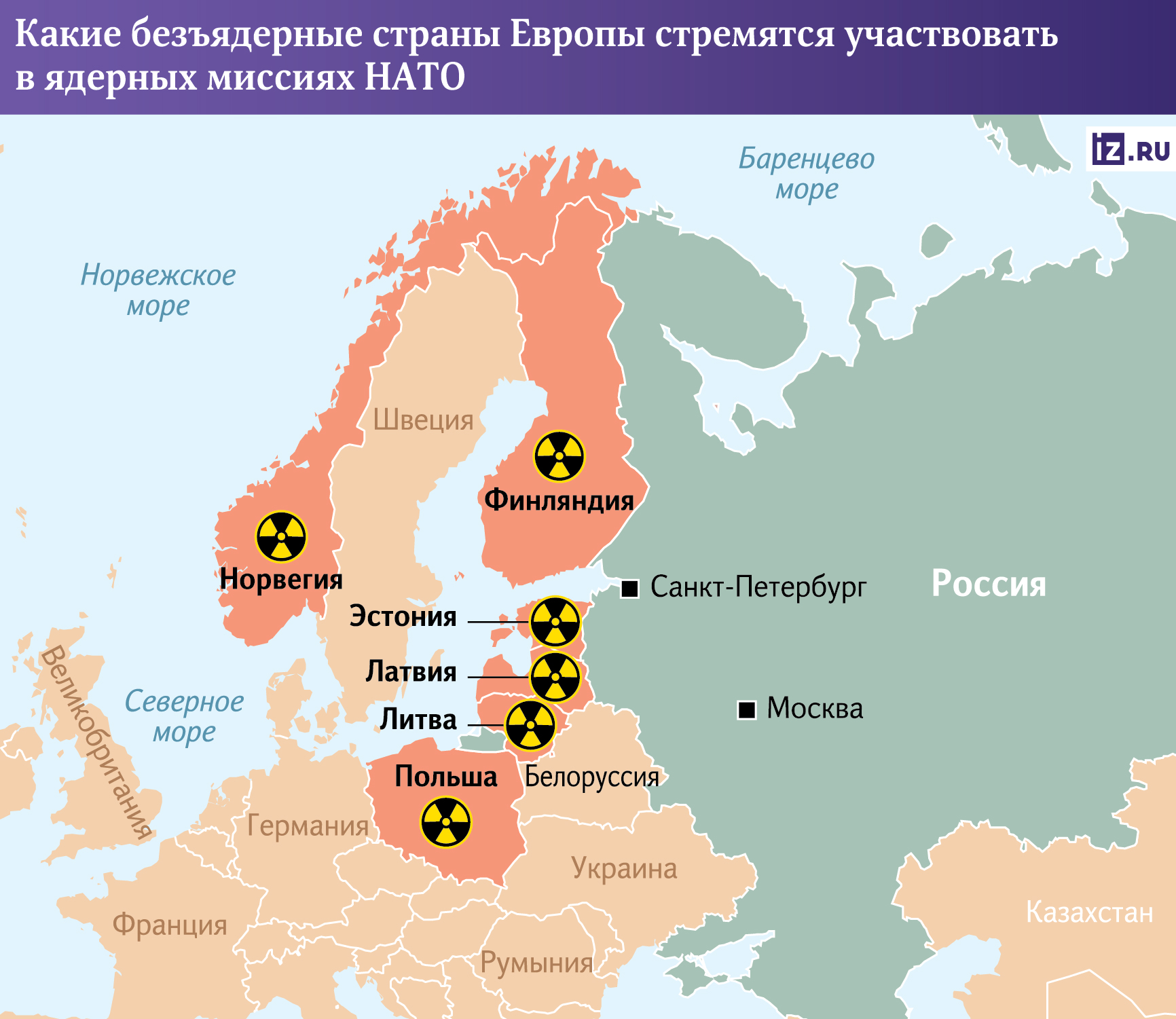
The deployment of nuclear weapons in Norway cannot be ruled out, although the country is unlikely to seek this, Dmitry Stefanovich, a researcher at the IMEMO RAS Center for International Security, told Izvestia. According to him, Oslo has a very long experience of living "on the front line" during the Cold War and is aware of the consequences of appropriate decisions.

Nevertheless, Norwegian plans should not be ignored. The Scandinavian Kingdom plays an important role in the alliance's plans, as it borders the Kola Peninsula, where Russian strategic nuclear forces are concentrated. And plans to create threats are already under way: Oslo is going to deploy South Korean-made MLRS systems in the north of the country, which could reach facilities on the Russian peninsula. The Russian authorities warned that Norway's actions would not remain without an adequate military-technical response.

Which NATO countries may have nuclear weapons
The nuclear structure of the North Atlantic Bloc can be roughly divided into three levels. The first is the countries that own an atomic arsenal: the United States, Great Britain and France. The second is the participants of the already mentioned Nuclear Sharing program: Belgium, Germany, Italy, the Netherlands and Turkey. There are 100-150 American B61 tactical aerial bombs at the air bases of these countries. In the event of a conflict, they will be placed on carrier aircraft under the control of pilots from the participating country. By the way, earlier American nuclear weapons were also deployed in Greece and Canada.

It is the states of the "eastern flank" of the bloc that are showing increased interest in hosting the nuclear arsenal. According to Dmitry Stefanovich, the appearance of nuclear weapons is most likely in Poland. Warsaw has long been striving for the coveted status: back in 2024, the country applied for participation in Nuclear Sharing. In May, the first three F-35A fighter jets out of 32 ordered from the United States arrived in Poland. These aircraft have technical certification to carry upgraded B61-12 nuclear bombs, so the issue now probably rests on whether the United States is ready to escalate relations with Russia.
And the permanent deployment of nuclear weapons in the Baltic States is unlikely, since there are only three air bases in the region: Emari in Estonia, Zoknai in Lithuania and Lielvard in Latvia. They are located in close proximity to Russia, and it is strategically fraught to place stationary nuclear bomb depots there. In addition, the Baltic countries do not have their own dual-purpose fighters: the skies above them are patrolled by other countries of the bloc on a rotating basis.
In Scandinavia, Finland is the most likely candidate for the appearance of weapons of mass destruction on its territory. Izvestia previously wrote that this process could begin from the air base in Rovaniemi, 147 km from the border with the Russian Federation. It is there that the F-35A will be based, which will arrive in full by 2030. Denmark does not exclude the deployment of nuclear carriers on its territory either.

It is important to note that we are talking specifically about American nuclear weapons, since they are the only ones used in joint nuclear missions. France is promoting its nuclear umbrella project, and nine European countries have already joined negotiations with it. However, Paris has so far denied plans for the long-term deployment of its Rafale fighter jets with nuclear weapons on the territory of other states. On July 12, it became known that representatives of Poland and France held the first consultations on nuclear deterrence in Paris.

Russia will take countermeasures against countries that deploy nuclear weapons near its borders, Kremlin spokesman Dmitry Peskov said. Earlier, Moscow deployed TNW and Oreshnik missile systems in Belarus. According to Dmitry Stefanovich, the Russian Federation is already strengthening strategic security in the north-western direction, including through the creation of the Leningrad Military District.
The gradual spread of nuclear weapons is objectively destroying the security system in Europe. Instead of dialogue, the West is consistently eliminating agreements in this area — the Intermediate-Range and Shorter-Range Missiles Treaty in 2019 (INF) and the Strategic Offensive Arms Treaty in February this year (START-3). Reducing nuclear risks could create the basis for a common dialogue on normalization of relations. But so far, the aggravation policy prevails in NATO.
Переведено сервисом «Яндекс Переводчик»
