- Статьи
- Science and technology
- The injected spot: AI will detect skin pigmentation disorder at the earliest stage.

The injected spot: AI will detect skin pigmentation disorder at the earliest stage.

Artificial intelligence has been taught to detect the early signs of vitiligo, a chronic disease in which the skin loses pigment. The system created in the Russian Federation analyzes photographs of affected areas, evaluates the degree of depigmentation, identifies signs of disease activity and pigmentation restoration, and can also be used as a training tool for dermatologists. The developers have already tested the service in India and plan to deliver it to the BRICS countries. At the same time, experts emphasize that the technology is not intended for self-diagnosis. Its main task is to help the doctor to assess even minor changes in the skin condition faster and more accurately, increasing the objectivity of patient monitoring.
An AI dermatologist will find vitiligo
Russia has developed an artificial intelligence-based tool that helps doctors and patients detect vitiligo at the earliest stages. Unlike traditional visual assessment, the service analyzes a photo of a skin area and issues an expert opinion.
— The user takes a photo of the site, and the system analyzes it and transforms the visual picture into a structured assessment. It determines how pronounced the skin color changes are, whether there are signs of process activity, whether there are signs of pigment restoration," said Evgeny Sobolev, co—founder of the Scanderm development company.
Vitiligo is a chronic disease in which the skin loses the pigment melanin, which causes light or white spots to appear. The disease increases the risk of sunburn and is often combined with autoimmune and endocrine diseases. At the same time, it can be difficult to identify the disease at an early stage, since depigmentation foci can have different causes.
The new service allows you to standardize the assessment of skin changes and track them over time. The development is based on computer vision technology. The model is trained on the basis of more than 50 thousand photographs marked up by doctors. The AI divides the image pixel by pixel into areas of healthy skin and foci of vitiligo, automatically calculates the area of the lesion, compares new images with previous ones and evaluates the dynamics of the disease.
— Not only the area of the foci is taken into account, but also the degree of their depigmentation. AI determines what percentage of a person is occupied by foci. Then calculations are carried out, from which we get a calculated estimate that reflects not just the area of foci on the face, but the severity of depigmented skin," said Maria Salnikova, the company's chief medical specialist in digital diagnostics, dermatologist.
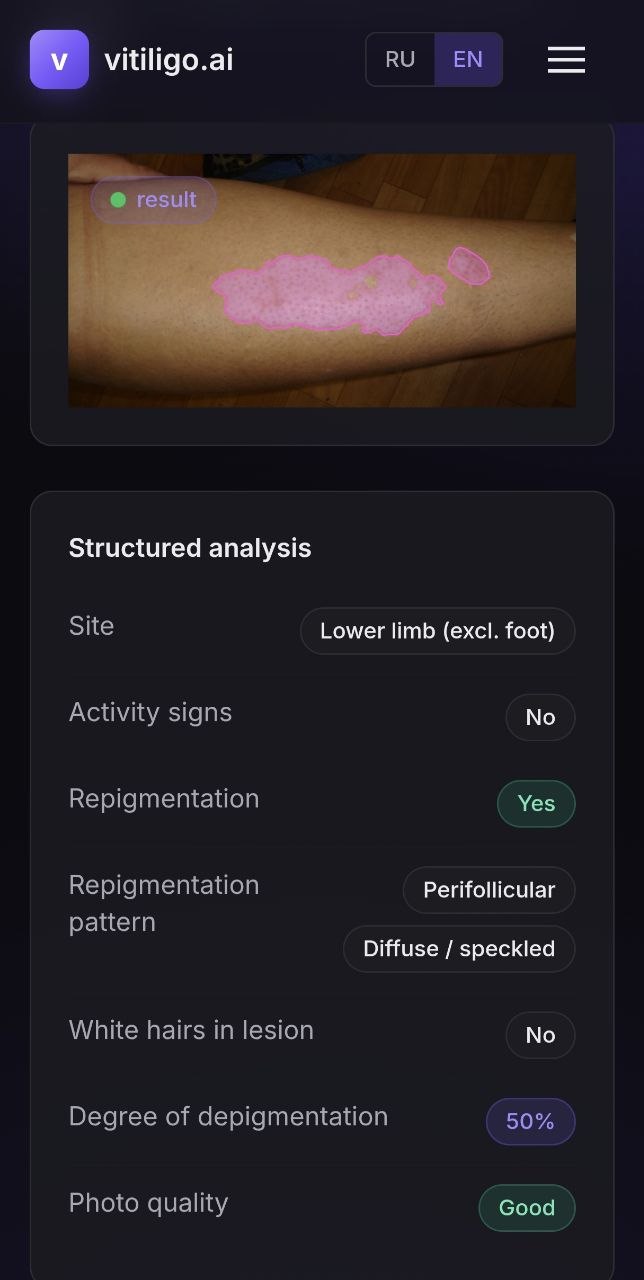
In addition to helping doctors and patients, the software can be used as a simulator for medical students and residents. With the help of such a tool, a young specialist learns to analyze photographs of vitiligo foci, and determine the degree of depigmentation, signs of disease activity and pigment restoration, and then compares his findings with an expert assessment.
— In practice, such signs are not always easy to recognize immediately: it is important to understand what to look for and how to interpret what you see. The simulator helps students and residents learn to see these signs more confidently, compare their answers with a reference interpretation, and gradually move from theory to practical photo analysis," added Maria Salnikova.

According to the developers, the technology has already been tested in India. It was presented as part of World Vitiligo Day with the support of PGIMER University (Postgraduate Institute of Medical Education and Research). In the future, the company plans to supply the service to medical institutions and universities in the BRICS countries, as well as expand its international use.

Prospects of using the vitiligo detection tool
The development looks promising, as it solves one of the key tasks of modern medicine — the standardization of visual assessment, told Izvestia Marketing director and co-founder of Cels (a company participating in the NTI Helsnet market) Nikita Nikolaev. In many areas where a doctor works with images, be it dermatology, radiology or other diagnostic fields, the result largely depends on the specialist's experience and ability to interpret visual signs in a clinical context.
— We are already seeing the demand for this trend in the Russian and international markets. It is important that we are talking not just about a service that gives the user the correct answer, but about an educational system with expert markup and gradation of matching answers. This approach is closer to real clinical practice: in diagnostic medicine, there is not always a binary "yes" or "no", the degree of severity of the sign, the dynamics of the process, the comparison of the image with the medical history and other data are often important, the expert said.

AI takes over routine work, freeing up more time for the doctor to communicate with the patient, said Antonina Arsenyeva, Head of the Department of Dermatovenerology and Cosmetology at the Institute of Professional Education at SamSMU.
— Turning complex visual pathology into a safe and visual tool is a real step forward for dermatology. It is especially important that the simulator helps future doctors to gain more visibility and shows the degree to which their assessment coincides with the expert's opinion. This approach shapes clinical thinking, rather than being limited to memorizing the correct answers. In addition, computer vision technologies make diagnostics more objective by translating a subjective visual assessment into quantitative indicators," she said.

Project manager
At the same time, the developers emphasize that the service is not intended for self-diagnosis and does not replace a doctor. His task is to help a specialist to evaluate skin changes faster and more objectively, track their dynamics and use the data obtained when making clinical decisions.
Переведено сервисом «Яндекс Переводчик»
