- Статьи
- Science and technology
- African misfortunes: West Nile fever virus captures new regions in Russia

African misfortunes: West Nile fever virus captures new regions in Russia

Russian scientists have analyzed the routes of import and spread of the West Nile virus across the country. The pathogen is carried by migratory birds, so the foci of infection appear and disappear in many ways chaotically. At the same time, the average speed of its movement to new territories is about 92 km per year. The virus is spreading through the southern and western regions towards the north and east. According to experts, this is an average indicator that reflects the expansion of areas where the virus manages to gain a foothold. If this trend continues, it may be necessary to develop a vaccine against fever, as there is currently no specific treatment for the disease.
Virus penetration into the Russian Federation
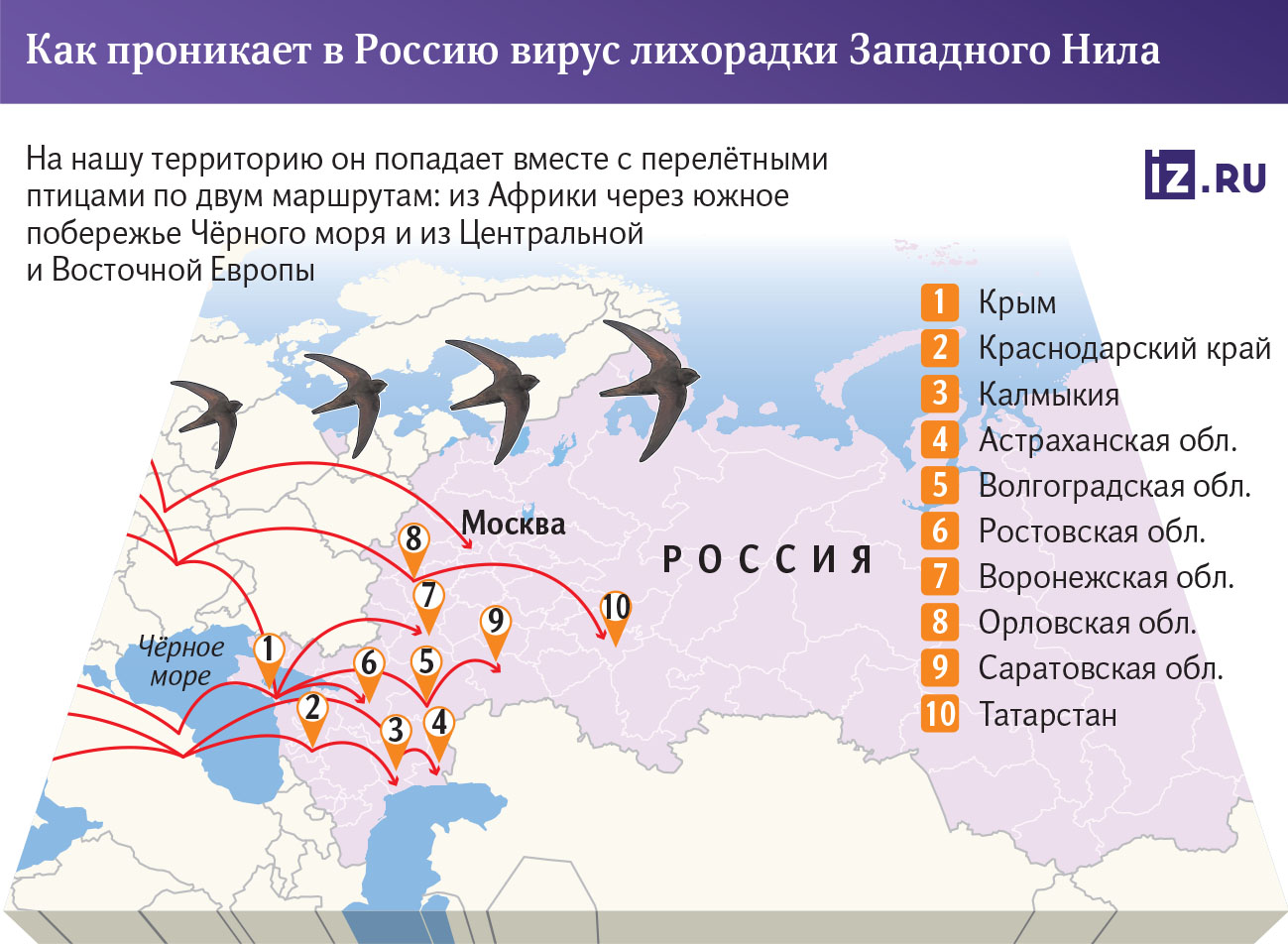
Specialists from the Volgograd Anti-Plague Research Institute have studied the ways in which the West Nile virus enters Russia and the specifics of its spread across the country. The virus most often enters the territory of our country with migratory birds along two main routes: from Africa via the southern coast of the Black Sea and from Central and Eastern Europe via Hungary and Romania. Scientists have documented the appearance of various genetic variants of the pathogen in Moscow, Rostov, Orel, Volgograd and Astrakhan regions, Tatarstan and Krasnodar Krai. In general, the dominant subtype of the virus was detected in 17 regions of Russia.
"In this study, for the first time, we present a comprehensive reconstruction of the history of the spread and evolutionary dynamics of West Nile virus line 2 circulating in Russia. Our results show that the genetic variants of infection in the country are formed not only due to local evolutionary processes, but also as a result of repeated drifts along the southern and western migration routes," the authors of the work, published in the scientific journal, note.

This is the first large-scale study of the origin of the West Nile virus in the context of its geographical distribution in Russia. According to experts, such work is important for monitoring and controlling dangerous infections, especially given that ordinary mosquitoes are carriers of the virus, immunologist Mikhail Bolkov explained to Izvestia.
— Our scientists have calculated how gradually the West Nile virus spread from Africa to Europe, and then to Russia, and what is the trend. The rate of evolution was calculated, and most importantly, the rate of spread, which turned out to be significant — 78-106 km per year (on average 92 km per year). It is noticeable that this is not a uniform increase in the number of the virus, because there have been periods of decline, but in general the trend towards spread remains," the scientist said.

Mutations are possible
At the same time, the dominant variant is ABB.1.1 actively expands its range to the north and east. And the appearance of the ABB strain.2.2.2 in the Krasnodar Territory indicates a new introduction of the pathogen from Romania, which carries the risk of the formation of new foci of infection. Climate warming and bird migration will contribute to the further spread of the pathogen. Scientists warn that the virus continues to change, adapt, and possibly mix with neighboring variants of the same species, which may lead to new variants, Mikhail Bolkov emphasized.
West Nile fever virus is capable of causing an acute infectious disease that is transmitted primarily through the bites of infected mosquitoes. The disease is widespread on all continents, while the virus is not transmitted from person to person. The incubation period is from two to 14 days. In mild form, the disease proceeds according to the type of flu—like condition: fever, severe headache, body aches, weakness, nausea, vomiting, enlarged lymph nodes, and sometimes a skin rash. The duration of this form is usually 3-6 days. In rare cases, a severe course develops with damage to the central nervous system, which is accompanied by rigidity of the occipital muscles, disorientation, convulsions, paralysis and the possible development of coma. Patients over 50 years of age, as well as people with weakened immune systems, are most vulnerable to such forms. There is currently no specific treatment for infection, and therapy is symptomatic and aimed at alleviating the patient's condition.
According to Alexander Lukashev, director of the E.I. Marcinovsky Institute of Medical Parasitology, Tropical and Vector-Borne Diseases, due to the fact that this virus is carried by birds, it can be difficult to identify the regions in which it occurs and in which it does not.
— This can change in a few months. Wherever these birds fly, that's where he'll end up. It largely depends on the climate during the warm period. The area where the virus can be found includes Moscow. It appears, but then disappears," the specialist said.

The rate of spread of the virus to new territories of 92 km per year is a very average indicator, which is very different from the actual movements of the pathogen. He no longer talks about where the virus can occur in principle, but about those new areas where it has gained a foothold, said Andrey Prodeus, chief freelance allergist and immunologist of the Moscow region.
— This is a decent speed, because in 10 years it will advance by 1,000 km. Monitoring needs to be carried out, but it is impossible to stop this process. You can't kill all the mosquitoes, and you can't do that, because we'll disrupt the biocenosis. If the infection spreads like this, then the question of creating a vaccine may arise," he said.
According to him, West Nile fever is currently mild in most cases, but there is no guarantee that the pathogen will not mutate and change its properties.
Переведено сервисом «Яндекс Переводчик»
