Honor of the Light: Kazan will host over 10 delegations from Southeast Asia


In the coming days, key Southeast Asian politicians will gather in Kazan. Among them is the president of the Philippines, who, despite his status as a U.S. ally, is preparing for face—to-face talks with Vladimir Putin. The Prime Minister of Singapore, the only ASEAN country that has imposed sanctions against Russia, will also arrive. Southeast Asia is asserting itself as a new stable center of power in the international arena, experts say. Active rapprochement with ASEAN allows Moscow to effectively diversify its "turn to the East." Moreover, military-technical cooperation is becoming an important trend. For example, Russian sappers are actively working in Laos — they have already cleared more than 200 hectares of land there, and this year the republic has accepted 120 SVO fighters for rehabilitation.
Which of the world leaders will arrive in Kazan
The capital of Tatarstan is preparing for the Russia–ASEAN Summit, one of the largest international events this year. It will be held on June 17-18. This is not the first time that Russia has hosted this global event: in 2016, a summit dedicated to the 25th anniversary of relations between Russia and ASEAN was held in Sochi.
— These relations (Russia and ASEAN. — Izvestia) there is a definite story. They began in 1991, back in the Soviet Union. First Deputy Chairman of the Council of Ministers Yuri Maslyukov was invited to a meeting of ASEAN foreign ministers in Kuala Lumpur. After that, our relations began to develop, and very dynamically and fruitfully," Presidential aide Yuri Ushakov told reporters on the eve of the summit.
The first delegations have already started arriving at Kazan International Airport on June 16. Among the guests are the Special Representative of the President of Myanmar, Hau Khan Sum, Indonesian Foreign Minister Sugiono and ASEAN Secretary General Kao Kimhorn. The countries will be represented mainly at the level of heads of government — the prime ministers of Vietnam, Cambodia, Laos, Malaysia, Thailand, and East Timor will arrive in Kazan. Their colleague from Singapore, Lawrence Wong, will personally attend, which causes a huge resonance in diplomatic circles. This is the only ASEAN country that imposed direct sanctions against Russia in 2022 due to the Ukrainian conflict, after which Moscow added Singapore to the list of unfriendly countries. Since then, there have been no such high-level contacts between the two countries.
The Philippines, the Chairman of ASEAN, will also be represented at the summit. It is a key and almost the most loyal ally of the United States in the Asia-Pacific region. Nevertheless, Manila not only does not break off contacts with Russia, but also counts on a bilateral meeting between President Ferdinand Marcos Jr. and Vladimir Putin. Sultan Hassanal Bolkiah will fly to Russia from Brunei. Obviously, the Kazan summit will not only expand the partnership with Southeast Asia, but also strengthen Russia's position in the Asia-Pacific region as a whole.
The summit has a busy program: These are meetings where the most important documents will be adopted, as well as bilateral meetings. The parties will have to determine approaches to international issues and areas for further partnership until 2030. Russia has historically cooperated with ASEAN countries in various fields, from high technology to agriculture, Pavel Shaternikov, PhD in History and senior lecturer at the Higher School of Economics, told Izvestia.
— The main thing is that Russia's turn to the East should not be limited to a turn only to China. The more actively we cooperate with the countries of Southeast Asia, the more positively we will be perceived there. Now, for many residents of the Asia—Pacific region, Russia is still either a fragment of the Soviet Union or just an incomprehensible cold northern country. Russia, of course, is becoming more famous in the region, but there is still a lot to do along the way," said Pavel Shaternikov.
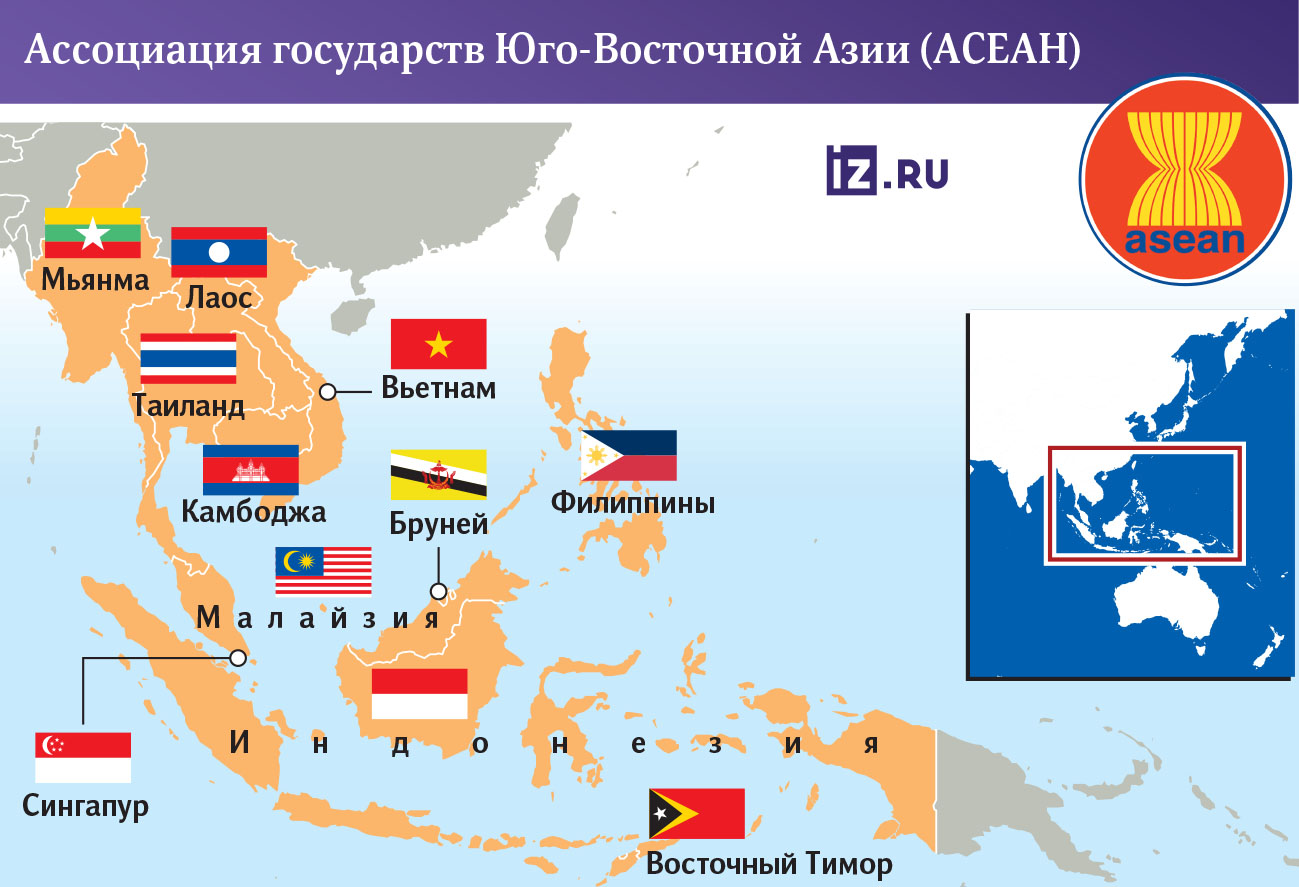
ASEAN unites 11 countries: Brunei, East Timor, Vietnam, Laos, Cambodia, Indonesia, Malaysia, Singapore, Myanmar, Thailand and the Philippines.
How is the geopolitical influence of the ASEAN countries changing
The importance of Southeast Asia on the world stage has increased significantly in recent years. The ASEAN countries have long achieved steady growth: Vietnam has become a global electronics hub, Malaysia is closing the most important semiconductor production chains, and Indonesia is becoming a key player in the green energy and battery market due to its huge reserves of nickel.
Southeast Asia clearly declares itself as a new center of strength and stability, especially in the face of crises and turbulence in other parts of the world.
At the same time, the Asia-Pacific region plays a significant role in a major geopolitical game, in particular, in the confrontation between the United States and China. Both countries consistently conclude defense agreements with the countries of the region, thus expanding their military presence.
And Russia is not standing aside, deepening, in particular, military-technical cooperation with ASEAN members. So, right now Moscow and Vietnam are conducting joint exercises to respond to emergencies — rescuers from the two countries are practicing cooperation in natural disasters and other crises. In 2024, the first ever joint naval exercises between Russia and Indonesia were held. The next ones are planned for 2026, and this time in the waters of the Russian Far East. The military-technical cooperation is developing well in certain segments with Thailand. A few years ago, the countries chaired the CMOA+ working group (meeting of ASEAN Defense Ministers and dialogue partners) on military medicine.
Military-technical cooperation is also expanding with Laos. Russian sappers, for example, regularly conduct mine clearance missions in the country (it was heavily bombed during the Vietnam War).
As Izvestia found out, since the start of work in 2018, 228 hectares of land have been cleared and 4,367 explosive objects destroyed by specialists from the International Mine Action Center of the Armed Forces of the Russian Federation.

— Russia and Laos have stable friendly relations. The military—technical cooperation is one of the systemic vectors of cooperation that meets the interests of both countries. Russian assistance in mine clearance is very important for Laos, which remains (more than half a century after the end of the Indochina wars) the most heavily mined territory in the world. Joint exercises and special training of the Lao military are another significant area of cooperation," Ekaterina Koldunova, director of the ASEAN Center at MGIMO, told Izvestia.
Laos, in turn, helps Russia. The Republic is rehabilitating participants and veterans of the special operation. Since the beginning of 2026, about 120 Russian military personnel have taken advantage of sanatorium-resort recreation programs in this country, the Russian Embassy in Laos told Izvestia.
The Kazan Summit will clearly show the vector of distribution of forces in a multipolar world. And as the main result, Southeast Asia will finally prove itself as a pragmatic and independent player on the world stage. For the ASEAN countries, the summit provides an opportunity to choose their economic benefits. For Russia, the willingness of the leaders of the region's countries, including the Philippines and Singapore, to sit down at the negotiating table opens a direct path to diversifying ties in the Asia-Pacific region and allows building a balanced counterweight to the West in the East.
Переведено сервисом «Яндекс Переводчик»
