Cell on the map: a model of immune failures will accelerate the creation of drugs for diabetes and arthritis
- Статьи
- Science and technology
- Cell on the map: a model of immune failures will accelerate the creation of drugs for diabetes and arthritis


Russian scientists have developed a mathematical model to study the malfunction of the protective system in autoimmune diseases, or rather, the B-cell response. It will help to better understand how rheumatoid arthritis, type 1 diabetes, and multiple sclerosis occur, in which the immune system begins to attack body tissues. The tool will help answer one of the key questions when creating medicines — why the same drug can be highly effective in some patients and hardly help others. At the same time, experts emphasize that the mathematical model does not replace laboratory experiments and clinical trials, but it allows for more accurate planning of their conduct.
A model of the B-cell immune response
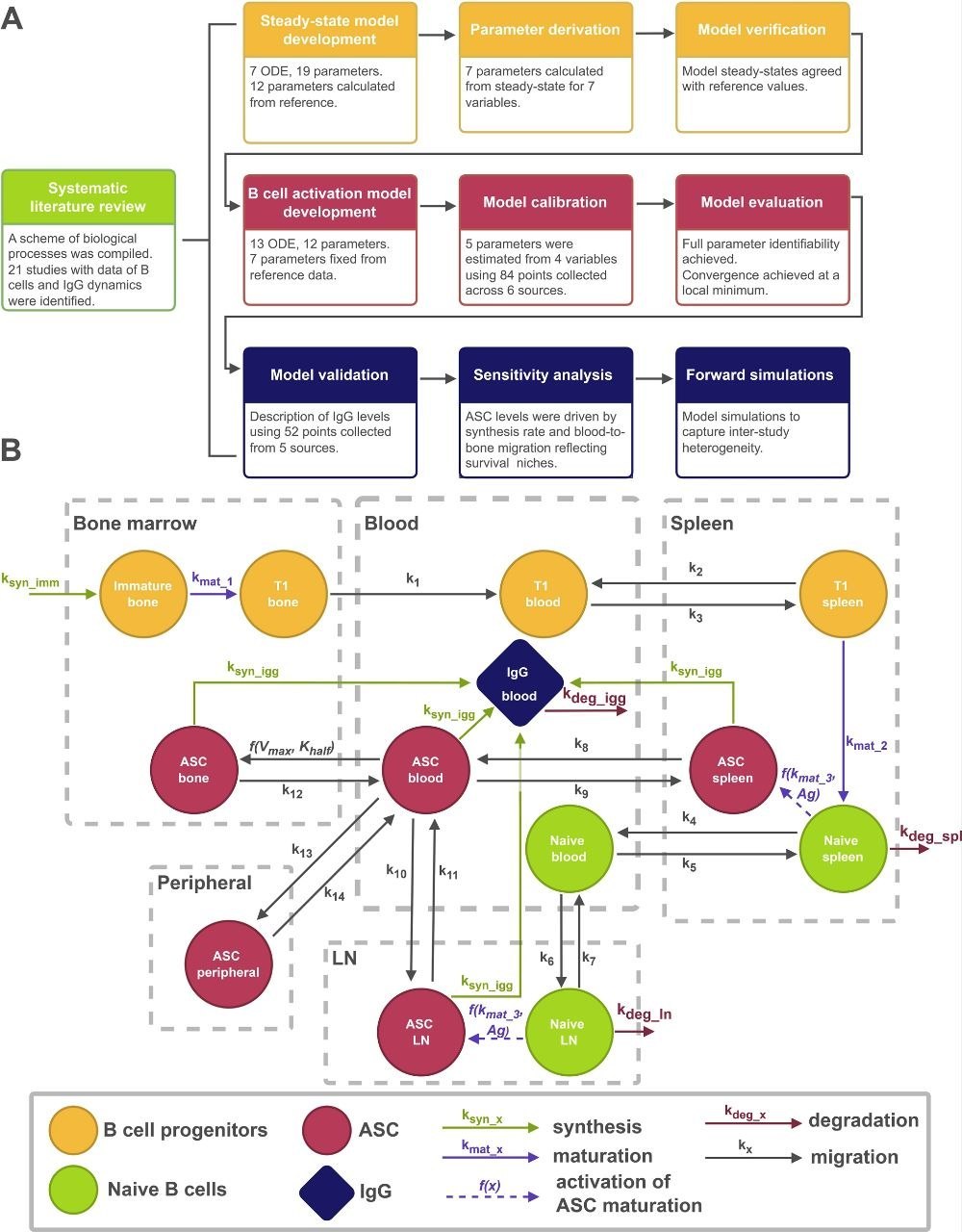
Researchers at the Center for Mathematical Modeling in Drug Development at Sechenov University, together with colleagues from the Institute of Computational Mathematics of the Russian Academy of Sciences and the Simurgpharm company, have developed a model of the B-cell immune response. This mechanism plays a key role in protecting the body: B lymphocytes produce antibodies that help neutralize viruses and bacteria. However, in autoimmune diseases, the protective system is disrupted. In this case, B cells begin to produce autoantibodies that attack their own tissues and organs, provoking the development of chronic inflammatory processes and severe diseases.
"Today, a lot of experimental data has been accumulated explaining the dynamics of the B—cell response, but there has not yet been a complete picture," Yaroslav Ugolkov, a junior researcher at the Institute of Medical Sciences of the Russian Academy of Sciences, told Izvestia. — Mathematical modeling allows you to combine these data together and see the system process.

The mat model will help to better understand how rheumatoid arthritis, type 1 diabetes, multiple sclerosis and other diseases occur, in which the body mistakenly begins to fight its own tissues. It describes the entire life cycle of B cells in the body.: how their balance (homeostasis) is maintained, how they are activated in lymphoid organs, how they turn into cells that produce antibodies, how they migrate to the bone marrow and are distributed in peripheral tissues.

The analysis using the model allowed us to identify the factors that have the greatest impact on the strength of the immune response. In particular, the first interaction of a naive B cell with an antigen is of key importance, since it is at this stage that the further composition of the cell populations involved in the reaction is largely determined. The bone marrow microenvironment also plays an essential role, which determines the ability of cells to produce antibodies.
In the future, the new model will help developers create drugs for the treatment of autoimmune diseases.
"When creating new drugs for autoimmune diseases, developers face a serious problem: a drug can work well in some patients and hardly help others," said Kirill Peskov, head of the Center for Mathematical Modeling in Drug Development at Sechenov University. — It's all about the high variability of the immune response. Our model allows us to explain the reasons for this variability and take them into account already at the planning stage of clinical trials.

The developed model belongs to the field of quantitative systemic pharmacology. It can be expanded by adding new diseases and drug action mechanisms, and most importantly, it is already possible to conduct virtual experiments on it and evaluate how various factors will affect the immune response. According to the developers, such experiments without expensive and lengthy laboratory tests will accelerate the development of innovative medicines.
How modeling will speed up drug creation
This model is based on data obtained from experiments on mice, and does not take into account personal genetics, age, previous infections, concomitant diseases, medications, and other factors that affect immunity. Therefore, it cannot be used as a test that predicts an autoimmune disease in an individual, Albert Rizvanov, head of the Personalized Medicine Excellence Center at Kazan (Volga Region) Federal University, told Izvestia.
— But it is important as a basic "map" of the B-cell immune response. For patients, this model is valuable in the long run. It provides a better understanding of the mechanisms of the disease: for example, why in some people the immune response can quickly fade, while in others it lasts longer and potentially participates in the autoimmune process. In drug development, such a model can be useful as a virtual laboratory: it can be used to check which parts of the response should be suppressed or regulated — the activation of B cells, the formation of antibody-producing cells, their migration or survival in the bone marrow," said the specialist.
According to him, this does not replace experiments and clinical trials, but helps to plan them better, select promising targets and evaluate in advance why the drug may work well in one group of patients and weaker in another.
This is an interesting study in terms of the accuracy of modeling a specific process in the immune response, Mikhail Bolkov, PhD, researcher at the Institute for the Study of Aging at the Russian Gerontological Research and Clinical Center at Pirogov University, said in a conversation with Izvestia.
— This is just a piece of a complex mosaic of the pathogenesis of various autoimmune diseases. Let's hope that this is the beginning of something more," the expert noted.
The results of the study are published in the journal Frontiers in Immunology.
Переведено сервисом «Яндекс Переводчик»
