
Supply gas: India is interested in purchasing LNG from Russia

India is ready to purchase Russian LNG, the country's ambassador to Moscow Vinay Kumar told Izvestia. LNG imports from Russia could help reduce the country's energy deficit caused by the conflict in the Middle East and the blocking of the Strait of Hormuz. From the beginning of 2027, the EU will stop all supplies of Russian liquefied natural gas, and these volumes may be redirected, including to the Indian market, experts say. India is also able to purchase LNG in circumvention of US sanctions, demanding relief, as in the case of renewal of licenses for the import of Russian oil.
LNG purchases from Russia
Gas is essential for India's rapidly growing economy. Since its own reserves are limited, the country relies on liquefied natural gas (LNG). Its main exporters are traditionally the countries of the Middle East, but now supplies have become seriously hampered due to the blocking of the Strait of Hormuz.
"India is interested in everything it needs from all possible sources, including Russia," Vinay Kumar, the country's ambassador to Russia, told Izvestia. — Russia is our strategic partner with special privileges.

After the escalation of the conflict over Iran, New Delhi had to reduce LNG purchases. In March, only five gas carriers managed to reach India from the Persian Gulf countries: two from Qatar and three from the UAE. In previous periods, shipments from the Gulf countries accounted for up to 70% of national imports. Oman, which is located outside the Strait of Hormuz, as well as the United States and Nigeria have now become the largest LNG exporters to India. India bought one large-tonnage shipment of raw materials from China in March.
Currently, judging by open information, the Russian Federation does not regularly supply LNG to India. In April, for the first time in a long time, Moscow sent a Kunpeng tanker with LNG cargo from the Portovaya plant, which is under US sanctions, to the Indian Dahage terminal, Reuters reported. However, it later became known that India refused to accept this shipment.
Washington's secondary restrictions on energy cooperation with Russia are a serious obstacle to increasing LNG exports. However, the authorities can find a way to circumvent the restrictions, said Alexey Kupriyanov, head of the Center for the Indian Ocean Region of the IMEMO RAS.
— India is quite capable of resisting US pressure if the issue of purchasing Russian gas becomes extremely acute for it. Until then, the Indians will be balancing, trying to find the most economically and politically advantageous solution," he told Izvestia.

The expert believes that Indian importers in the future could purchase LNG produced at plants subject to US sanctions. For example, we may be talking about the Arctic LNG 2 enterprise. But in this case, they will minimize the risks by hiding information about the transactions. India may also require the Americans to introduce temporary relief, as in the case when New Delhi asked Washington to extend a license mitigating restrictions against Russian oil.

Redirecting supplies from Europe
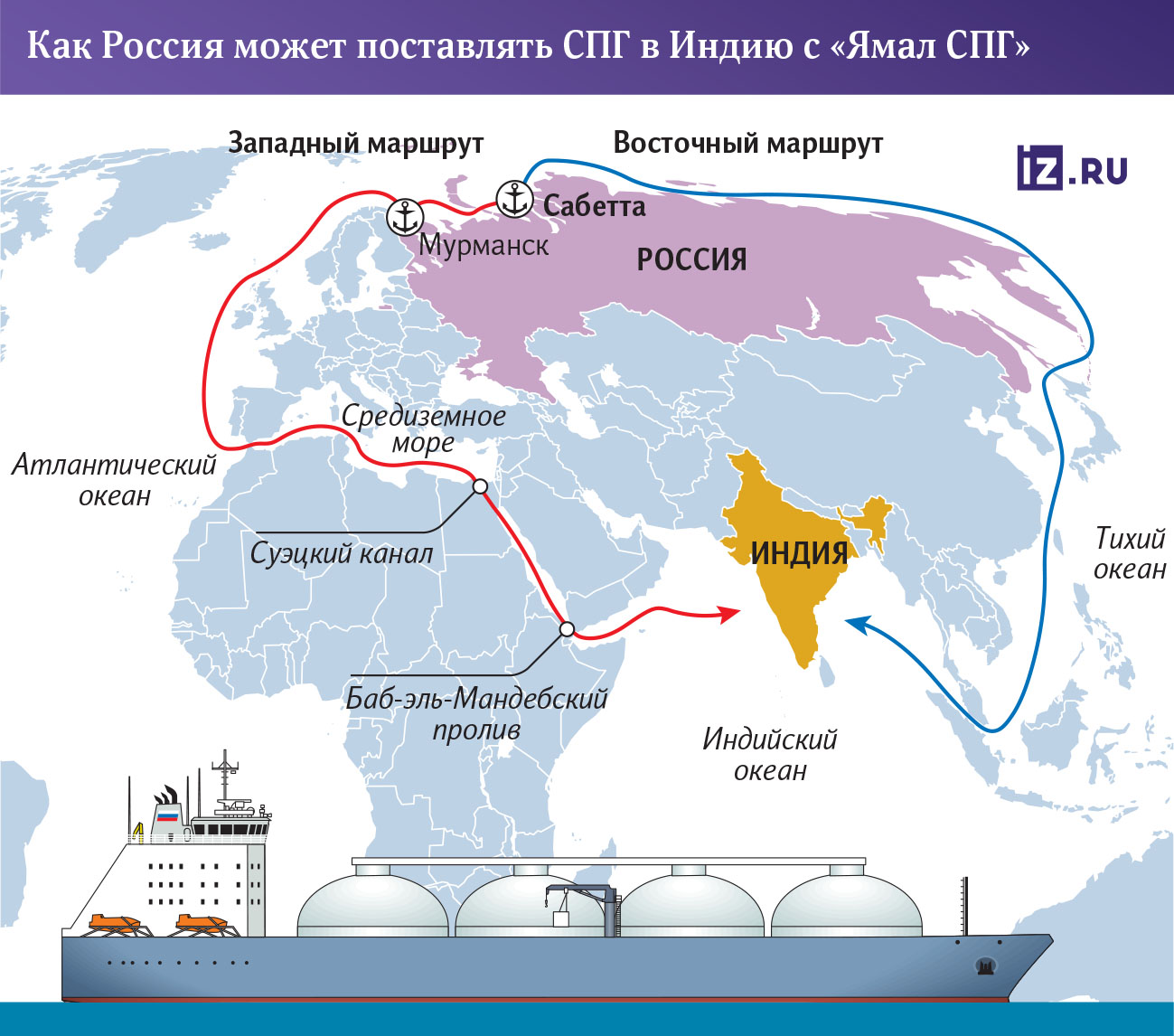
In parallel, Russia could supply India with liquefied natural gas produced at the Yamal LNG plant, which is not under American sanctions. So far, gas is exported from it to the EU countries, however, starting from January 1, 2027, the EU will completely stop importing it from the Russian Federation. In April, a ban on importing Russian liquefied natural gas under short-term contracts came into force. Earlier, Deputy Prime Minister Alexander Novak said that Moscow would redirect part of LNG supplies from Europe to the Asia-Pacific region, and gas would be redirected to the markets of India, Thailand, the Philippines and China.
— In winter, when the eastern part of the Northern Sea Route is closed by ice (we do not yet have year-round navigation along it), if LNG cannot be transported to Europe, gas to Asia will have to be supplied via the western route. From Yamal, the tankers will head west, circumnavigate the whole of Europe, pass through the Mediterranean Sea, then the Suez Canal and the Red Sea. And the gas will go to Asian markets," Igor Yushkov, an analyst at the Financial University and the National Energy Security Fund, told Izvestia.

However, the western route is now under enormous sanctions pressure. It is becoming increasingly difficult for tankers from the Yamal LNG pool to enter European ports, even for technical transit, and geopolitical instability in the Red Sea may create additional risks and make insurance more expensive.
Alexander Frolov, Deputy Director General of the Institute of National Energy, believes that after the Europeans refuse to purchase LNG under short-term contracts, the first deliveries to India from Yamal LNG may begin as early as 2026.
—From May to December, from 5 to 8 billion cubic meters of Russian LNG in terms of regasified volume may leave the European market and reach buyers in the Asia-Pacific region," he told Izvestia. — Theoretically, from 2 to all 8 billion cubic meters (under different scenarios) could be sent to India.

Another major LNG producer is Sakhalin-2, against which Washington has also not imposed any restrictions. However, the capacity of this plant is almost completely contracted and is mainly focused on Japan, South Korea and China.
Переведено сервисом «Яндекс Переводчик»
