
To raise resignations: a quarter of companies intend to cut staff by the end of 2026

The Russian labor market is faced with a paradox: there are still not enough workers - unemployment is updating historical lows, but companies are cutting staff. By the end of the year, a quarter of enterprises plan to cut staff, mostly by 10%, a business survey showed. And it's not just small companies that find it difficult to operate in conditions of declining profits and rising mandatory payments. Major corporations and government agencies, such as Sber, Gazprom, Russian Railways, and VEB, have already announced plans to reduce costs.The Russian Federation, Moscow authorities and a number of regions. Among the reasons are the slowdown in the economy, high unemployment, rising costs and the rapid introduction of AI. How not to lose your job, who will have to look for a new profession, and why trying to replace people with neural networks can cost your superiors dearly — in the Izvestia article.
Why businesses are cutting staff
Despite a slight increase in unemployment to 2.2% in April after 2.1% in February, the rate in Russia remains at a record low, according to Rostrud data.

However, against the background of a high key and growing fiscal burden, part of the business began to look for ways to reduce costs. The Russian-German Chamber of Foreign Trade, one of the largest business associations, which includes not only domestic but also foreign businesses, surveyed 265 organizations. These are mainly small and medium-sized companies, but there are also large structures among the study participants. According to its results (Izvestia has it), 23% of companies plan to reduce staff in the second half of 2026. Most of them intend to reduce their staff by about 10%. At the same time, more than half of the organizations are not going to change the number of employees, and 14% of enterprises are going to expand their teams.
Plans to reduce staff may be related to the revision of operational plans against the background of a slowing economy, declining profits and rising mandatory payments, said Olga Belenkaya, head of the Macroeconomic Analysis Department at Finam. According to her, the situation of small and medium-sized businesses is complicated by changes in the terms of use of the STS, the cancellation of a number of benefits for insurance premiums, expensive loans and an increase in defaults on the part of counterparties. An additional factor is the automation of processes and the introduction of AI.
Paradoxically, the largest cuts are not carried out by companies that are on the verge of losses, but by the country's largest employers, many of whom retain access to government support and continue to earn actively. Experts note that against this background, staff optimization no longer looks like a necessary measure, but as a way to maintain profit growth and increase business efficiency in the face of a slowing economy.

Thus, the head of Sberbank, German Gref, said in February that in 2025 they had reduced about 20% of inefficient staff, or about 14 thousand people. At the same time, the net profit of the credit institution at the end of the year increased by 8.4%, to 1.7 trillion rubles, and in January – May 2026 increased by another 21%, to 827 billion rubles.
The press service of the bank explained to Izvestia that the changes in numbers are related to business transformation, automation of processes using AI, elimination of duplicate functions and redistribution of resources. Sberbank also recalled that it remains one of the largest employers in the country: the company receives more than 5 million job applications annually, and more than 5,000 positions are currently open.

Other large structures have also announced plans to optimize their staff. At the beginning of the year, Gazprom announced its intention to reduce the central office from 4,000 to 2,500 employees in order to reduce bureaucratic costs. At the same time, the company ended 2025 with a net profit of over 11 billion against a loss of 1.2 trillion a year earlier.
In March, Oleg Belozerov, the head of Russian Railways, also spoke about reducing 15% of the central office — about 6 thousand people. The decision was explained by a change in the organizational structure and increased efficiency. At the same time, the company's net profit increased by 1.3% last year, to 14 billion.
At the same time, it became known about the plans of the largest publishing house "Prosveshchenie" to reduce at least 20% of the staff. At the same time, Magnitogorsk Iron and Steel Works announced a 10% reduction in its management staff, explaining the downturn in metallurgy and the need to adapt to lower capacity utilization.

In June, at the SPIEF, the head of VEB.Russian Federation Igor Shuvalov announced the reduction of 15% of employees. According to him, the decision was made against the background of cooling of the credit market. At the same time, the state corporation's net profit increased by 18% to 89 billion by the end of 2025. Izvestia has sent inquiries to all the companies mentioned.
Optimization has also affected the public sector. In March, Moscow Mayor Sergei Sobyanin announced a 15% reduction in the number of civil servants. The reason is a slowdown in the growth of the city's budget revenues.
According to Rostrud, at the beginning of April, the number of employees recommended for dismissal reached 105 thousand people. Over the past ten months, their number has increased almost 1.5 times. Such decisions are mainly expected in the capital, Moscow, Omsk and Irkutsk regions, as well as in the Krasnoyarsk Territory.
The regions are also reducing the bureaucracy. Astrakhan Region Governor Igor Babushkin approved a 10% reduction in the number of civil servants in March. In the Samara region, the authorities also announced plans to reduce staff by 20% by the end of the year. The editors asked the regional administrations for comments.

Who can be cut
The biggest risks of cuts in 2026 remain in the financial sector, where junior staff - assistants, secretaries and back office staff — are primarily at risk, said Natalia Milchakova, a leading analyst at Freedom Global. In her opinion, these functions are the easiest to automate with the help of AI.

Layoffs may also affect retail trade, the state apparatus, part of the public sector and industries experiencing economic difficulties, such as the coal, metallurgical and automotive industries. In these segments, the need for employees performing routine tasks will gradually decrease, the expert believes.
At the same time, staff shortages persist in many areas. According to Natalia Milchakova, the manufacturing industry needs skilled workers, the construction industry lacks staff, and high demand remains in transport and logistics. IT specialists, developers of mobile applications, experts in AI and cybersecurity, remain in demand.
According to the consulting company Technologies of Trust, 47% of large Russian companies allow staff reductions due to the introduction of AI, said Alexander Shkarupa, the founder of the Dynamics agency.

In practice, neural networks are more often replacing individual functions, rather than employees as a whole. Moreover, according to the data cited by Alexander Shkarup, 67% of small and medium-sized companies that have already reduced staff subsequently faced a decrease in revenue. In his opinion, a business that dismisses employees without investing in retraining and modernizing processes risks facing a shortage of competencies in a few years that technology cannot reproduce yet.

Despite some cases of staff optimization, the situation on the labor market as a whole remains stable, the All-Russian Research Institute of Labor told Izvestia. According to the institute, as of April 2026, there were 75 million employed people in Russia, more than 3 million employers and about 5 million sole proprietors.
Individual companies can either reduce staff or expand it, depending on their own tasks and financial situation. At the same time, record low unemployment and an increase in the number of vacancies indicate that the labor market remains favorable for applicants, the All-Russian Research Institute emphasized.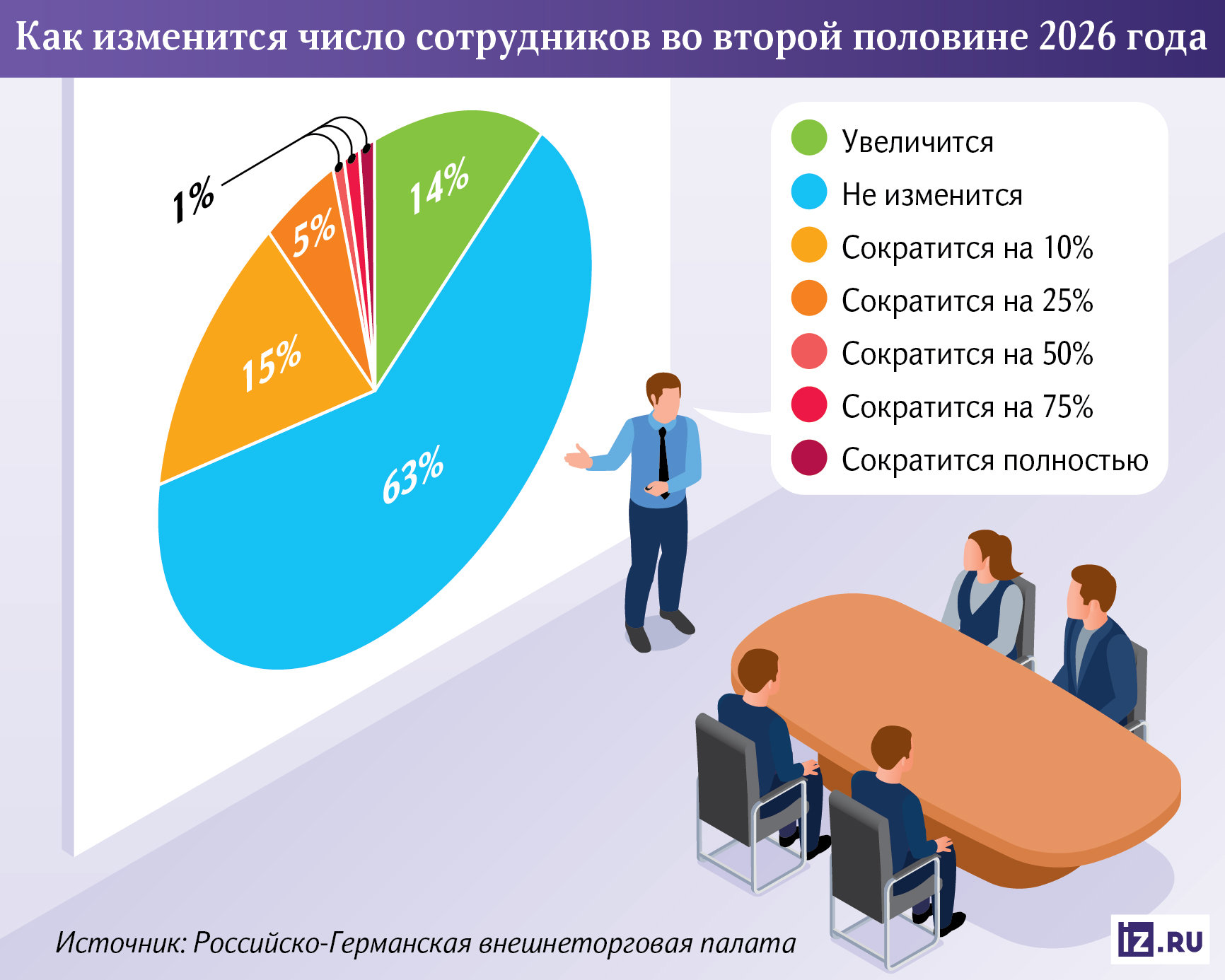
They also noted that after a decrease in the number of vacancies in 2025, the Work of Russia portal is experiencing growth again this year. In May alone, the number of offers increased by 145 thousand.
What will happen to unemployment in 2026
A moderate cooling of the market may be beneficial for the economy. In recent years, wages have grown faster than labor productivity, which has become one of the factors of inflation, noted Alexander Shkarupa from Dynamics. Therefore, a slight slowdown in earnings growth and a decrease in employers' competition for employees correspond to the goals of the Central Bank to curb price increases.
However, such a scenario would require retraining programs for employees, added Olga Belenkaya from Finam. According to the expert, people who have been cut may not have the skills they need in other areas. In addition, rising unemployment can slow down the increase in household incomes and consumer demand, which will become an additional factor slowing down the economy.

There will be no mass unemployment in Russia, Olga Lebedinskaya, Associate Professor of Statistics at the Plekhanov Russian University of Economics, is sure. According to her, even if individual companies cut staff, these processes will be invisible against the background of a general shortage of staff. The labor market remains so scarce that even an increase in unemployment against the background of staff optimization is more likely to help restore the balance between labor supply and demand than lead to serious employment problems.
Thus, the situation in the country is atypical: cuts are taking place today not in a weak, but in an overheated labor market. While some companies are reducing their staff and transferring some tasks to technology, others continue to look for employees. Therefore, the main challenge in the coming years is not the growth of unemployment, but the ability of Russians to quickly adapt to the new demands of the economy, and the task of the authorities is to help them in this.
Переведено сервисом «Яндекс Переводчик»
