Let's talk about it: drugs for deadly fungi have been made tenfold more effective
- Статьи
- Science and technology
- Let's talk about it: drugs for deadly fungi have been made tenfold more effective


The effectiveness of antifungal drugs used to treat candidiasis and aspergillosis can be significantly improved with the help of liposomes, microscopic membrane vesicles that are used to deliver drugs, scientists have found. In this form, the drugs destroy the membranes of fungal cells more effectively and retain their activity in much lower concentrations. Depending on the strain of microorganisms, the researchers were able to increase the antifungal effect of the drugs by 4-64 times. This will allow the development of more effective dosage forms and reduce the risk of developing resistance in pathogens, which often cause death in people with weakened immune systems. However, there is a long way to go through clinical trials before the finished drug appears, experts interviewed by Izvestia noted.
A new way to deliver antifungal drugs
Fungal diseases, including candidiasis and aspergillosis, are quite common, and they pose the greatest threat to patients with weakened immune systems. For example, those who have suffered severe viral or bacterial infections, taking immunosuppressive drugs and other types of chemotherapy. Moreover, like bacteria, pathogenic fungi are increasingly developing resistance to drugs, so scientists are looking for ways to increase the effectiveness of already known drugs, as well as to find new molecules with a fundamentally different mechanism of action.
Researchers from the Institute of Cytology of the Russian Academy of Sciences (St. Petersburg) and the Gause Scientific Research Institute for the Development of New Antibiotics (Moscow) have found a way to enhance echinocandins, a whole group of popular drugs for fighting fungal infections.
For a long time, it was believed that these molecules kill fungal cells only because they block an enzyme needed to build a cell wall. Later, some studies indicated that echinocandins may have a second mechanism of action, namely, to destroy fungal membranes. However, there has been no clear evidence of this effect so far.
To test whether echinocandins actually interact with fungal cell membranes, the authors conducted experiments with artificial analogues that mimic the structure of fungal cell membranes. It turned out that drugs from this group integrate into the membrane, disrupt its structure and make it more liquid. In addition, the tested molecules created pores in the membranes, through which vital substances "leak" in the case of living cells.
— Computer modeling has shown that echinocandin molecules can create waterways through the membrane, and electrophysiological studies have confirmed that in groups of 3-4 molecules they form stable channels that lead to the death of the fungal cell. To enhance this effect, we placed the drugs in microscopic liposome bubbles that fuse with the natural membranes of fungi and release the drug right in the place where it should act," explained Svetlana Efimova, PhD, a leading researcher at the Laboratory of Ion Channels of Cell Membranes at the Institute of Cytology of the Russian Academy of Sciences.
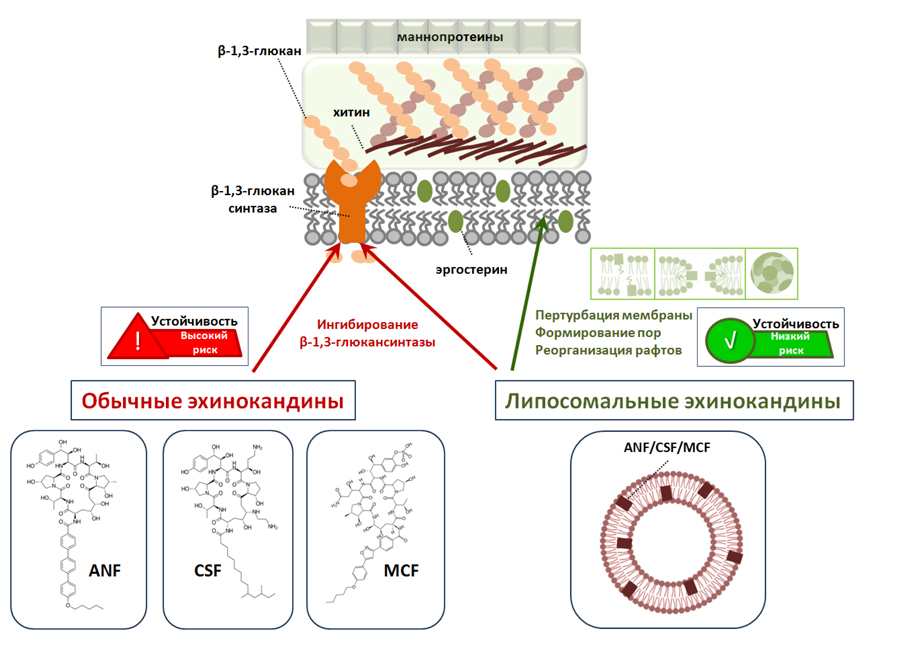
This "packaging" facilitated the penetration of active substances through the cell membrane of the fungus and increased their activity 4-64 times, depending on the strain, against candida, a drug—resistant fungus that affects the skin and mucous membranes. This will allow the use of drugs in lower dosages without loss of effectiveness and reduce the risk of developing resistance in microorganisms.
"In the future, we plan to find ways to increase the pore—forming ability of echinocandins to make them even more effective, and to confirm the results obtained using laboratory animals as models,— Svetlana Efimova said.
The global threat of fungal infections
Echinocandins are considered one of the main drugs for the treatment of severe forms of candidiasis and aspergillosis, especially in patients with weakened immune systems, molecular biologist Arina Kholkina told Izvestia. However, the effectiveness of such therapy is gradually decreasing due to the growth of fungal resistance, while increasing dosages is limited by the risk of toxic side effects. According to her, the researchers have identified an additional mechanism of action of these drugs, which previously remained only the subject of scientific speculation. It turned out that echinocandins not only prevent the formation of the cell wall of the fungus, but also damage its membrane, forming pores in it. As a result, the cell loses important substances and dies.
— Packaging of the drug in liposomes enhanced the "breakdown" effect. They work like a targeted delivery container: they merge with the membrane of the fungus and release the medicine precisely to the target. This makes it possible to reduce the dose without loss of effectiveness, which means that it reduces the burden on the patient's liver and kidneys and makes it more difficult for the fungus to develop resistance," she said.

On the basis of such "packaging", safer forms can be created for patients undergoing chemotherapy, after transplantation, with HIV — anyone for whom a fungal infection is deadly. The drug will become more effective against resistant strains and will allow combining therapy without the risk of overdose, Arina Kholkina believes.
If a substance has already proven its safety and effectiveness, but begins to lose out to resistant strains of fungi, then changing the method of its delivery is one of the most realistic ways to prolong the clinical life of a drug without many years of developing a fundamentally new molecule, said Marina Chumakova, a leading market expert at NTI Helsnet.
— Liposomal forms already exist in medicine, so the technological platform is well-known and well-developed. The question is whether it will be possible to reproduce the laboratory result in a clinical setting. Of course, there is a long way to go through clinical trials before the finished drug is available, but the scientific basis looks convincing," she said.
The results of the study, supported by a grant from the Russian Science Foundation (RSF), are published in the journal Cell Death Discovery.
Переведено сервисом «Яндекс Переводчик»
