- Статьи
- Economy
- It's not enough for business: after freezing the VAT threshold, the authorities will prepare new benefits for SMEs

It's not enough for business: after freezing the VAT threshold, the authorities will prepare new benefits for SMEs

In Russia, the requirements for SMEs will be relaxed. Vladimir Putin has already instructed to postpone the reduction of the revenue limit of 20 million for the transition of entrepreneurs from simplified taxation to VAT. In addition, he asked to develop comfortable working conditions for small and medium-sized enterprises. Experts interviewed by Izvestia believe that small organizations should provide affordable financing, simplify reporting, and lower insurance premium rates. What support mechanisms may appear and whether companies should prepare for increased control by the Federal Tax Service — in the Izvestia article.
Why did Russia decide to freeze the VAT threshold?
Russia is preparing new measures to ease the working conditions of small and medium-sized companies. On June 5, the president took the initiative to postpone further lowering of the revenue target, after exceeding which small businesses under the simplified taxation system (USN) are required to pay VAT. It will be fixed at the level of 20 million.

The income threshold for simplified taxpayers was planned to be gradually lowered starting this year. In 2026, the limit was lowered from 60 million to 20 million rubles, in 2027 it was supposed to be reduced to 15 million, and from 2028 to 10 million. In addition, starting from January 1 of this year, the base VAT rate was increased by 2 percentage points to 22%.
Now it is important to avoid increasing the burden on entrepreneurs, Vladimir Putin stressed. Therefore, further rate changes will be suspended for now.

The Head of State also proposed to work out preferential and more comfortable conditions for small enterprises in the manufacturing sector. We are talking about organizations that create jobs through real production and participate in the development of the industrial base. According to Putin, this will have a positive impact, among other things, on creating a more fair and competitive business environment. Izvestia was clarified by the Ministry of Finance and the Ministry of Energy, which exemptions are being discussed.
At SPIEF 2026, Federation Council Chairman Valentina Matvienko also stated that the state should strengthen support for small and medium-sized businesses — this will ensure a more stable foundation for the entire economy. She explained that it was important to increase the number of SMEs that large corporations could involve in industrial production and science.

After the changes related to lowering the revenue threshold, the tax burden for a number of enterprises at simplified turned out to be too high, said Natalia Milchakova, a leading analyst at Freedom Global.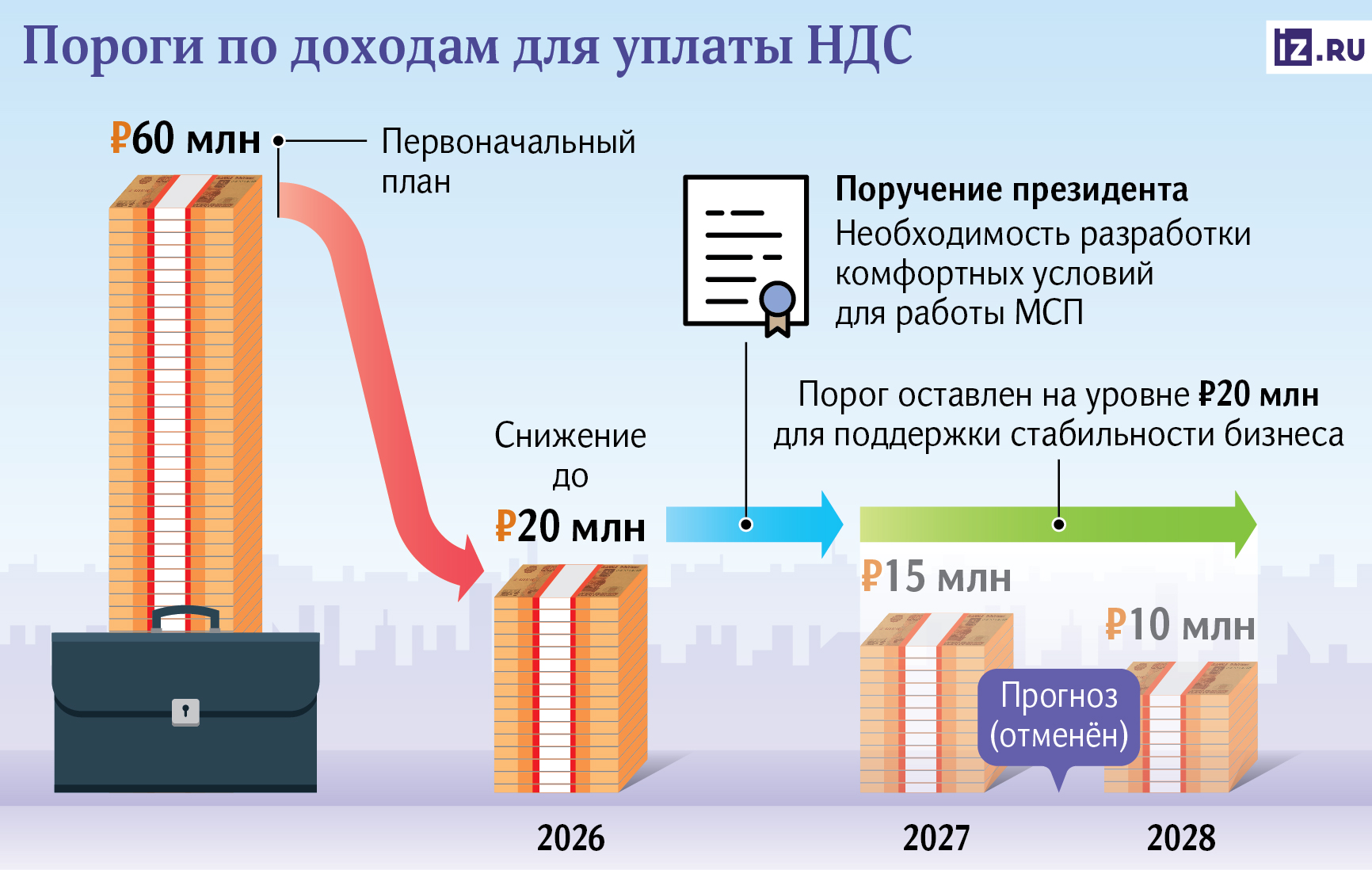
Against the background of high rates, maintaining the limit for VAT payments will make it possible not to increase the financial burden on companies, says Alexander Isaevich, CEO of SME Corporation. This will create conditions for replenishing working capital, increasing business sustainability and implementing investment projects.
How can conditions for SMEs be improved in Russia
The main constraints for business development now are the high cost of borrowed funds, rising costs, staff shortages and increasing complexity of tax administration, explained Sergey Katyrin, head of the Russian Chamber of Commerce and Industry. For small manufacturing companies, such factors are particularly sensitive, so it is important to prevent an increase in workload from squeezing legitimate small businesses.
Now the authorities can support SMEs in several ways. For example, you can set a VAT threshold for a long period of time. According to Finance Minister Anton Siluanov, the limit of 20 million will be frozen for at least three years.

In Russia, it is also important to expand the list of industries with reduced insurance premium rates. Since 2026, the private healthcare sector has been deprived of such benefits - as a result, prices for private healthcare have increased by about 15%, recalled Alexander Kalinin, president of Opora Russia.
In addition, a business that has just passed the revenue threshold of 20 million rubles and has become a VAT payer may need a more lenient transition to the new rules, says Salavat Alparov, CEO of Gamma Group Management Company. We can talk about simplified reporting, deferrals on individual obligations, and other mechanisms that will reduce the administrative burden at this stage.

Today, SMEs in the manufacturing sector need measures that allow them to save working capital and continue the technological cycle, said Sergey Katyrin. Such an enterprise buys raw materials first, pays for labor, logistics, energy, warehouse and equipment, and often receives funds from the customer later. Therefore, among such companies, fast and affordable financing tools are most in demand: loans for specific purposes, equipment leasing, guarantees and guarantees, as well as tools to combat the reluctance of large customers to pay off small businesses on time, the expert added.

According to the head of the Chamber of Commerce and Industry, additional adjustment of the tax regime is really necessary, but it should not be about expanding benefits as such, but about a smoother and more predictable adaptation of business to new requirements. One of such measures could be the payment of VAT using the cash method — after receiving payment from the customer, and not after shipping the goods, he explained. Sergey Katyrin added: this is especially important for small manufacturing companies. If the money has not yet been received from the client, then the transfer of tax actually leads to the withdrawal of funds that could be used for the next production cycle.
Will the control of the Federal Tax Service increase after the limit is frozen
The decision to fix the VAT threshold at 20 million rubles is a direct response to a business request and an important signal: the state is ready to adjust the course when entrepreneurs talk about real problems, explained Ravshan Khadyrov, Director of product development for small and medium—sized businesses at Compare. According to him, the measure affects about 200 thousand SMEs. They would have been subject to a reduction in the threshold in 2027 or 2028.

And this relaxation gives them the main thing — predictability, the ability to plan hiring, investment and pricing without looking at the next rule change, he added.
At the same time, it is expected that the Federal Tax Service will strengthen control over compliance with current regulations so that tax collection does not suffer. The more preferential regimes there are, the more attentive the government is to attempts to artificially adjust business to formal criteria, says Anton Nikitin, founder and CEO of Fingold. Izvestia asked the Federal Tax Service.

The authorities can pay special attention to the fight against artificial fragmentation of business — when one company is actually divided into several legal entities in order not to be subject to taxes, explained Salavat Alparov from the Gamma Group Management Company. However, control should not turn into additional pressure on bona fide companies. It is important to separate attempts to circumvent the requirements of the law from the difficulties that businesses face when switching to new operating rules.
Thus, maintaining the revenue threshold for VAT payments at 20 million may be only the first step in setting up the tax regime for small businesses. Additionally, it would be worthwhile to introduce support for companies that will exceed this limit and expand, according to business associations.
Переведено сервисом «Яндекс Переводчик»
