The city of Norilsk and the brightening sky of the Arctic: how clean air and large-scale construction are changing the reputation of the northern metropolis
- Статьи
- Local news
- The city of Norilsk and the brightening sky of the Arctic: how clean air and large-scale construction are changing the reputation of the northern metropolis


The city of Norilsk is increasingly appearing in the news in an unusual context. The agenda is not cold weather records and environmental anti—ratings, but a tourist boom, new houses and a brightening sky. For many years, the image of this place seemed frozen: the Far North, permafrost, and metallurgical plants. But right now, another story is unfolding here. Over the past three years, the tourist flow has doubled and reached 23 thousand people per year. In the first half of 2025, Norilsk became the leader in the growth of bookings among all northern destinations of the Russian Federation - plus 93%. Since January 2026, a tourist fee has been introduced: a sure sign that tourism here has ceased to be exotic, and the aurora borealis over high-rise buildings and architecture in the spirit of St. Petersburg have not gone away. About how Norilsk becomes the best version of itself — in the material of Izvestia.
Norilsk today: the sky is changing
The conversation about Norilsk should start with the main thing — from the air. Its quality has defined the city's reputation for decades, and it is here that the changes are most noticeable. For many years, Norilsk was one of the most polluted cities on the planet — in 2013, it was among the world's top ten anti-leavers. The changes began in 2016: the Nickel Plant, the oldest enterprise operating since 1942, was closed. Capacities were redistributed between existing enterprises, specialists were transferred to other sites — production was not affected. Following the results of 2023, the Russian Hydrometeorological Service for the first time excluded Norilsk from the list of cities with a "very high" index of atmospheric pollution.
The next step is the "Sulfur Program" of the mining and metallurgical company Norilsk Nickel. The technology captures sulfur dioxide and turns it into gypsum. In April 2026, the third production line at the Nadezhdinsky plant was launched. The goal is to reduce emissions in Norilsk by 10 times by 2028.
Today, Norilsk has a real—time air quality monitoring system, which is one of the first such projects in Russia. The data is updated every 20 minutes and can be viewed on the official website of Norilsk.:
- green color — there is no pollution;
- yellow — moderate;
- red means high.
Nature is already responding to the changes: the forest cover is returning. Clean air and a resurgent nature are not the only things that change the face of the city. In parallel, Norilsk is being rebuilt in the literal sense.
A city that is being built anew
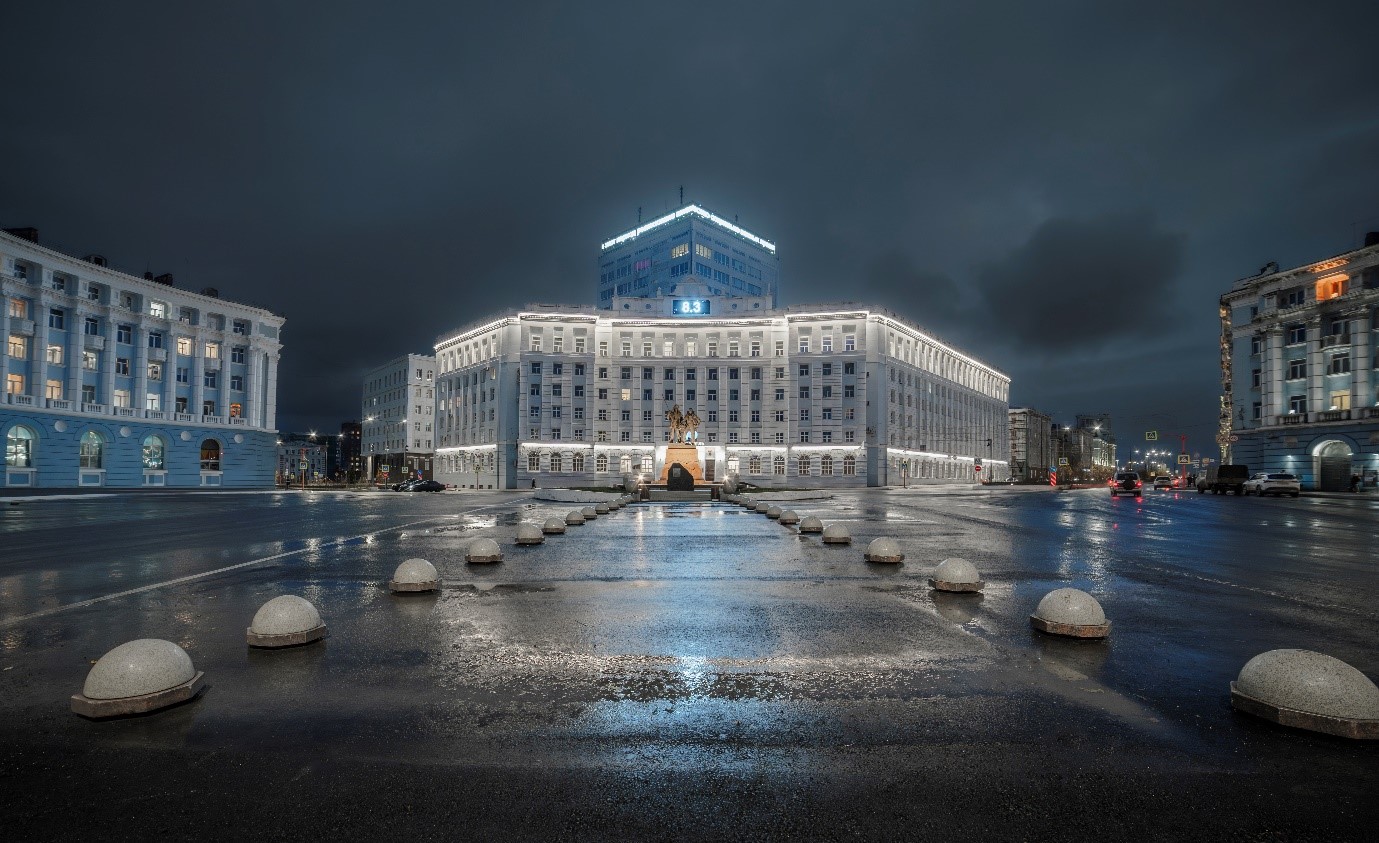
In 2021, the Russian government approved a Comprehensive development Plan for Norilsk until 2035: 120 billion rubles, of which the lion's share is from Norilsk Nickel. This is the first renovation of an entire city in modern Russia beyond the Arctic Circle — there are no analogues in Arctic conditions.
By 2035, it is planned to build about 100 new houses with a total area of 384 thousand square meters and demolish 45 dilapidated and dilapidated buildings. Three residential buildings in the city center, which have historical value, will be reconstructed, while preserving the historical facades.
In 2024, 6.2 thousand square meters were commissioned, in 2025 — 16.2 thousand square meters. Norilsk is actively being improved: courtyards and public spaces are being renovated, warm bus shelters have been installed throughout the city. In the famous high—rise on Lenin Square, a building recognized as a cultural heritage site, known as the "gateway to the city", the "Tower" has opened: a multifunctional space that has become a new point of attraction. The V. I. Dolgikh Lyceum is being built for 1.1 thousand students.
Arctic Laboratory: Norilsk at the forefront of science
There is permafrost under every house, under every road, and under the city itself. Its thickness here reaches 500 m, and the average annual soil temperature varies depending on the depth and area. In the context of global warming, this is not an abstract problem — it is an engineering and scientific challenge that the city of Norilsk works with all year round.
Norilsk Nickel has created the country's largest permafrost background monitoring system, covering an area of about 8,000 square kilometers. For this purpose, 11 sites with different geological conditions have been selected: each has wells with a depth of 10 to 200 m with rock temperature sensors that transmit indicators around the clock.
Scientists have also joined this work: The Polar State University, together with Moscow State University, annually conducts winter field schools right in the courtyards of the city of Norilsk: students and specialists study snow cover and the temperature regime of soils, forming a single data register. Today, Norilsk is one of the main centers of permafrost research in the country, and the knowledge accumulated here works for the entire Russian Arctic.
Further from Moscow than the North Pole
The city of Norilsk is located in such a way that this in itself sounds like a fact from the book of records: from it to the North Pole — 2.4 thousand km, and to Moscow — more than 3 thousand. You can only get here by air all year round, and in summer you can also go along the Yenisei.
Climate is a separate world. Winter here lasts from the beginning of October to the end of May, the snow cover lasts from seven to nine months a year. The average temperature in January is about -26 °C, in extreme frosts the thermometer drops to -55 °C. The city of Norilsk is the northernmost city in the world with a population of more than 150,000 people, and it is this climate that has shaped what the locals call the "northern character."
From the end of November to the middle of January, the sun does not rise above the horizon at all. Instead, the sky glows with northern lights every night — green, pink, purple. For tourists, this is an excuse to fly thousands of kilometers to Norilsk, for locals it is a familiar view from the window. From May 19 to July 25 is a polar day: the sun does not set, and at two o'clock in the morning it is light outside, as if at noon.
The city of Norilsk. At the edge of the earth — literally
In 1921, geologist Nikolai Urvantsev spent his first winter in Taimyr and confirmed that it had the world's largest deposits of nickel, copper, and platinum group metals. His small wooden house still stands in the center — now it is a museum. Mining in these parts began long before the geologists of the 20th century: traces of copper smelting from the Bronze Age were found on the shores of Lake Pyasino.
Today, Norilsk Nickel, one of the world's metallurgical giants, is engaged in the development of deposits in Norilsk. By 2025, it had the following performance indicators: 41% of the world's palladium; 11% of platinum; 10% of high-grade nickel; 9% of rhodium.
Norilsk was founded in 1935. It received the status of a city in 1953. Until the early 1990s, the city of Norilsk was closed: entry was prohibited without a special permit. Now everyone comes here: some to work, others to observe the northern Lights, others to see the Putorana Plateau, a unique mountain range the size of Great Britain, a UNESCO World Heritage Site.
Architecture that surprises
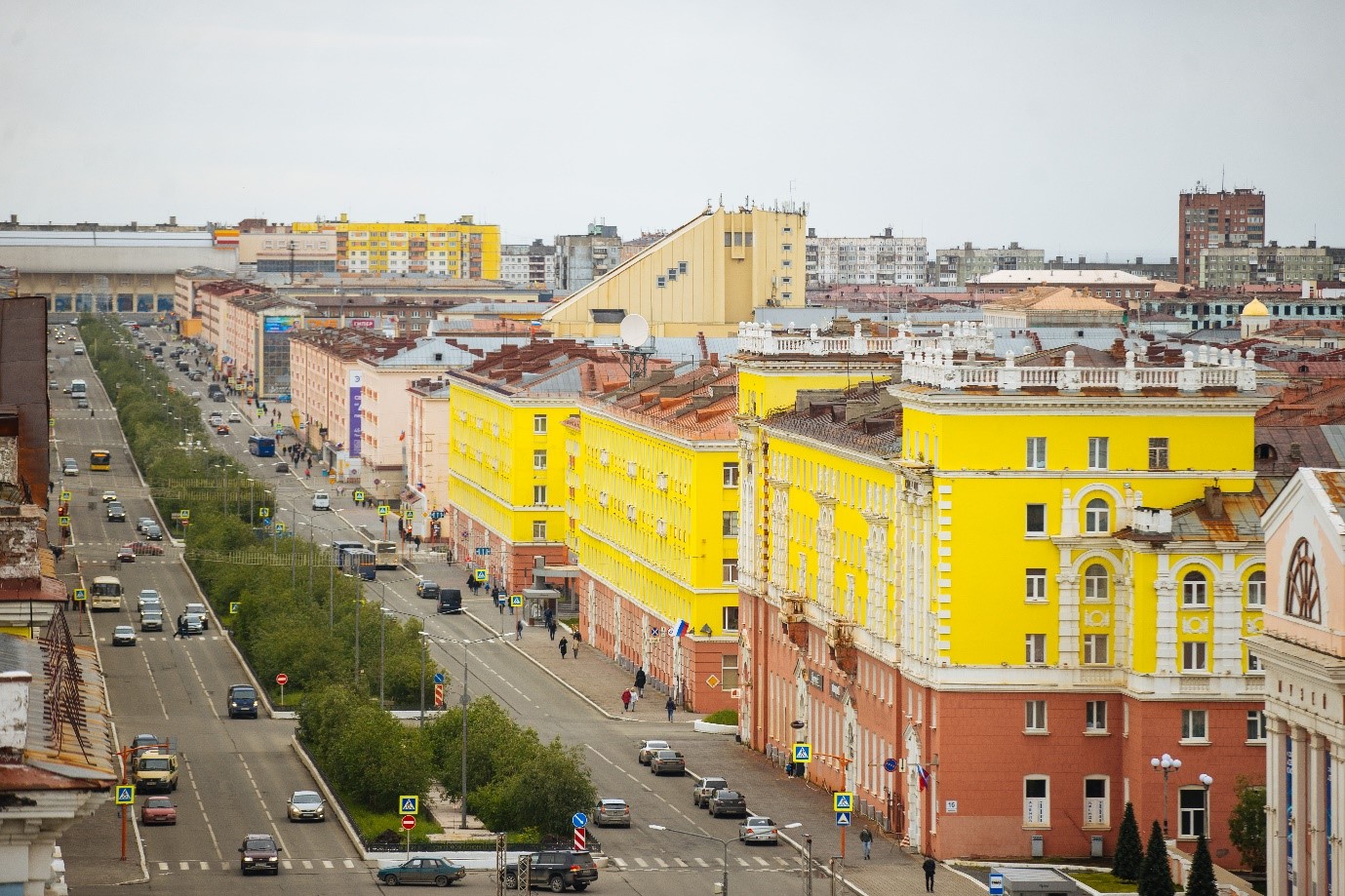
The first thing that strikes the guests of Norilsk is not the snow or the industrial landscape. This is Leninsky Prospekt. More than two kilometers of Stalinist neoclassicism: arches, columns, and the symmetry of the streets. The central quarters were designed by graduates of the Leningrad School of Architecture.
The courtyards here are wells, like in St. Petersburg: the houses stand close together, protecting the space from the wind. Some buildings are connected by internal galleries. Houses in the city of Norilsk stand on stilts: permafrost does not allow a conventional foundation. The facades are painted with murals, painted in acid colors, so that the polar night presses a little less.
Переведено сервисом «Яндекс Переводчик»
