Sour the bitter: the Russian Federation has proposed a technology for the industrial production of dairy alcohol
- Статьи
- Science and technology
- Sour the bitter: the Russian Federation has proposed a technology for the industrial production of dairy alcohol

Russian scientists have conducted a comprehensive study of the traditional Buryat low-alcohol drink darasuna, which can become the basis for Russia's first technology for the industrial production of dairy vodka. The raw material for it will be whey, which is formed as waste during cheese production. By distillation, its strength can be increased to 11 degrees, like wine, or 40 degrees, and the microorganisms contained in the starter culture are promising as useful probiotics.
Wine and vodka made from milk
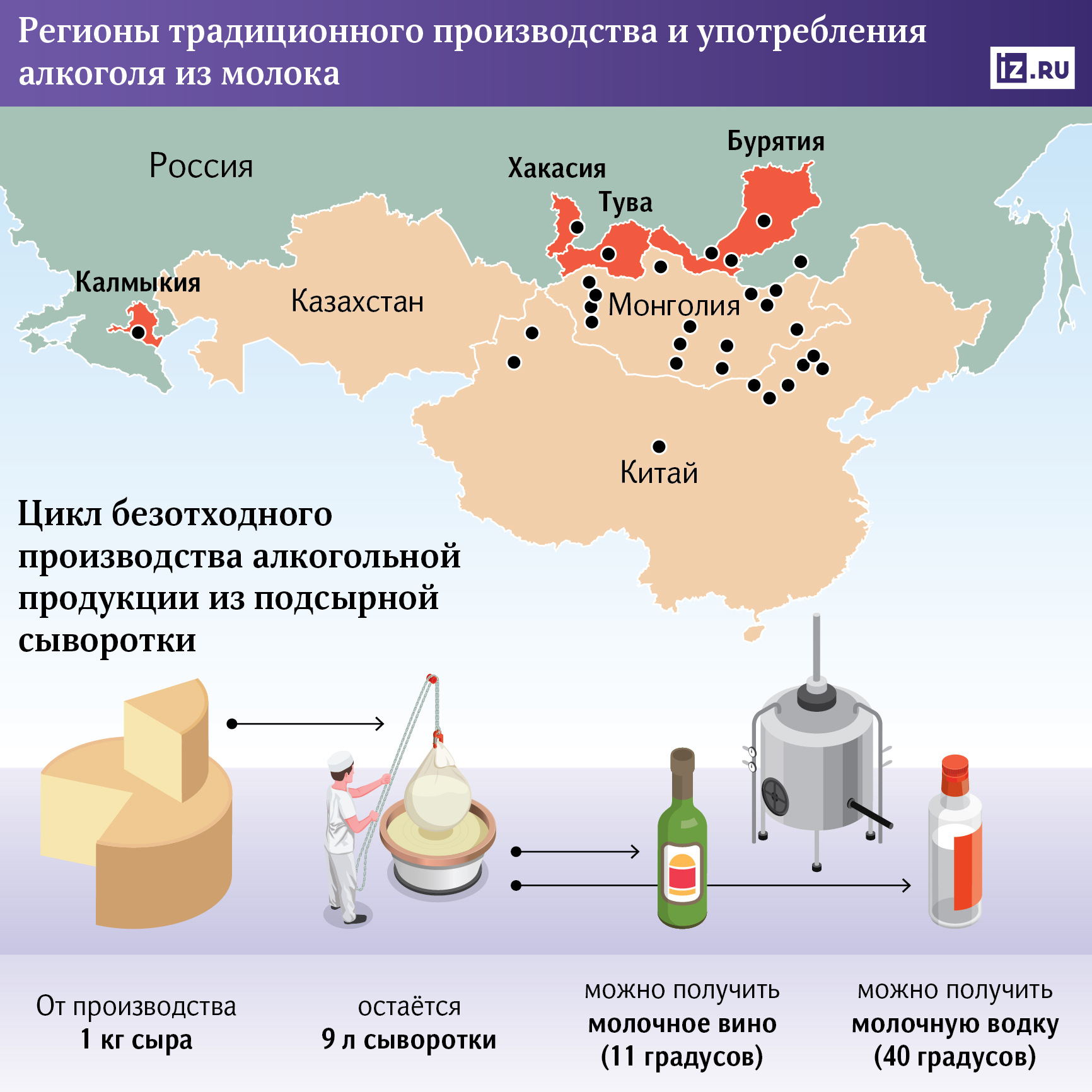
Specialists from the Kurchatov Institute, together with colleagues from Sirius University of Science and Technology and other scientific organizations, have obtained data that can form the basis for the technology of industrial production of alcohol from dairy products. Whey, a waste product of cheese production, is suitable as a raw material for a new type of alcohol. Scientists have analyzed the milk fermentation technique for the traditional Buryat drink darasun (tarasun), known since at least the 13th century. Its strength is about 11%. However, with the help of distillation, it can be increased to 40% or even 75%.
"This study demonstrates that the Buryat method of milk fermentation and distillation is a unique biotechnological system that illustrates the principles of a low—cost and closed bioeconomy," the experts noted in their article in the scientific journal Scientific Reports.
During the production of 1 kg of cheese, 9 liters of whey are formed, so the task of its utilization and useful use is extremely relevant for Russian companies, said Zorigto Namsaraev, one of the authors of the study, head of the Laboratory of Synthetic Biology at the Kurchatov Genomic Research Center, NBICS-pt Research Center, Kurchatov Institute. After cheese is obtained, fat and protein leave the milk, but lactose remains — milk sugar. Compared with classical vegetable sources, the sugar content in the liquid is low, about 2%, therefore, during primary fermentation, the strength of the drink is small and further distillation is required.
— The first stage of distillation allows you to achieve an ethanol concentration of about 11%. Let's say it's like dry white wine. The second stage is about 40%. In principle, this is enough, but for the sake of experiment, we conducted the third stage and received a fortress of about 75%," he said.
Currently, weak drinks are in demand in the market among a younger audience. An 11-degree option is suitable for such people.
It takes a year to launch the first commercial production of dairy alcohol, the researchers noted.
Using genetic methods, experts have also studied which microorganisms are involved in the fermentation of milk using traditional sourdough. These include bacteria and yeast, which can become a source of new effective probiotics. Depending on the origin of the drink and the specifics of its preparation, the ratio of groups of microorganisms may vary, and this changes the strength of the drink. The scientists described in detail all the stages of the traditional darasun production method, its chemical composition and the differences that exist in the drink depending on the place where the sample was taken.
A significant part of the research was devoted to the history of darasun and the term itself. In modern Mongolian languages, this word has acquired different semantic shades. In today's Buryat language, "tarasun" means "milk vodka", in Mongolian the word "dars" means "fruit wine", in Kalmyk it is "bread vodka". The term is mentioned in several ancient sources: for example, it is listed on a vessel from the time of the Mongol Empire, which is now kept in the British Museum.
A similar terracinam meaning "rice wine" is mentioned in his text by the Franciscan monk Guillaume de Rubruck, who in 1254 visited the Mongol Khan Mongke in his capital Karakorum and left a description of the palace. There he saw a fountain in the shape of a tree, from which four types of drinks flowed.
"And from one such tube flows wine, from another — karakosmos, or clarified mare's milk, from the third — bal, a drink made with honey, and from the fourth — rice honey, which is called terracina; and for each drink at the foot of the tree there is a special silver bowl to accommodate it," he wrote. He was one of the first Europeans to visit the khan's court on behalf of the Pope.
Technology application
Currently, in many countries with a developed dairy industry, significant efforts are being made to create closed cycles in which waste or by-products from some industries are used as raw materials for others. And the proposed technology can be used not only to produce strong drinks, but also biofuels, said Alexey Sazonov, Executive Director of the Scientific Center for Genetics and Life Sciences at NTU Sirius.
— We can consider seemingly unrelated industries — cheese making and ethanol production. By using whey, a byproduct of cheese production, and by fermentation and distillation, converting it into high-quality bioethanol, we not only get the basis for biofuels and other products, but also build a zero-waste system. This synthesis of ecology and the interlocking of different industries is the essence of sustainable bioeconomics," he said.
According to Elena Kolistratova, a technologist at MordovAlkoProm, the most important thing in the work of specialists at the Kurchatov Institute from a practical point of view is the selection of yeast that will best cope with the processing of whey for alcohol production.
— Milk alcohol is interesting and unusual. Creating a production will be quite difficult, because the product must be such that you want to try it. It is also necessary to conduct chemical safety studies. Think over every detail, choose the temperature regime for fermentation and yeast injection, and other parameters," the specialist said.
According to Igor Shein, the chief distiller of the Keml distillery, alcohol from milk as a natural distillate will be less harmful to the body than rectified vodka, and much tastier than it.
Переведено сервисом «Яндекс Переводчик»
