- Статьи
- Economy
- Don't cut down on LPG: the cost of liquefied natural gas in Russia has increased by almost a quarter in a month

Don't cut down on LPG: the cost of liquefied natural gas in Russia has increased by almost a quarter in a month

The cost of liquefied petroleum gas (LPG), which is used as motor fuel and raw materials for the petrochemical industry, increased by 23.6% on the stock exchange over the month. This trend is observed against the background of an increase in exports: in January–April, its volumes increased by almost 30% compared to the same period in 2025. According to industry representatives, the domestic market remains in surplus, and the growth of stock quotes is associated with the desire of some players to form additional reserves in advance for the summer period. What other factors influence the cost of LPG and how fuel competition with gasoline supports demand — in the Izvestia article.
What impact has the Middle East conflict had on prices?
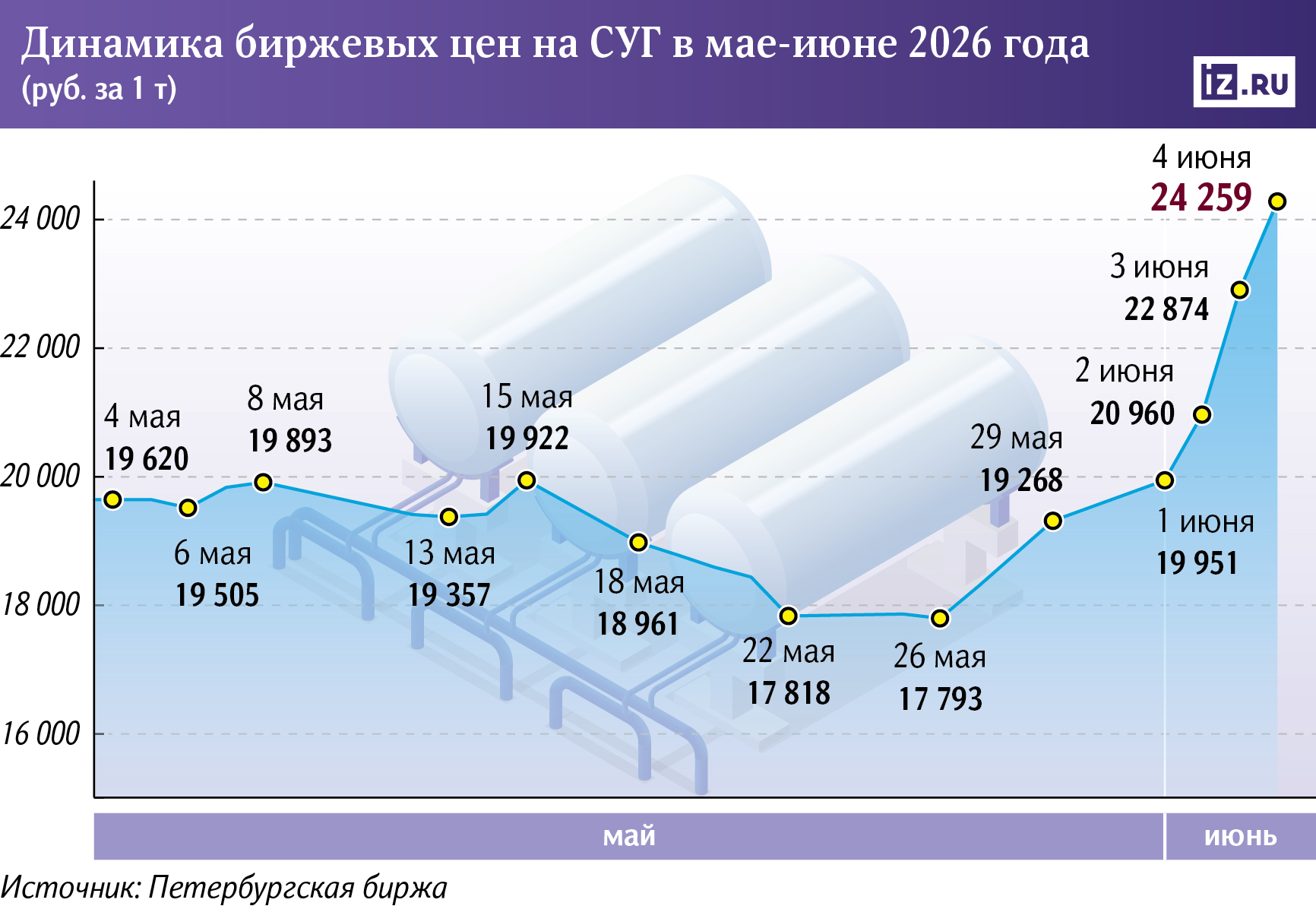
The cost of liquefied petroleum gas (LPG) on the stock exchange for the month (from May 4) increased by 23.6%, rising from 19.6 thousand to 24.3 thousand rubles per ton, according to data from the St. Petersburg Stock Exchange. During the auction on June 4 alone, prices immediately rose by 7.9%.
LPG is used not only as fuel for vehicles, but also as a raw material for the petrochemical industry and utilities, said Tamara Safonova, General Director of the Independent Analytical Agency for the Oil and Gas Sector.

According to Ivan Timonin, senior manager of the Implementation company, the increase in exchange prices for LPG in early June was primarily due to an improvement in the export economy against the background of high world prices, as well as a seasonal increase in demand in the domestic market.
The situation around the Strait of Hormuz, through which a significant part of the world's LPG supplies traditionally pass, had an additional impact on the market. Against this background, in early April, Saudi Aramco raised the official selling prices of propane and butane, the main components of LPG, by 35-50% per month, to about $750 and $800 per ton, respectively.
As Ivan Timonin noted, since the end of February, the cost of propane on FOB Middle East (Middle East) terms, a key export region for LPG, has increased from $544 to more than $700 per ton by the end of March, and on some days exceeded $800. Currently, the quotes are at around $685. Bhutan has demonstrated a similar dynamic.

According to the data of "Implementy", in January–April 2026, the export of Russian LPG increased by 27%, exceeding 1.4 million tons. Shipments to China increased by 148%, to almost 500,000 tons, and to Central Asian countries and Afghanistan — by 71%, to about 550,000 tons.
— The main external driver is the "Hormuz" premium in Asian LPG quotations: the tension around supplies from the Middle East supports high prices for propane and butane in Asia and makes the eastern direction more attractive to Russian producers. At the same time, further export growth is primarily based on logistics: the availability of tanks, the capacity of border crossings and export infrastructure," said Ivan Timonin.

At the same time, according to him, the Russian market "entered" June after the May drawdown: by May 26, quotations for the Urals and Siberia index dropped to 17.79 thousand rubles per ton. Part of the current growth is recovery from a period of weak prices, and not just a reaction to a physical shortage of the product, he noted.
— Against the background of high demand for hydrocarbons on the foreign market and attractive cost conditions, there was a special interest of domestic companies in selling fuel for export. High demand factors are pushing down domestic prices for liquefied petroleum gases," Tamara Safonova told Izvestia.

According to Infotech, the production of liquefied petroleum gases in Russia is about 16-17 million tons per year. Of this volume, about 14 million tons (80%) remains on the domestic market, the rest is exported. Moreover, this situation has been maintained since 2022, despite the sanctions and logistical restrictions. More than 42% of LPG produced in Russia is directed to the needs of petrochemical plants, the rest is used for motor transport, the utility sector and other industries. Sales of liquefied petroleum gases for vehicles and food products are carried out through the St. Petersburg Stock Exchange. In 2025, this figure was more than 2 million tons.
Russia, according to InfoTEK, is one of the three largest autogas markets in the world. The absolute leader in production is Sibur's ZapSibNeftekhim, which accounts for about 20% of output, followed by Surgut ZSK (12%) and Lukoil-Permnefteorgsintez (6%). Ust-Kutsky GPP, Rospan, and Orenburg GPP are also considered major producers.
What internal factors influence the cost of LPG
— The increase in exchange prices for liquefied petroleum gases is due to a combination of factors operating mainly in the domestic market. First of all, we are talking about a seasonal increase in demand for autogas and municipal consumption," the press service of the Titan Group told Izvestia.
The company stressed that additional cost support is provided by a decrease in LPG reserves in certain regions, "due to logistical constraints and delays in rail shipments." Against this background, the demand for exchange trading remains high and in some cases exceeds supply, they added.

Valery Andrianov, an associate professor at the Financial University under the Government of the Russian Federation, stressed that on a number of railway sections "LPG tanks can be idle for weeks, which also creates a stir and affects price increases."
— The approach of the scheduled maintenance season at oil and gas processing plants also has a significant impact. Market participants are already pricing in the risks of a temporary reduction in output and are trying to build up reserves in advance for the summer period," added GC Titan.

Sibur told Izvestia that "the market for liquefied petroleum gases in Russia is generally in surplus and there is no physical shortage of the product."
— The increase in stock prices is largely due to increased price sensitivity and the desire of some market participants to form additional reserves ahead of schedule in case of force majeure. As these volumes reach consumers and fall into excess supply, the pressure on the price should decrease," the press service commented on the price dynamics.

According to the company's representatives, there is no significant increase in exports, which could lead to a shortage of LPG in the country.
"For the segments of autogas and utility consumption, it is important that Sibur practically does not export the mixed fractions used in these types of consumption — export shipments are of a one-time nature, the corresponding volumes are supplied mainly to the domestic market," the company noted.
Fuel competition with gasoline supports domestic demand, but does not directly explain the sharp stock market surge, Ivan Timonin believes.
— With a gas price of 28.64 rubles per liter versus 67.53 rubles per liter of gasoline, autogas costs about 42% of the price of gasoline, so it remains economically attractive for an existing fleet of gas-powered equipment. But this is more a factor of steady demand in retail, rather than the reason for a one—time increase in wholesale quotations," said Ivan Timonin.

Izvestia sent inquiries to the largest producers of LPG and to the Ministry of Energy.
What to expect next for the LPG market
In the short term, price volatility may increase costs for certain related industries, but in the medium term, the situation is expected to stabilize due to the surplus balance of the market, Sibur representatives believe.
— In June and July, the market is likely to remain highly volatile. High seasonal demand and repairs at factories can keep LPG prices at an elevated level, — noted in GC "Titan".
According to Ivan Timonin, further dynamics will depend primarily on how long the Hormuz premium will remain in foreign prices.
— If the risks for LPG supplies from the Middle East persist, Asian prices will remain high, and the Russian resource will continue to be directed to China and Central Asia. In this case, domestic prices may consolidate above the levels of the end of May," he believes.
At the same time, even if the situation around Middle Eastern supplies begins to normalize, there may not be a quick return to the May lows: the summer season is ahead, when demand for natural gas fuel is traditionally higher, and manufacturers still have the opportunity to direct part of the resource to more profitable foreign markets, the expert noted.
— For gas station chains, an increase in the exchange price increases the purchase price of the resource and may temporarily squeeze margins if retail prices do not have time to adapt. For taxis, small commercial vehicles and regional logistics, this means an increase in fuel costs, but it does not negate the economic advantage of autogas over gasoline," added Ivan Timonin.
According to Valery Andrianov, AGZS already has a significant margin margin for LPG, which allows them to partially compensate for the rise in wholesale prices due to their profits. By the end of summer, global markets are expected to cool down and the situation in domestic processing will stabilize, which will bring down the price wave.
Переведено сервисом «Яндекс Переводчик»
